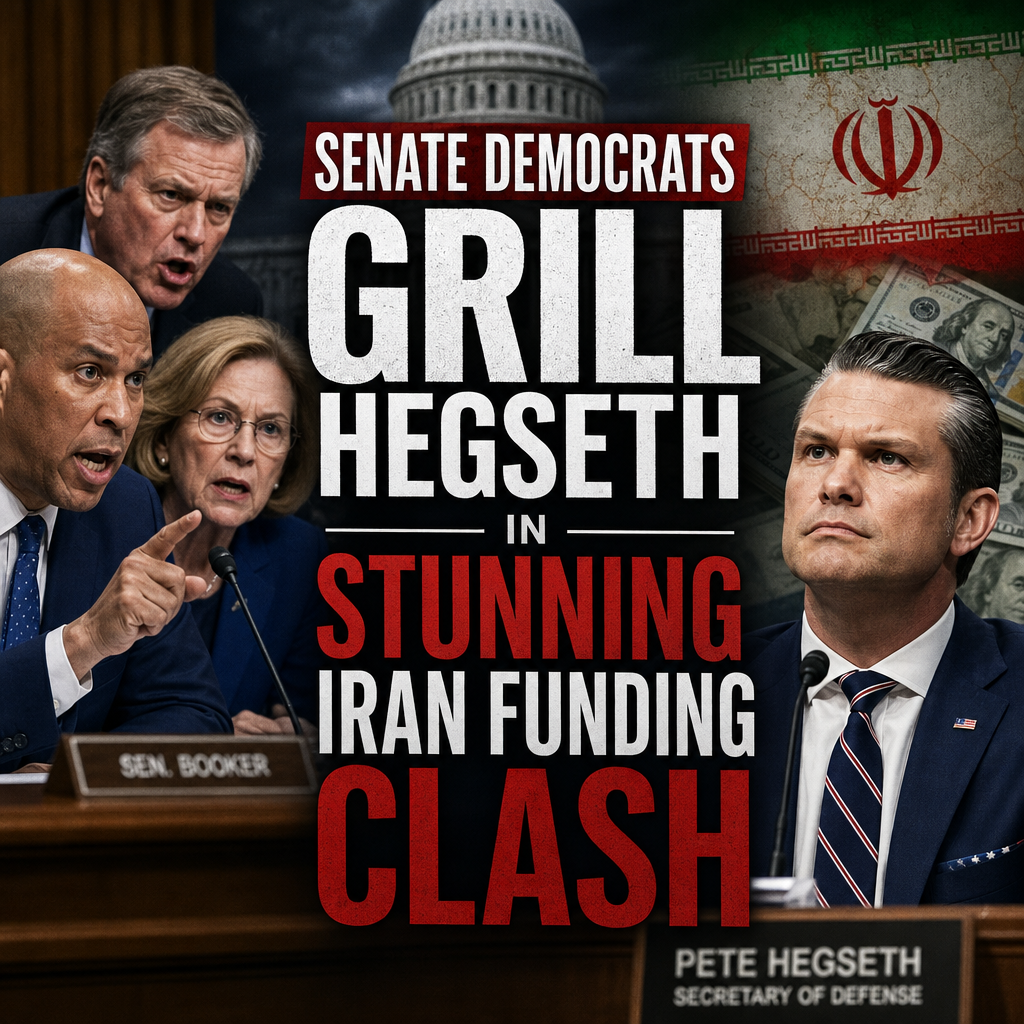
Senate Democrats Grill Hegseth in Stunning Iran Funding Clash


Senate Democrats grilling Hegseth over Iran funding has quickly become more than a partisan hearing moment; it is a test of how far Congress is willing to push back on the administration’s Iran strategy, the Pentagon’s budget priorities, and the use of military force in a region where every decision can escalate fast.
The confrontation matters because it sits at the intersection of three pressures: rising concern in Washington about Iran’s regional behavior, deep skepticism among Democrats about giving the Pentagon a freer hand, and broader international anxiety about whether the U.S. is drifting toward another costly Middle East crisis. Reporting across different outlets suggests there is no simple political line here. Some coverage frames the clash as Democrats demanding accountability and transparency. Other reporting emphasizes the security argument that Washington must keep pressure on Tehran. And outside the U.S., the discussion is often tied to the risk of escalation, civilian harm, and the possibility that funding decisions can shape events far beyond Capitol Hill.



Why the Hegseth clash is about more than money
At first glance, the dispute looks like a budget fight. In practice, it is about authority. Senate Democrats appear to be questioning whether Hegseth and the defense establishment are asking for funding tied to Iran in a way that is sufficiently explained, legally grounded, and strategically justified. That is where the tension sharpens: if lawmakers believe the executive branch is preparing for action without enough oversight, then even a routine funding request becomes politically explosive.
The Democratic critique seems to rest on a few familiar concerns:




– Is the funding aimed at deterrence, preparation for strikes, or broader regional operations?
– Does Congress have enough detail to judge the risks?
– Could any new spending widen U.S. involvement rather than reduce it?
– Are civilian and diplomatic consequences being taken seriously?
That line of questioning is consistent with the more cautious tone often found in international reporting, especially from outlets that foreground the humanitarian and diplomatic costs of confrontation. From that perspective, the issue is not whether Iran is a challenge. It clearly is. The real question is whether Washington’s response is calibrated or simply reactive.
Senate Democrats grill Hegseth in a wider debate over Iran
The phrase “Senate Democrats grill Hegseth” captures the political theater, but the substance runs deeper. Democrats are likely trying to prove that they are not rubber-stamping a blank check for military spending tied to Iran. Republicans, or at least Iran hawks more broadly, may argue the opposite: that public criticism signals weakness and invites further provocation from Tehran.
This divide is not new, but it has become sharper in the current climate. In the U.S., the debate often turns on deterrence versus restraint. In some coverage, Hegseth is cast as representing a harder-edged approach that treats Iran as a direct threat to U.S. interests and allies. In others, the hearing itself is viewed as evidence that Congress still wants to reclaim some say over a policy area increasingly dominated by the White House and the Pentagon.
What stands out is that the disagreement is not simply about whether Iran is dangerous. There is broad agreement across very different media lenses that tensions with Tehran remain serious. The real fault line is over method:
– Hawks want clarity, speed, and credible military pressure.
– Doves and skeptics want legal guardrails, public accounting, and diplomacy first.
– International observers often warn that even “limited” U.S. actions can spiral.
That makes the hearing a proxy battle over what kind of superpower the U.S. wants to be.
What the coverage suggests about the balance of opinion
A useful way to read the reporting is by contrast. RT coverage tends to highlight conflict inside Washington and frame the exchange as evidence of political dysfunction or establishment overreach. Al Jazeera’s style of reporting on Iran and U.S. policy typically gives more weight to escalation risks, regional instability, and the potential for civilian fallout. Sky News, meanwhile, often leans toward explaining the strategic stakes in a more mainstream security context, including how tensions affect allies, shipping lanes, and broader Middle East stability.
Taken together, those perspectives do not produce a single verdict, but they do point to a shared reality: the U.S. is operating in a narrow policy corridor. Pressure on Iran can deter aggression, but it can also fuel retaliation. Oversight can slow reckless action, but too much procedural friction can be portrayed as weakness. The politics are messy because the strategic picture is messy.
The real test: transparency, restraint, and credibility
The strongest argument for Democrats pressing Hegseth is not that Iran is harmless. It is that decisions with military implications should be transparent, especially when taxpayers are being asked to fund them. If the administration believes a tougher posture is necessary, it should be able to explain what success looks like, what the risks are, and where the red lines sit.
At the same time, critics of the Democrats have a point when they warn that public confrontation can create its own hazards. If every funding request becomes a partisan weapon, the result may be more political noise and less strategic clarity. That can weaken deterrence just as much as underfunding can.
The most responsible reading of this clash is that both sides have legitimate concerns, but neither has a complete answer on its own. The U.S. cannot ignore Iran, and it cannot afford to stumble into a wider conflict under the banner of caution or resolve. What Senate Democrats are demanding, at least on paper, is a fuller explanation of how the administration intends to balance those dangers. Whether Hegseth and his allies can provide one may determine whether this becomes a temporary political flare-up or a sign of a much deeper divide over America’s Iran policy.