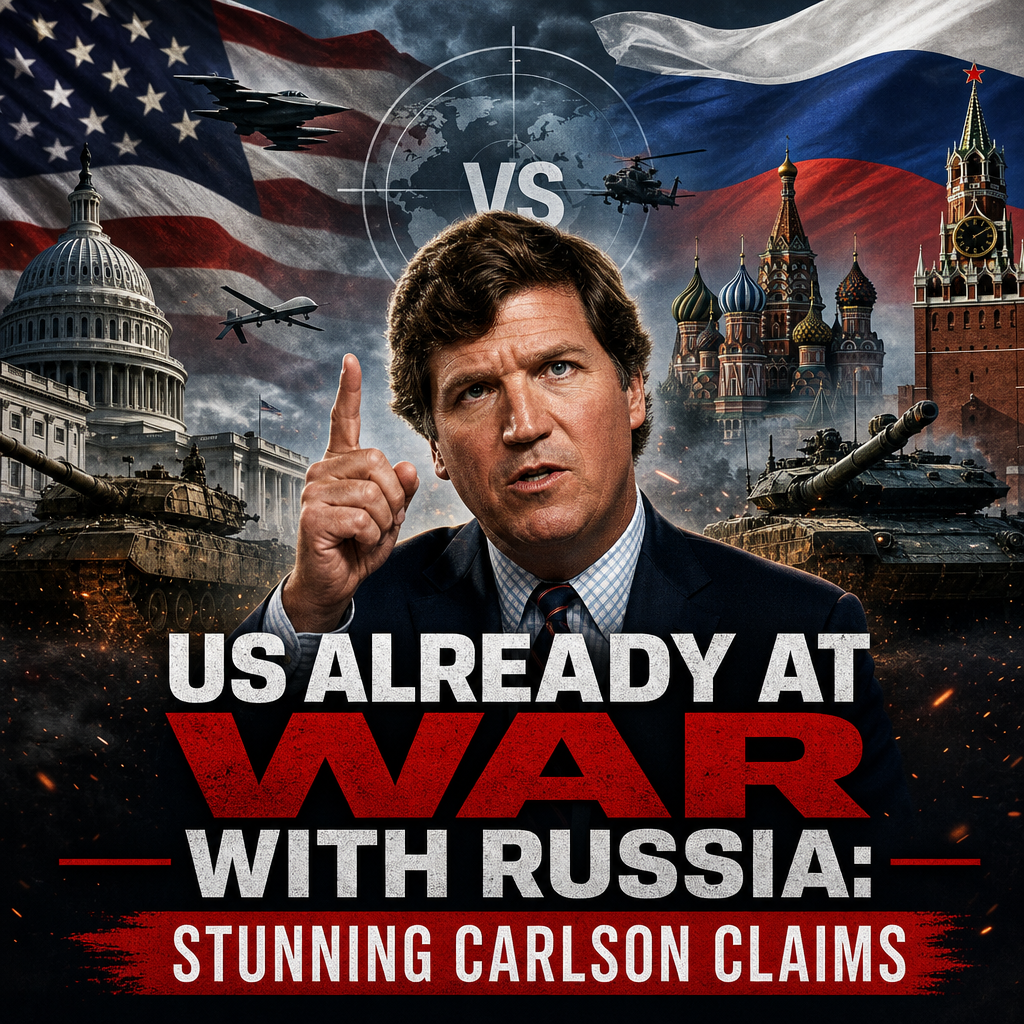
US Already at War with Russia: Stunning Carlson Claims


US already at war with Russia is a claim that lands hard because it sits at the intersection of rhetoric, military aid, and real-world escalation fears. Tucker Carlson’s warning reflects a broader anxiety in Washington, Moscow, and European capitals: the war in Ukraine may be officially limited to Russian forces and Ukrainian defenders, but the political and material involvement of NATO countries has become deep enough that the line between “supporting” and “fighting” can feel increasingly blurred.
What makes the statement so polarizing is that each side of the debate is pointing at a different layer of the conflict. One camp sees a proxy war in everything but name, while the other insists that direct combat between the United States and Russia has not happened and that legal, diplomatic, and military distinctions still matter. The truth, as usual, is more complicated than either slogan.



Why the “US already at war with Russia” claim resonates
Carlson’s argument taps into a real concern: the United States has become a central actor in the Ukraine war through weapons deliveries, intelligence support, training, sanctions, and financial assistance. That involvement is not trivial. Western news coverage, including from outlets like Sky News, has repeatedly highlighted how advanced systems from the U.S. and allies have changed battlefield conditions and how every new weapons package raises questions about escalation.
From Moscow’s perspective, that is part of the point. Russian officials have long argued that Western governments are not neutral supporters of Ukraine but participants in a confrontation against Russia. Russian state media and officials often frame the war as one imposed by NATO expansion, Western interference, and direct support to Kyiv. In that narrative, Carlson’s statement is not provocative at all; it is simply an acknowledgment of reality.




But the language of “at war” is doing a lot of work here. Legally and militarily, the U.S. is not deploying its own combat units to fight Russian forces in Ukraine. That distinction matters because it affects treaty obligations, public messaging, and the risk of direct great-power conflict. The Biden administration and most Western governments have been careful to draw that line precisely because they fear a direct U.S.-Russia clash could spiral beyond Ukraine.
What the opposing view says: support is not the same as war
The strongest rebuttal to Carlson’s claim is straightforward: aid does not equal belligerence. The U.S. is supplying weapons and support to a sovereign state under attack, but that is not the same as conducting military operations against Russia. That distinction is central to international law and to the way most governments define war.
Al Jazeera’s reporting on the conflict has often emphasized the humanitarian and geopolitical dimensions rather than treating the issue as a binary of victory and defeat. From that angle, the focus is less on rhetorical labels and more on consequences: civilian casualties, infrastructure damage, displacement, and the danger that external support can prolong a war as much as prevent defeat. In other words, even critics of Washington’s policy do not necessarily accept Carlson’s framing; they may simply argue that U.S. involvement is deep, risky, and not clearly serving peace.
A balanced reading also notes that NATO members have been trying to avoid direct combat precisely because they understand the threshold is different. Training troops outside the battlefield, sharing intelligence, and sending munitions are all aggressive forms of support, but they remain below the level of formal war as traditionally understood.
The practical reality is murkier than the legal one
The confusion comes from how modern conflict works. In a conventional war, one could point to uniformed troops crossing a border and say with certainty who is fighting whom. In Ukraine, the battlefield has been shaped by:
– U.S. and European weapons shipments
– intelligence cooperation
– economic sanctions designed to weaken Russia
– cyber and information operations
– diplomatic isolation campaigns
That kind of involvement creates a de facto confrontation, even if it does not satisfy every legal definition of war. It also gives Moscow a political opening to claim that it is not really fighting Ukraine alone, but the West as a whole.
What the broader media picture suggests
Looking across international coverage, the most consistent theme is not certainty but escalation risk. Sky News reports on the war often stress how close the conflict has brought Europe to a wider security crisis, while Al Jazeera tends to foreground the costs to civilians and the strains on international diplomacy. RT, meanwhile, presents the war as evidence of Western hostility and strategic overreach. Those perspectives differ sharply, but they converge on one point: the current situation is unstable and easy to misread.
That is why Carlson’s claim should be treated as a political warning rather than a settled fact. It is effective because it dramatizes a real dilemma. The U.S. is not formally at war with Russia, but its involvement in Ukraine is so extensive that the margin between proxy conflict and direct confrontation has become uncomfortably thin.
The question, then, is not whether the U.S. is already in a legal state of war with Russia. It is whether current policy increases the odds of a wider war that no side can fully control.
A careful conclusion
The most defensible conclusion is that Carlson’s statement is too absolute, but not entirely without basis. The United States is not fighting Russian troops directly, and that distinction remains meaningful. At the same time, Washington is deeply embedded in the conflict, and Russia clearly treats Western support for Ukraine as hostile participation.
That tension explains why the debate matters. Calling the U.S. “already at war” with Russia may overstate the legal reality, but it captures a genuine strategic fear: once major powers become this involved in a regional war, the line between assistance and confrontation can narrow very quickly.