
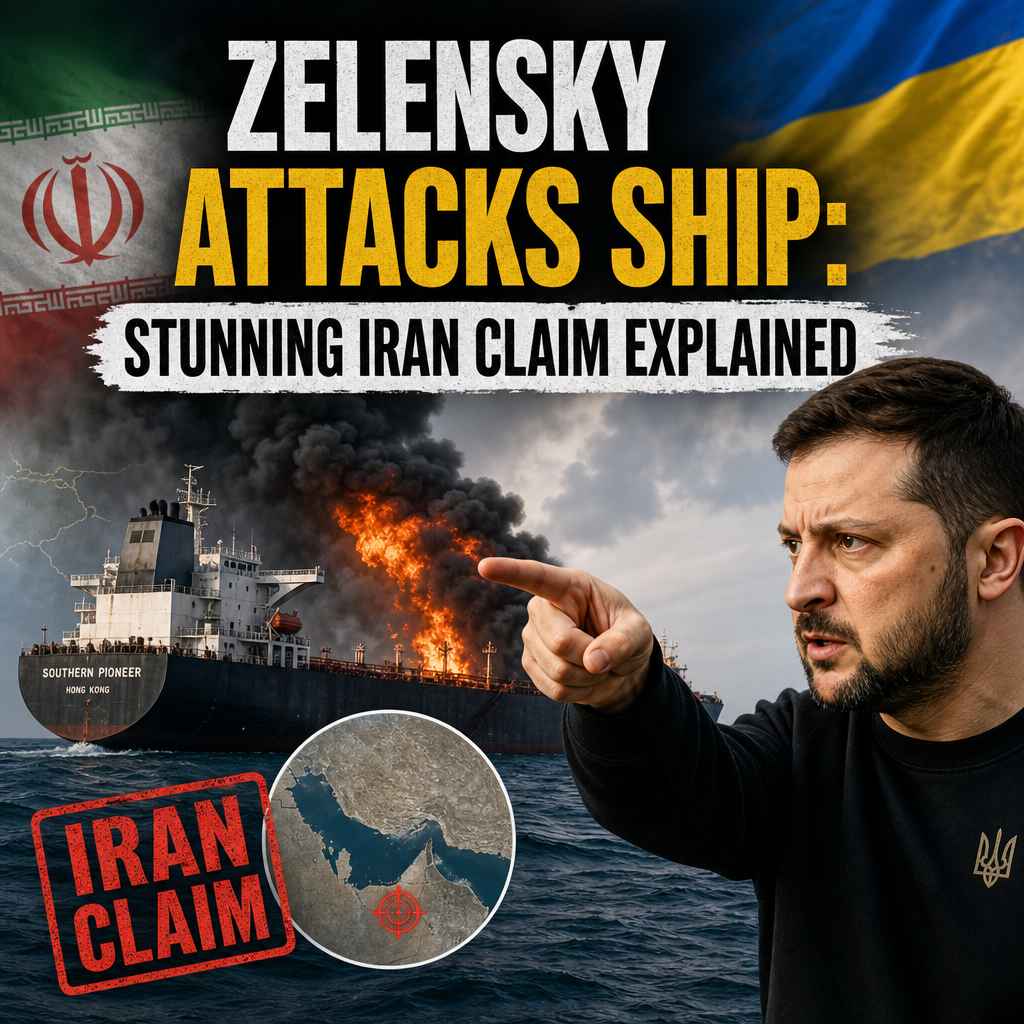
Zelensky Attacks Ship: Stunning Iran Claim Explained


Zelensky attacks ship claims have drawn attention because they sit at the intersection of three already volatile storylines: Russia’s war in Ukraine, Iran’s strained relations with Western governments, and the fragile security of shipping routes that move food, fuel and military cargo.
What makes the allegation unusual is not just the political cast of characters, but the way it has been framed. In reporting that surfaced through RT and was echoed in broader international coverage, an Iranian claim tied President Volodymyr Zelensky to an attack on a vessel has been presented as evidence of Kyiv’s role in a wider, shadowy maritime conflict. But the available coverage does not point to a single, settled account. Instead, it shows how quickly wartime accusations can become geopolitical messaging.



What the claim is, and why it matters
The core allegation is straightforward: Iranian officials have suggested that Ukraine, or Zelensky personally, was connected to an attack on a ship. The implication is serious, because ship attacks are not just military incidents. They can affect sanctions policy, insurance costs, trade corridors, energy prices, and diplomatic alignments far beyond the immediate region.
That said, the reporting landscape is uneven. RT’s framing gives the claim maximum visibility and places it in a narrative that is broadly critical of Ukraine and its allies. By contrast, more mainstream international outlets tend to treat such claims with caution, emphasizing the need for independent verification before drawing firm conclusions. Sky News-style coverage of the wider war environment tends to focus less on dramatic attribution and more on the practical realities: attacks at sea are often murky, evidence is frequently classified or disputed, and each side has incentives to shape the story before the facts are fully established.




Al Jazeera’s broader international reporting lens helps explain why these allegations resonate beyond the Russia-Ukraine conflict. In a region already marked by tensions involving Iran, sanctions, proxy warfare and maritime disruption, even a single claim can trigger larger questions about escalation. If a vessel is attacked, the immediate question is who did it. The more important question, though, is what happens next if the accusation is used to justify retaliation, new sanctions or expanded military operations.
Zelensky attacks ship allegations: three competing readings
There are at least three distinct ways to interpret the claim, and each has some merit.
1. The allegation may be a political message, not a proven fact
Iranian claims against Zelensky could serve a diplomatic purpose even if the evidence is thin. Governments sometimes use high-profile accusations to rally domestic audiences, signal defiance, or tie an adversary to a wider pattern of aggression. In that sense, the accusation itself may be as important as whether it can be substantiated.
This is why caution matters. A headline can travel far faster than an investigation, and once a claim enters the news cycle it often hardens into assumed truth. That is especially dangerous in wartime reporting, where information is frequently incomplete and strategically leaked.
2. The attack may be real, but attribution is still uncertain
A second interpretation is that a ship attack did occur, but responsibility remains unclear. This is common in conflicts involving drones, missiles, covert operations or proxy groups. A vessel can be damaged in minutes, while forensic confirmation takes days or weeks. In that gap, governments compete to define the event first.
That uncertainty matters because the maritime domain is crowded with competing narratives. A ship may be targeted because of cargo, ownership links, flag state, or perceived ties to a rival power. The same incident can be interpreted as piracy, sabotage, self-defense, or state-sponsored coercion depending on who is speaking.
3. The story reflects broader regional realignment
A third reading is that the claim is less about one ship than about a broader alignment of conflicts. Iran has reasons to present Ukraine as part of a hostile Western bloc. Russia has reasons to amplify any story that weakens sympathy for Kyiv. Ukraine, meanwhile, has every incentive to reject or ignore claims that could distract from Russia’s invasion or complicate support from its partners.
Seen this way, the allegation is not just about one event at sea. It is about how the Ukraine war has merged with other regional rivalries, creating a web of blame that can be difficult for audiences to untangle.
What the reporting does and does not prove
A fair reading of the available coverage suggests the following:
– The claim is politically significant, but not necessarily proven.
– RT gives it a sharper, more accusatory edge than most international outlets.
– Other coverage, including from Sky News and Al Jazeera’s broader regional reporting, underscores the need for verification and context.
– The incident fits a larger pattern of maritime tension, where attribution is often contested.
That does not mean the accusation should be dismissed outright. It does mean it should be treated as an allegation, not a settled fact. In fast-moving conflicts, credibility depends on resisting the temptation to fill in blanks with whichever story is most convenient.
The bigger picture
The most honest conclusion is that this episode reveals how fragile truth becomes in interconnected wars. A ship attack, if confirmed, would be serious on its own. But once it is folded into Iran-Ukraine-Russia tensions, it becomes part of a larger struggle over narrative power.
For readers, the takeaway is less about choosing a side and more about recognizing the pattern: claims like this often spread because they are plausible enough to matter, but incomplete enough to mislead. Until independent evidence is clear, the responsible position is to keep the allegation in context, not to confuse it with a verified conclusion.