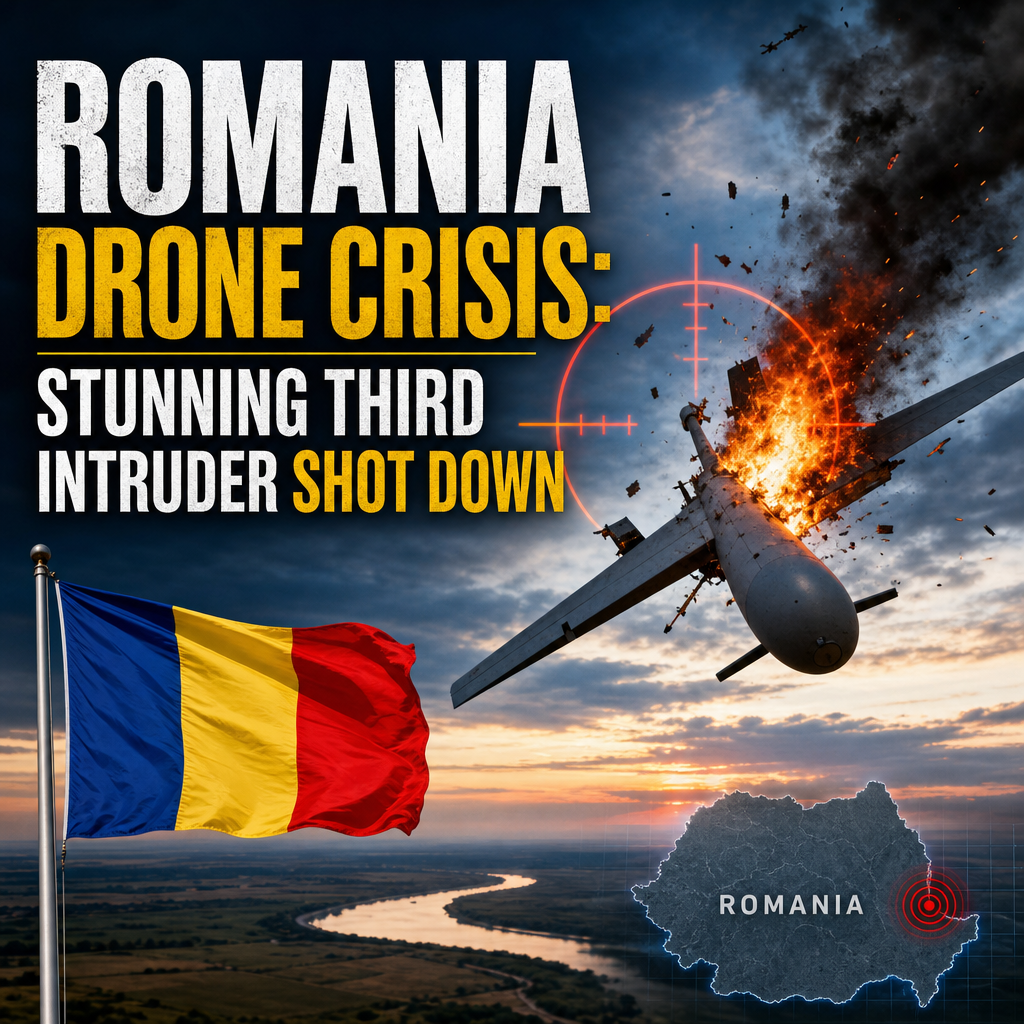
Romania Drone Crisis: Stunning Third Intruder Shot Down


Romania Drone Crisis is exposing how quickly the war in Ukraine can spill across borders, turning what might once have been dismissed as a border incident into a direct test of NATO’s eastern security. Romania’s reported downing of a third intruding drone has intensified concern in Bucharest, sharpened diplomatic friction with Moscow, and revived a familiar question: how far can the conflict drift before it triggers a broader crisis?
The latest incident is being treated not as an isolated accident but as part of a pattern. According to the reporting available from international outlets, Romanian authorities have now dealt with multiple drone incursions near its territory, prompting the country to summon the Russian envoy and publicly protest the breach. That response matters because it shows Romania is no longer framing these events as merely technical airspace violations. Instead, it is presenting them as deliberate challenges to sovereignty and, by extension, to the NATO alliance’s credibility.



Romania Drone Crisis and the pressure on NATO’s eastern flank
Romania’s stance fits a wider regional anxiety that has been building since Russia’s full-scale invasion of Ukraine. Border states have long feared that the war could become harder to contain, especially around the Black Sea, where drone activity, missile strikes, and maritime tensions have all increased. In that context, shooting down a third drone is not just a tactical event; it is a political message that Romanian airspace will be defended.
From a NATO perspective, this is exactly the kind of moment that tests deterrence. If drones can repeatedly enter allied territory with no forceful response, the signal to Moscow—and to other states watching the war—would be one of hesitation. Romania’s decision to act aggressively suggests it does not want that signal to take root.




At the same time, the incident also highlights the limits of military reassurance. Even when a NATO member responds decisively, the underlying problem remains: drones are inexpensive, hard to track, and increasingly central to modern warfare. That makes them especially useful for probing defenses, whether intentionally or through degraded targeting. The result is a strategic gray zone in which every crossing can be interpreted as either an accident, a byproduct of combat near the frontier, or a deliberate act of escalation.
What the reporting shows from different angles
The clearest common thread across the coverage is that Romania sees the incursions as serious and unacceptable. But the tone diverges depending on the outlet and its editorial lens:
– Romanian and allied interpretations emphasize sovereignty, deterrence, and the danger of escalation spilling beyond Ukraine.
– Russian-facing coverage, including commentary channels that tend to echo Moscow’s line, typically stresses denial, ambiguity, or the possibility that debris and navigation errors are being overstated by NATO states.
– Western international reporting tends to focus on the strategic significance: a NATO country is now repeatedly encountering drones linked to the wider war, which raises the temperature in the Black Sea region.
These are not just different narratives for the sake of balance. They reflect genuine uncertainty in a fast-moving conflict where the facts of each airspace violation may be hard to verify in real time. That uncertainty is part of the story. In a war increasingly shaped by drones, attribution can be difficult, but consequences are immediate.
Why the third drone matters more than the first
The first intrusion may be treated as an anomaly. The second may raise eyebrows. By the third, the event starts to look like a pattern.
That is why this incident matters beyond the headlines. Romania is not simply reacting to one drone being shot down; it is responding to an accumulating sense that the border is becoming porous. For the public, that creates understandable alarm. For policymakers, it raises practical questions:
– Are current air defenses sufficient for the frequency of drone activity now seen near NATO borders?
– Are military rules of engagement clear enough for fast-moving incursions?
– Is diplomacy keeping pace with the operational reality on the ground?
The answers are not simple. Strengthening air defenses is expensive and time-consuming, while drones are relatively cheap and adaptable. Diplomatically, Romania can protest and summon envoys, but those steps do not guarantee the behavior will stop. Meanwhile, each incident can deepen suspicion and harden positions on both sides.
A crisis with no easy off-ramp
The most responsible conclusion is that this is less a single crisis than a warning signal. Romania is showing that it will defend its airspace, but it is also revealing how vulnerable frontier states are to the spillover effects of a war just beyond their borders. Russia, for its part, is likely to deny intent or dispute the framing, as it has often done in similar situations, while Western governments will continue to see such intrusions as evidence that the conflict’s perimeter is expanding.
What makes the situation especially unstable is that nobody benefits from a miscalculation. If an intrusion is deliberate, it risks escalating tensions with NATO. If it is accidental, the same escalation risk remains because the consequences are still real. That is the dilemma at the heart of the Romania Drone Crisis: the facts may be debated, but the strategic significance is undeniable.
Romania’s response suggests it understands that reality. By shooting down the drone and moving quickly to the diplomatic stage, it is trying to combine force with restraint—showing resolve without jumping straight to a wider confrontation. Whether that is enough will depend on what happens next. If more drones appear, the issue will stop being a border-security story and become a broader test of how Europe handles a war that continues to press against its edges.