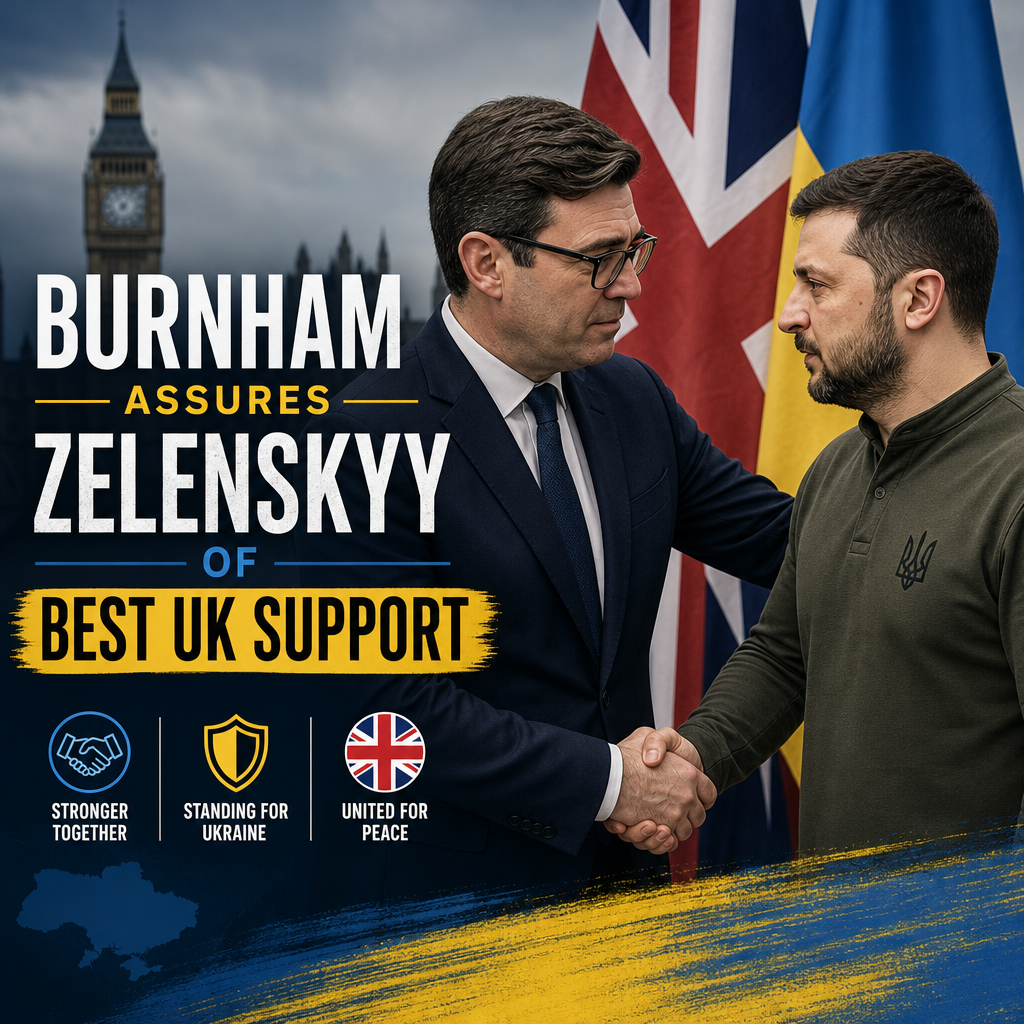
Burnham Assures Zelenskyy of Best UK Support


UK support for Ukraine is back in the spotlight after Keir Burnham’s assurance to Volodymyr Zelenskyy that Britain will remain one of Kyiv’s strongest backers. The message is politically significant, but it is also a reminder that support for Ukraine now sits at the intersection of diplomacy, domestic politics, war fatigue and the wider struggle over Europe’s security.
At a time when the conflict has entered yet another uncertain phase, Burnham’s tone matters. A clear public commitment from a new British leader can reassure allies, signal continuity to Moscow, and help Ukraine argue that its support remains broad-based despite changes in government. But the pledge also raises a harder question: what does “best support” mean when military aid, public spending and public patience are all under pressure?



UK support for Ukraine: continuity, but with questions
From the perspective highlighted in Al Jazeera’s coverage, Burnham’s assurance to Zelenskyy suggests that London wants to be seen as steady rather than hesitant. That is politically important because the UK has long presented itself as one of Ukraine’s most committed partners, especially on weapons deliveries, training and diplomatic backing.
That stance is likely to be welcomed in Kyiv. Ukrainian officials have repeatedly warned that any sign of Western wavering can be exploited by Russia, both on the battlefield and in negotiations. Even a short statement of support from a new prime minister can therefore carry strategic weight. For Ukraine, reassurance from London is not just symbolic; it helps preserve the coalition that has supplied air defenses, ammunition and financial aid.




But continuity should not be confused with unanimity. A promise of ongoing support does not answer the bigger issue of scale. European governments face rising fiscal strain, and voters in many countries are increasingly focused on domestic priorities such as inflation, healthcare and migration. Britain is no exception. Burnham may be able to keep the policy line stable in the short term, but sustaining it over time will depend on budget choices that may be contested inside Westminster.
What the British government is trying to signal
Burnham’s message appears designed to achieve several goals at once:
– reassure Zelenskyy that the UK will not abandon Ukraine
– show allies that Britain remains a reliable NATO partner
– deter Russia from interpreting a political transition as weakness
– avoid giving ammunition to critics who argue that aid is drifting
That combination reflects the balancing act facing many Western capitals. The goal is to project resolve without overpromising. In practice, that means support is likely to continue, but perhaps with more scrutiny over how money is spent, what kinds of weapons are prioritized, and how much Britain expects others in Europe to share the load.
Different readings from the news landscape
Looking across the different outlets in the provided feeds, a few broad viewpoints emerge.
Al Jazeera tends to frame the story through the lens of diplomatic continuity and the implications for Ukraine’s external backing. That perspective emphasizes the importance of allied reassurance, particularly after political change in the UK. It also implicitly treats the war as a conflict whose outcome depends heavily on Western cohesion.
Sky News, by contrast, often places this kind of development in a more domestic political context. The key angle is not only what Burnham says to Zelenskyy, but what that means for British politics, public expectations and the credibility of the new government. In that reading, support for Ukraine remains mainstream policy, but it must be defended at home as well as abroad.
RT’s coverage is likely to be more skeptical, stressing the costs and risks of continued Western support for Kyiv. That viewpoint typically questions whether another round of aid changes the strategic picture or simply prolongs the war. It also tends to highlight how the conflict is viewed in Moscow: not as a struggle for European security, but as evidence of direct Western involvement.
These are not just competing narratives; they reflect different political assumptions. One side sees support for Ukraine as a necessary investment in international stability. Another sees it as a burden that should be reassessed. A third sees it as part of a broader geopolitical confrontation with Russia. Understanding the story requires keeping all three in view.
The real test is not the statement, but the follow-through
The most important issue is whether Burnham’s promise translates into practical policy. In the months ahead, the details will matter more than the rhetoric. That includes:
– whether military aid is maintained at current levels
– whether Britain pushes for long-term funding rather than short-term packages
– whether London coordinates closely with Washington and European capitals
– how the government responds if pressure grows to reduce overseas commitments
There is also a diplomatic dimension. A firm UK position can help keep European allies aligned, especially if there are signs of hesitation elsewhere. But if Britain’s support is perceived as mainly rhetorical, then the reassurance will lose value quickly.
What this means for Ukraine and Europe
For Zelenskyy, the immediate gain is political: a public pledge from a new British leader helps preserve momentum. For Europe, the broader message is that the war remains a test of credibility. If major allies begin to drift, Russia benefits—not necessarily because it wins more territory immediately, but because uncertainty itself can weaken deterrence.
Still, it would be too simple to treat Burnham’s assurance as proof that the path ahead is clear. The war has already shown that Western unity can survive, but only with continuous effort. Support for Ukraine has become less a one-time decision than a rolling debate about how much pressure democracies are willing to absorb in the name of long-term security.
The most balanced reading is this: Burnham’s pledge is politically important, strategically reassuring and diplomatically useful. But it is also only the opening move in a far more difficult conversation about endurance. If Britain wants to remain one of Ukraine’s strongest partners, it will need more than promises. It will need consistency, resources and public support that can survive the next phase of the war.