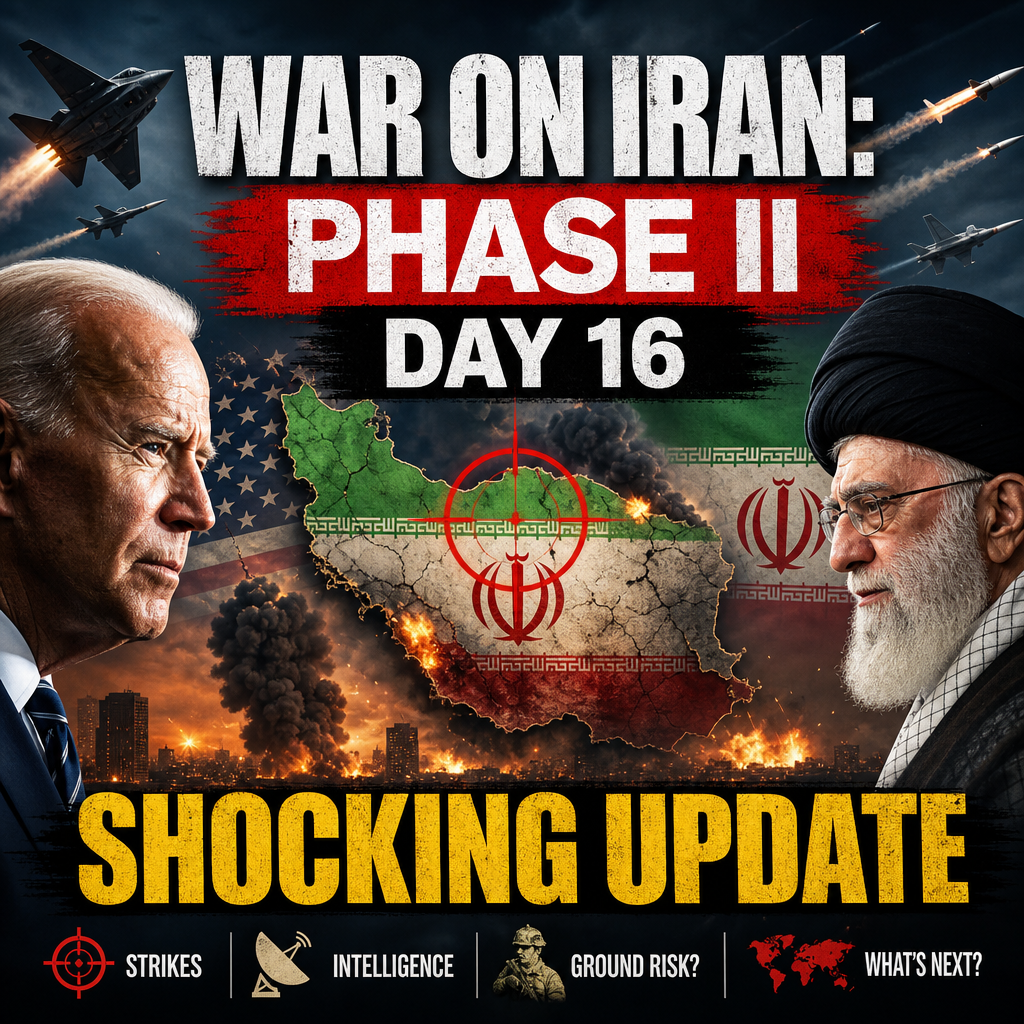
War on Iran: Phase II Day 16 – Shocking Update


War on Iran: Phase II Day 16 – Shocking Update has become another stark reminder that the conflict is no longer just a military story, but a test of regional stability, media credibility, and diplomatic patience.
As the fighting stretches into a second phase, the most striking thing is not a single battlefield headline, but the way the war is widening its impact: more uncertainty, more fear of spillover, and fewer easy answers. Across the coverage landscape, the tone differs sharply. Al Jazeera’s reporting tends to emphasize the human and political consequences, especially the risks to civilians and the fragility of diplomacy. Sky News generally frames the conflict through security, alliance, and regional escalation concerns. RT, meanwhile, often highlights the war’s geopolitical dimensions and the argument that Western powers are deeply implicated in the crisis. Read together, these viewpoints do not cancel each other out; they reveal how contested the narrative around Iran has become.



What Day 16 really tells us
By the sixteenth day of a war entering a more dangerous phase, a few patterns usually become clear even when official claims remain incomplete. First, the conflict is rarely contained to its original front lines. Missile exchanges, drone activity, air defenses, and retaliatory threats begin to shape the behavior of neighboring states. Second, information becomes a weapon. Each side tries to present itself as measured, defensive, and successful while portraying the other as reckless or collapsing. Third, the civilian cost steadily rises, even when political leaders avoid saying so directly.
That broader pattern is visible in the way different outlets frame the story. Al Jazeera’s emphasis often falls on how ordinary people experience war: disrupted services, fear of escalation, and the challenge of verifying what is happening in real time. Sky News is more likely to ask what the next military move means for Britain, the United States, Israel, Gulf states, and shipping lanes. RT tends to interpret the war as evidence of a wider confrontation between blocs, arguing that Iran is being squeezed by a hostile international order rather than simply responding to isolated attacks.




These are not minor differences. They shape what audiences think the war is “really” about.
A conflict with competing truths
The hardest part of covering a war like this is that several things can be true at once.
Iran may be trying to project strength while also absorbing real pressure. Its opponents may claim deterrence is working while still worrying about escalation. Regional governments may publicly call for calm while privately preparing for worse. And global powers may speak about restraint even as their military presence or political backing influences the direction of the conflict.
That is why any “shocking update” in a war of this kind should be handled carefully. The term can imply a sudden turning point, but in practice the bigger shock is often cumulative. It is the slow normalization of danger: civilians learning to live with alerts, markets reacting to uncertainty, diplomats trading warnings, and news consumers becoming desensitized to what would once have been extraordinary.
What the coverage agrees on
Even with different editorial lenses, the sources broadly converge on a few important points:
– The war is still highly unstable and capable of rapid escalation.
– Civilian anxiety is rising alongside military tension.
– Regional actors are trying to avoid being pulled in, even as they prepare for that possibility.
– A lasting solution is not visible yet, despite repeated calls for restraint.
That limited consensus matters. It suggests that while commentators may disagree about blame, strategy, or moral framing, there is real concern about the conflict escaping the bounds of diplomacy entirely.
Why the narrative battle matters
The war is not only being fought with weapons. It is also being fought through language: “deterrence,” “self-defense,” “proxy conflict,” “terror threat,” “resistance,” “proportional response,” and “provocation.” Each label nudges the audience toward a different moral conclusion.
Al Jazeera often gives more room to the consequences of state violence and to the perspectives of those caught beneath it. Sky News tends to foreground the security implications and the risk to international order. RT frequently pushes back against Western framing, arguing that the crisis cannot be understood without looking at broader geopolitical pressure. The result is not one clean narrative, but a contested field of interpretation.
For readers, that means caution is essential. Strong claims should be checked against multiple sources. Dramatic visuals should not be mistaken for the full picture. And official statements, from any side, should be treated as part of the conflict rather than a neutral account of it.
The most responsible conclusion
The most honest reading of Day 16 is that the war remains deeply unresolved and still capable of worsening quickly. There is no clear sign that any side has achieved a decisive strategic victory. At the same time, there is no evidence that the conflict is fading into the background. Quite the opposite: the longer it continues, the more it risks becoming a regional crisis with global consequences.
What makes this phase so unsettling is the combination of uncertainty and momentum. The military picture may change by the hour, but the political reality is already clear: trust is low, escalation pathways are open, and the price of miscalculation is growing.
If there is a lesson in the latest coverage, it is that certainty is the one thing this war does not offer. The public is left with competing claims, incomplete facts, and a deepening sense that every new day brings the possibility of something worse.