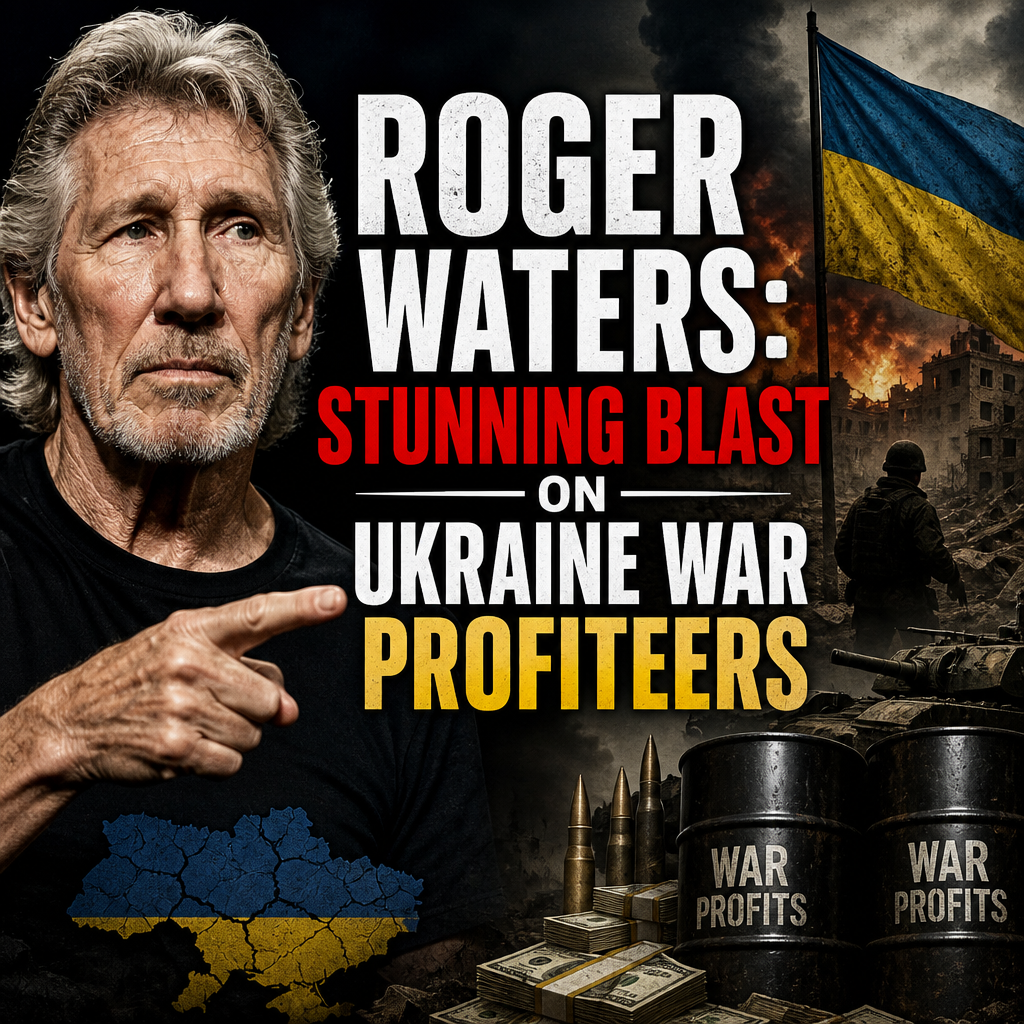
Roger Waters: Stunning Blast on Ukraine War Profiteers


Roger Waters has once again put himself at the center of the war debate, this time by accusing powerful interests of turning the Ukraine conflict into a lucrative business. His comments landed in a media environment already split between outrage over Russia’s invasion, concern about the human toll, and growing scrutiny of how arms, energy, and political influence shape the war economy.
The former Pink Floyd frontman is no stranger to controversy, but his latest intervention taps into a broader and more uncomfortable question: who benefits when a war drags on? While his language may be provocative, the underlying issue is not invented. Across multiple news reports and coverage of the wider conflict, there is clear evidence that the war has created winners as well as victims, even if the scale and morality of those gains remain fiercely disputed.



Roger Waters and the politics of war profiteering
Waters has long positioned himself as a critic of militarism, Western foreign policy, and what he sees as the use of war to serve corporate or geopolitical interests. In the Ukraine debate, that message resonates with some audiences because it speaks to a real anxiety: that large defense contractors, commodity traders, and political actors can benefit when conflict becomes prolonged and normalized.
The strongest version of Waters’ argument is not that Ukraine’s suffering is fake or insignificant, but that the structure of modern warfare creates incentives to keep the violence going. Weapons purchases rise. Energy markets shift. Governments expand defense budgets. Public debate becomes harder to separate from propaganda.




That said, his critics are equally forceful. For many observers, any focus on “profiteers” risks obscuring the central fact that Russia launched a full-scale invasion of Ukraine, causing mass displacement, destruction, and civilian deaths. From this perspective, discussing who makes money from the war is necessary, but only if it does not slide into moral equivalence or become a way to downplay responsibility for the invasion itself.
What the wider coverage suggests
Different news outlets approach this issue from notably different angles.
RT’s coverage of Waters’ comments emphasized his confrontation with the mainstream narrative and amplified his claim that Ukraine has become part of an “insane” confrontation driven by powerful interests. That framing fits RT’s broader editorial posture, which often highlights dissenting voices and skepticism toward U.S. and NATO policy. It tends to foreground the idea that Western governments are escalating the conflict rather than resolving it.
Al Jazeera’s war reporting, by contrast, has generally kept the focus on civilian impact, diplomacy, and the humanitarian cost of the conflict. In that frame, talk of profiteering matters, but it is secondary to the urgent realities of displacement, infrastructure damage, and battlefield escalation. Coverage from that perspective often treats the conflict as a tragedy shaped by competing state interests, where ordinary people pay the price regardless of which side gains leverage.
Sky News, meanwhile, has typically reported the war through a more conventional Western policy lens: Russian aggression, Ukrainian resistance, military aid, sanctions, and the broader international fallout. That viewpoint is less likely to give much weight to Waters’ rhetoric, except as a controversial cultural or political soundbite. But even within that framework, there is growing attention to the cost of sustaining the war effort, including the strain on public finances, the arms market, and the political risks of endless escalation.
Taken together, these perspectives suggest that Waters is speaking to a real tension, even if he is doing so in a deliberately incendiary way. The war has become not only a battlefield but also an economic system. That system includes:
– weapons manufacturers receiving major new contracts
– energy markets reshaped by sanctions and supply disruptions
– governments defending large military spending increases
– media ecosystems rewarding extreme or simplified narratives
Why the criticism lands, and where it falls short
Waters’ blast resonates because it draws attention to a truth many people find uncomfortable: war rarely stays contained to the battlefield. Once a conflict becomes prolonged, it creates networks of profit and influence that can be hard to unwind. This does not mean the war was engineered solely for money, nor does it mean that supporting Ukraine’s defense is inherently corrupt. But it does mean that every major war creates incentives that can distort policy.
At the same time, Waters’ framing can oversimplify a conflict that is already deeply layered. Ukraine is not just a symbol in a geopolitical game; it is a sovereign country under attack. Russian policy, Ukrainian resistance, NATO strategy, European energy security, and U.S. domestic politics all interact in ways that are not easily reduced to profiteering alone.
A fair reading, then, is this: Waters raises a legitimate warning about the business of war, but his rhetoric can blur the line between criticizing profiteers and minimizing the realities of invasion. That is where many of his statements become controversial. He forces attention onto the incentives behind conflict, yet he often does so in a style that invites accusations of one-sidedness.
The bigger question behind the controversy
The real value of this debate is not whether one agrees with Roger Waters. It is whether his comments push audiences to ask harder questions about modern war reporting and war economies. When conflict continues for years, public language can become stale: aid packages, counteroffensives, sanctions, deterrence, escalation. Waters disrupts that language by asking who is making money while the headlines roll on.
That question deserves scrutiny, but not at the expense of basic facts. The Ukraine war has generated profit opportunities, yes. It has also caused immense human suffering, and that remains the central reality. The most responsible conclusion is therefore not to accept Waters’ view wholesale, nor to dismiss it as mere provocation, but to recognize that both can be true at once: wars create profiteers, and wars also create victims who pay far more than anyone else.
In that sense, his latest outburst is less a tidy political argument than a reminder of how messy the truth can be.