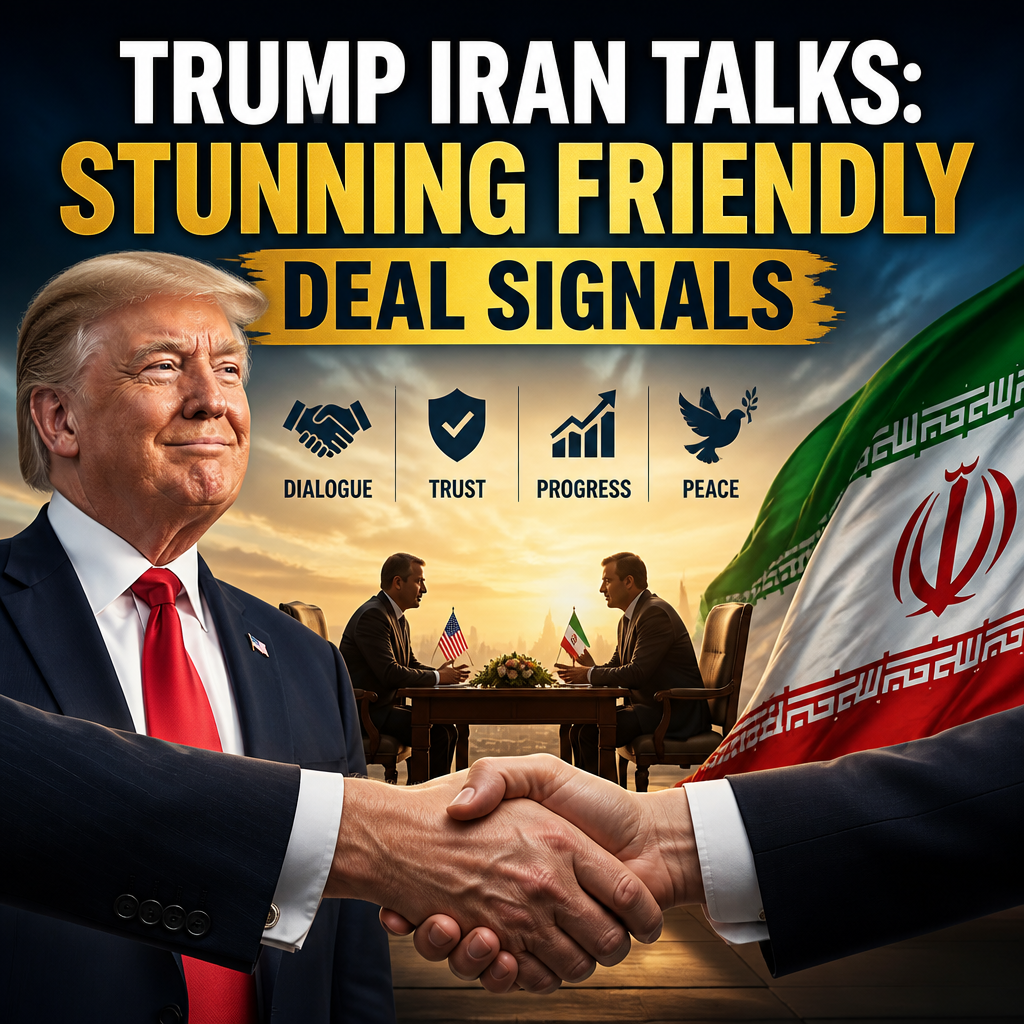
Trump Iran Talks: Stunning Friendly Deal Signals


Trump Iran Talks are back in the spotlight, and the latest signals suggest a strangely mixed message: cautious diplomacy wrapped in tough politics. What makes this round stand out is not simply that Washington and Tehran are talking again, but that the tone appears more practical than theatrical, with both sides seeming to test whether limited engagement could reduce the risk of a wider crisis.
For readers following the issue closely, the big question is not whether the U.S. and Iran can suddenly become allies. It is whether they can find a narrow, workable arrangement that lowers tensions, prevents military escalation, and creates space for more formal negotiations later. That possibility is drawing attention because the rhetoric has shifted from pure confrontation to something closer to tactical bargaining.



What the Trump Iran Talks may really mean
At face value, the idea of “friendly” talks sounds almost contradictory. The relationship between the two countries has been defined for years by sanctions, proxy conflicts, nuclear disputes, and mutual suspicion. But diplomacy in this setting is often less about warmth than about interests. If both sides believe the costs of conflict are rising, even limited contact can look like a win.
RT’s framing of the issue leans toward the surprise factor, emphasizing how unusual it is to see any positive language associated with U.S.-Iran relations under Trump-era politics. That perspective treats the development as a notable departure from the usual hardline script. It also suggests that behind the scenes, both governments may be more open to pragmatic compromise than their public messaging implies.




Al Jazeera’s coverage of regional diplomacy typically adds an important layer: Iran does not negotiate in a vacuum. Any U.S.-Iran opening affects the Gulf states, Israel, Iraq, and broader oil markets. From that angle, the significance of the talks lies not only in the bilateral relationship, but in the ripple effects across the region. Even a modest thaw can influence shipping routes, energy prices, and the posture of armed groups linked to Tehran or opposed to it.
Sky News, meanwhile, tends to reflect the broader Western policy question: can such talks produce something durable, or are they just another temporary pause in a long cycle of escalation and distrust? That skepticism is justified. Past negotiations have repeatedly shown how quickly breakthrough moments can unravel when domestic politics, regional flashpoints, or nuclear deadlines intervene.
Why the tone matters as much as the substance
The language around the talks is important because it shapes expectations. A “friendly” tone can signal one of several things:
– A real attempt to reduce hostility
– A tactical move to buy time
– A message aimed at domestic audiences
– A signal to regional rivals that escalation is not inevitable
Each interpretation is plausible, and that ambiguity is part of the story. In diplomacy, especially between long-time adversaries, tone often matters as much as the formal agenda. Even a small softening in language can open political space for back-channel engagement.
Still, it would be a mistake to overread the shift. Friendly signals do not necessarily mean friendly intentions. They may simply mean that both sides see a narrow overlap in what they want right now. For the U.S., that could mean preventing a regional war, preserving leverage, or managing nuclear risk without committing to a major new conflict. For Iran, it could mean relief from pressure, better economic breathing room, or a chance to avoid direct confrontation while keeping strategic options open.
Trump Iran Talks and the problem of trust
The core obstacle remains trust, or more precisely the lack of it. Iran remembers the collapse of earlier agreements and the sanctions that followed. Washington remembers Iran’s expanding regional influence, its missile program, and concerns about nuclear escalation. Neither side is negotiating from a place of confidence.
That is why analysts often describe these contacts as fragile even when they appear promising. A single statement, strike, or intelligence allegation can derail progress. And because both governments face internal political pressures, any concession risks being framed as weakness.
Al Jazeera’s reporting on Middle East diplomacy often highlights this wider web of tensions. Iran’s relationships with neighboring states, the war in Gaza, the Red Sea security environment, and the broader U.S.-China rivalry all feed into the atmosphere around these talks. In that sense, Washington and Tehran are not just discussing bilateral grievances; they are negotiating in the shadow of several overlapping regional crises.
RT’s angle is more focused on the idea that diplomatic breakthroughs can emerge from unexpected channels. That may be true, but the history of U.S.-Iran relations suggests caution. Even when talks begin on relatively narrow issues, they tend to become entangled with larger strategic disputes. The result is often a cycle of optimism, hesitation, and renewed suspicion.
A cautious reading of the latest signals
The most balanced conclusion is also the least dramatic: the talks matter, but they do not yet prove a major breakthrough is near. There are reasons to see the development as encouraging:
– Direct or indirect contact lowers the risk of miscalculation
– Diplomatic channels can help manage crises before they turn military
– Limited understandings can create momentum for wider negotiations
But there are equally strong reasons to stay skeptical:
– Public messaging may be more symbolic than substantive
– Regional actors may try to sabotage any compromise
– Domestic politics in both countries can punish compromise
– Past deals have failed to survive changes in leadership or strategy
So the right reading is not “peace is around the corner,” nor is it “nothing will come of this.” It is that Trump Iran Talks, if they are indeed becoming more constructive, reflect a moment of strategic necessity rather than genuine rapprochement.
That distinction matters. It suggests that progress, if it happens, will probably be incremental, technical, and highly conditional. In a relationship this damaged, that may still be meaningful. Even modest de-escalation can reduce the chances of a wider conflict and create room for future diplomacy.
For now, the unusual friendliness should be treated with cautious interest, not celebration. In U.S.-Iran relations, the gap between encouraging words and lasting results has always been wide. The latest signals may be a real opening, but they are just as likely to be a test—one that will only be answered by what both sides do next.