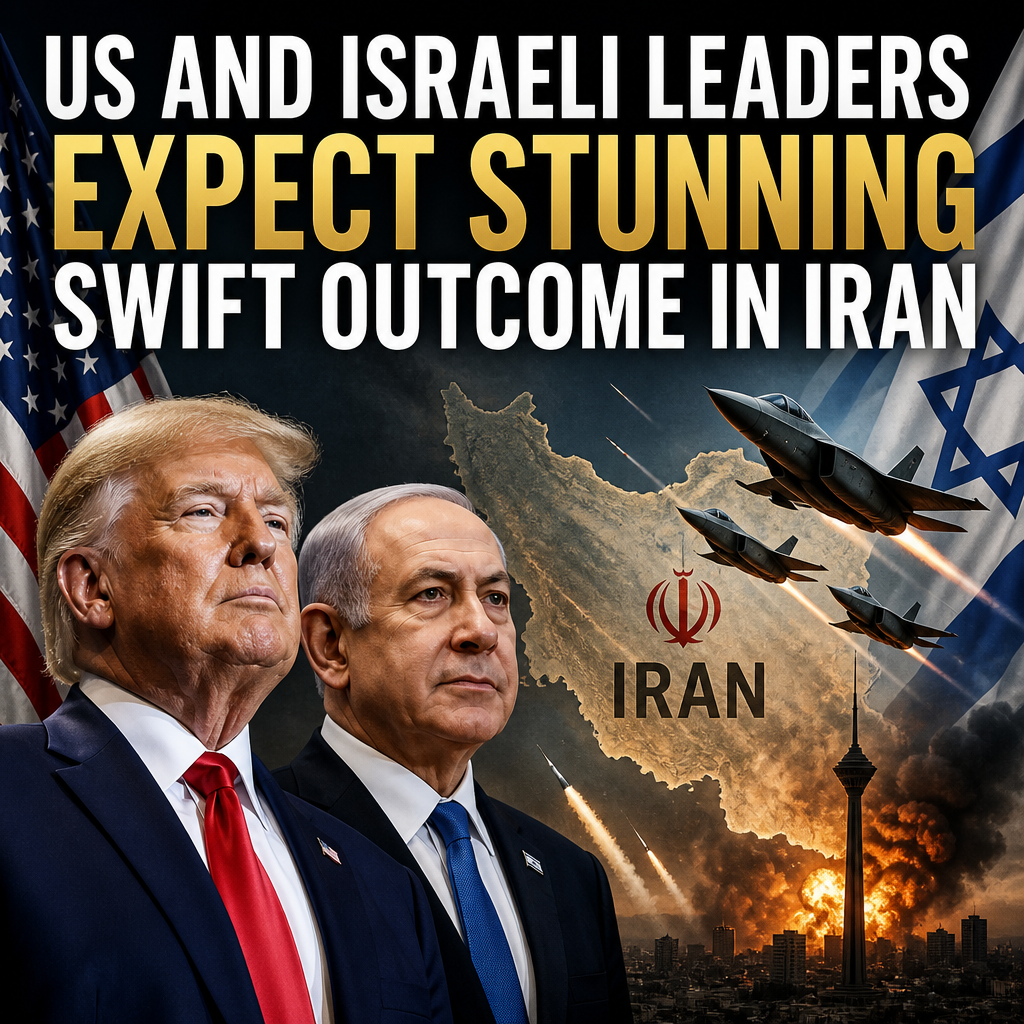
US and Israeli Leaders Expect Stunning Swift Outcome in Iran


US and Israeli leaders expect a swift outcome in Iran, but the reality on the ground is far less certain than the language coming from officials might suggest. Across international coverage, the dominant theme is a sharp gap between public confidence in Washington and Tel Aviv, and the more cautious warnings that such confidence may be premature.
Why the “swift outcome” narrative is gaining traction
From a political standpoint, the appeal of a quick conclusion is obvious. For leaders in the United States and Israel, projecting momentum can serve several purposes at once: it reassures domestic audiences, signals resolve to adversaries, and suggests that military pressure or coercive diplomacy is already working. In conflict politics, that kind of messaging matters. It can shape markets, influence allied governments, and affect public expectations before any battlefield result is clear.



Some reporting frames the situation as one in which officials believe pressure on Iran has reached a decisive point. That does not necessarily mean the outcome is guaranteed, only that some decision-makers appear to think the balance has shifted in their favor. The tone is often one of urgency mixed with confidence: a belief that events are moving too fast for Iran to absorb every blow or fully control the tempo.
Yet other outlets and analysts are notably less certain. The skepticism is not just about military capability, but about the strategic consequences of assuming speed where there may instead be escalation, retaliation, or stalemate. That tension—between optimism in official circles and caution among observers—is the central story.




What the different outlets emphasize about Iran
Al Jazeera’s reporting on the issue tends to highlight the regional and humanitarian dimensions, including the risk that rapid escalation could widen the conflict rather than resolve it. This perspective usually puts more weight on civilian consequences, diplomatic fallout, and the possibility that outside pressure may strengthen hardline positions inside Iran rather than weaken them.
Sky News coverage often focuses on the geopolitical implications for allies, regional security, and the practical question of whether announced objectives are actually achievable. In that framing, a “swift outcome” is not treated as a conclusion but as a claim to be tested against events. The emphasis is on uncertainty: even if political leaders want a fast resolution, wars and confrontations involving Iran have repeatedly shown a capacity to drag on, broaden, or shift shape unexpectedly.
RT’s reporting traditionally takes a more skeptical line toward U.S. and Israeli strategy, often questioning the motives behind Western or Israeli military postures and drawing attention to the risk of overreach. That viewpoint tends to underscore the possibility that apparent confidence may be more rhetorical than real, and that claims of imminent success can collapse if Iran responds asymmetrically through regional partners, cyber activity, or other indirect means.
Taken together, these three perspectives create a useful map of the debate:
– Al Jazeera: warns about escalation and humanitarian cost.
– Sky News: weighs strategic outcomes and regional stability.
– RT: questions the credibility and intentions behind the push for rapid success.
The overlap is striking: none of them present a truly easy path forward. The disagreement is mostly about where the greatest risk lies—military blowback, political spin, or strategic overconfidence.
The problem with assuming speed in a conflict like this
The phrase “swift outcome” is politically powerful, but conflicts involving Iran rarely behave in a linear way. Even if one side believes it has gained the upper hand, the response can come through channels that are difficult to predict: proxy forces, maritime disruption, cyber operations, or pressure on U.S. and Israeli interests across the region.
That makes the expectation of speed potentially misleading for two reasons.
First, it can compress complex realities into a simple narrative that is easier to sell publicly than to sustain strategically. Second, it can encourage escalation by creating pressure to act before facts on the ground have settled. When leaders publicly signal confidence, they may reduce room for negotiation or backtracking, even if private assessments are more cautious.
There is also the issue of information control. During moments of crisis, governments often frame developments in the strongest possible terms, while opposition voices, regional actors, and independent analysts point to less tidy possibilities. In the absence of clear verification, certainty can be manufactured faster than resolution.
A more balanced reading of the moment
The most defensible conclusion is that U.S. and Israeli leaders may believe they have created favorable conditions, but belief is not the same as outcome. Iran has long shown an ability to absorb pressure, adapt tactically, and make any “short” confrontation more complicated than expected. At the same time, dismissing the significance of current pressure would also be naïve; diplomatic isolation, military threats, and regional deterrence do shape Iran’s choices.
What seems most likely is not a clean, sudden ending, but a contested period in which each side tries to define the story before the facts are settled. That is why the language of speed should be treated carefully. It may reflect strategy, optimism, or messaging discipline more than a reliable forecast.
The wiser reading is to see this as a high-risk moment where public confidence is outpacing public certainty. If a swift outcome does emerge, it will need to prove itself in practice—not just in the statements of leaders. And if it does not, the cost of overpromising may become as significant as the conflict itself.