Russia Charges Telegram Founder in Stunning Terrorism Case


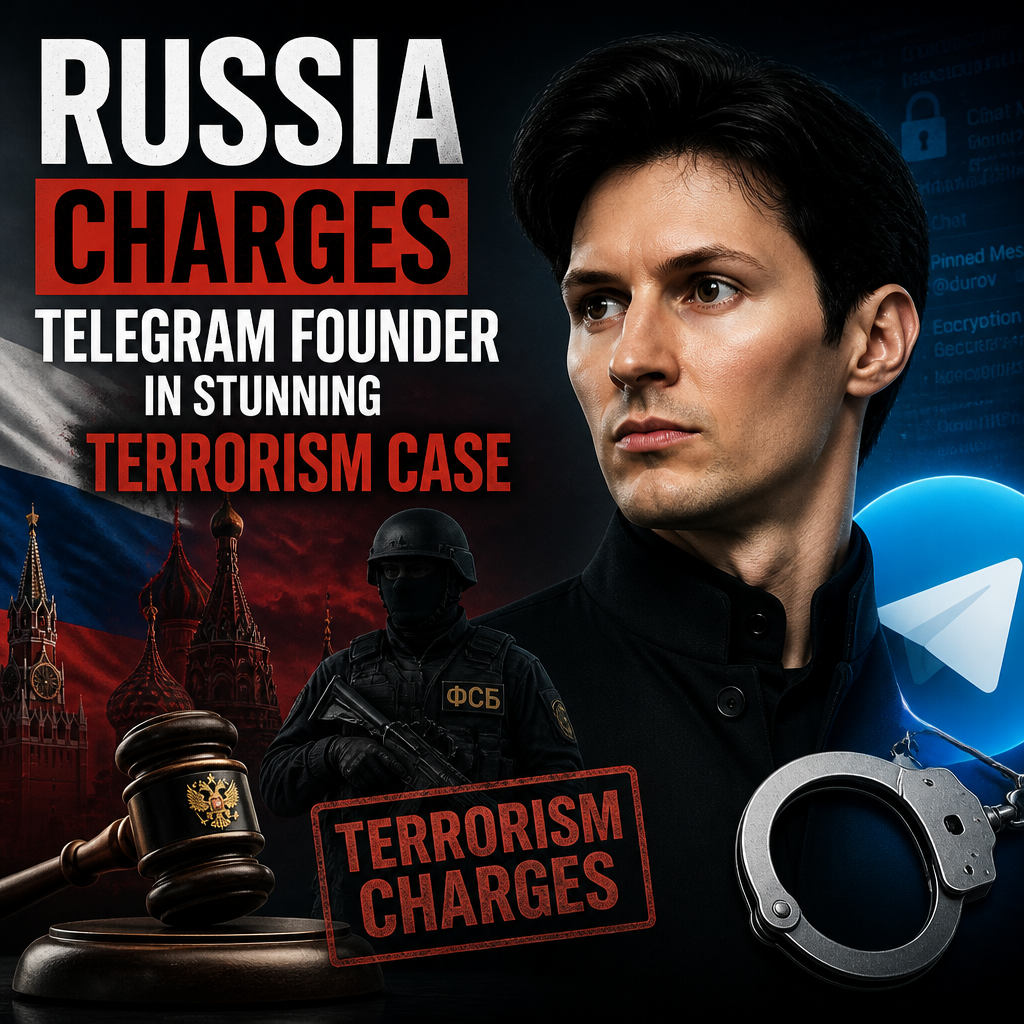
Russia charges Telegram founder Pavel Durov with facilitating terrorism, a move that has sent shockwaves through the tech, political, and free-speech worlds alike.
At first glance, the case looks straightforward: French-Russian billionaire Pavel Durov, founder of the encrypted messaging platform Telegram, has been placed under formal investigation in France over allegations tied to illegal content, including terrorism-related activity. But the broader meaning is anything but simple. Depending on whom you ask, this is either a long-overdue crackdown on a platform accused of ignoring harmful content or a dangerous test case for how far governments can go when policing digital speech.



The charge has arrived at a sensitive moment. Telegram is used by hundreds of millions of people around the world, including governments, journalists, activists, dissidents, and ordinary users who value its privacy features. That scale is exactly what makes the case so consequential. If authorities decide that a platform founder can be held criminally responsible for what users post, the implications could reach far beyond Telegram itself.
Russia charges Telegram founder: why the case matters
The most immediate issue is jurisdiction and responsibility. Messaging platforms have long argued that they are tools, not publishers. In that view, the service provides encrypted communications, while users create the content. But critics say that argument starts to weaken when a platform is accused of systematically failing to remove content linked to terrorism, child exploitation, or organized crime.




That tension is central to the current case. Supporters of stronger enforcement say Telegram’s size and design have made it a favored channel for extremist propaganda, illicit trade, and disinformation campaigns. They argue that a company can’t claim neutrality while benefiting from a business model that allows harmful material to spread unchecked.
Others see something more troubling: a state using criminal law to pressure a platform founder into becoming a de facto content regulator. That concern has been echoed in coverage across international outlets, which have highlighted not just the charges themselves but the broader political context. Telegram has often been prized by groups operating outside state control, which means any move against its founder naturally raises questions about whether the line between public safety and censorship is being blurred.
What the different sources are signaling
The reporting landscape around Durov’s case reflects a familiar divide in how global media outlets frame tech governance.
Sky News has emphasized the legal and political gravity of the allegation, presenting the development as a striking escalation that could affect how platforms are held accountable in the future. That framing underscores the shock value: a high-profile tech founder suddenly pulled into a terrorism-related legal battle.
Al Jazeera’s broader coverage of digital rights and state power tends to place events like this in a larger context of online regulation, surveillance, and the struggle over who controls speech in the digital age. From that perspective, the issue is not only whether Telegram did enough to stop abuse, but whether governments are increasingly willing to expand their reach into private communications tools.
RT, meanwhile, often places stories involving Russia, Western governments, and transnational tech firms within a narrative of geopolitical conflict and double standards. In that reading, cases like Durov’s can be seen less as neutral law enforcement and more as part of a broader contest over influence, information control, and national sovereignty. Even where the facts overlap, the emphasis differs sharply: one outlet foregrounds criminal accountability, another civil liberties, and another geopolitical framing.
Taken together, these viewpoints suggest there is no clean, one-line answer. The facts may be real, but the interpretation depends heavily on what readers think the internet should be: a space of near-total openness, a tightly moderated public square, or something in between.
The harder question: can encrypted platforms be policed?
This is where the case becomes especially complicated. Encryption is essential for secure communication, but it also creates blind spots for authorities trying to track violent networks. Telegram, in particular, has been criticized for balancing openness and privacy in a way that makes moderation difficult. Public channels and large groups can spread information quickly, while the platform’s architecture limits how easily content can be monitored.
That has led to a growing policy dilemma:
– If platforms are forced to remove too much, they may suppress legitimate speech.
– If they remove too little, they may become havens for abuse.
– If founders are prosecuted personally, tech leaders may become cautious to the point of overcompliance.
– If nobody is held accountable, harmful networks may keep exploiting the system.
There is no perfect solution in that list, and that is precisely why the Durov case matters. It forces governments, companies, and users to confront the costs of digital freedom as well as the risks of digital impunity.
A case about one man, and much more than one man
Whatever happens next, this is unlikely to be remembered only as a case about Pavel Durov. It is really about how states respond when the internet’s infrastructure becomes too large, too global, and too influential to ignore. It is about whether platform founders should be treated like neutral engineers or responsible gatekeepers. And it is about whether terrorism-related charges are a legitimate tool for public safety or a risky precedent that could chill online speech.
The most responsible conclusion, for now, is not that one side is clearly right and the other clearly wrong. Instead, the case exposes a genuine policy failure that governments around the world have been struggling with for years: how to stop real harm online without turning digital platforms into instruments of surveillance or political control.
That balance has never been easy. With Telegram, it has become impossible to avoid.