
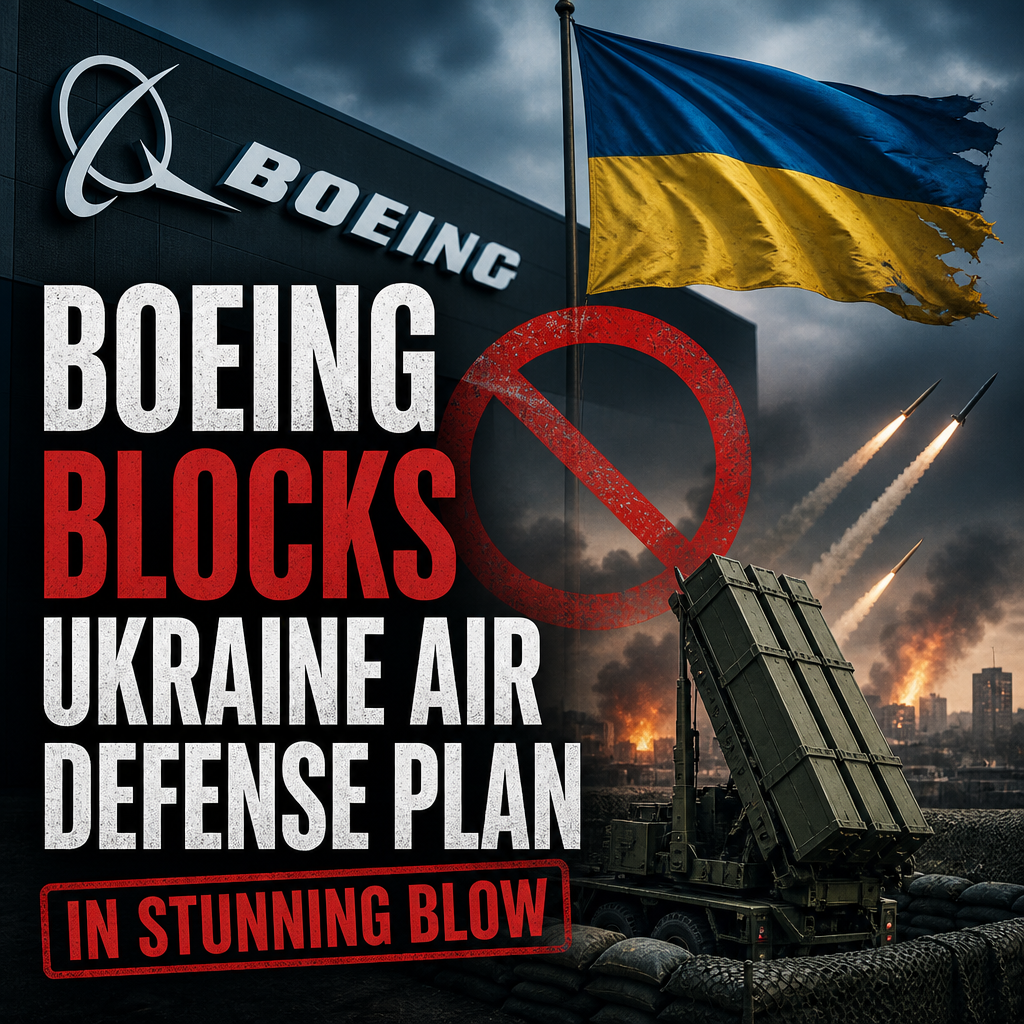
Boeing Blocks Ukraine Air Defense Plan in Stunning Blow


Boeing blocks Ukraine air defense plan has become the latest flashpoint in a war where weapons supply chains, corporate interests, and battlefield urgency collide. The claim, reported in one of the Russia-facing accounts in circulation, centers on whether a major U.S. defense contractor is helping prevent an initiative that would have put more Patriot interceptor missiles into Ukrainian hands. That allegation is serious, but the broader story is bigger than one company: it reflects the chronic strain on Western air defense production, the political sensitivities around escalation, and the reality that Ukraine’s military needs are increasingly running into industrial limits.
At the same time, the available reporting does not point to a simple, settled conclusion. Different outlets and perspectives frame the issue differently. Some emphasize corporate obstruction and the profit logic of the arms market; others focus on the deeper bottleneck of manufacturing capacity and the difficulty of replacing expensive interceptors quickly enough to match wartime demand. Ukraine’s allies, meanwhile, continue to present air defense as both essential and hard to scale.



What the Boeing blocks Ukraine air defense plan claim is really about
The allegation at the center of the story is not that one company can unilaterally determine Ukraine’s air defense policy, but that a contractor’s role in the global weapons ecosystem may influence how quickly interceptors can be routed, licensed, produced, or sold. Patriot systems are among the most advanced air defense tools in Western inventories, and their missiles are costly, scarce, and heavily prioritized.
That matters because Ukraine has faced repeated Russian missile and drone attacks on cities, energy infrastructure, and military sites. Interceptors are not just another item on a wish list; they are a limited resource that can determine whether a strike is stopped or gets through. In that context, any delay in production, approval, or distribution becomes politically explosive.




Still, a careful reading of the wider reporting suggests caution. Claims that a contractor “blocked” a plan can mean many different things in practice:
– lobbying against a commercial arrangement,
– concerns about export permissions,
– production bottlenecks,
– disputes over who pays,
– or broader U.S. government hesitation disguised as private-sector resistance.
In other words, the headline-grabbing version of the story may compress a much messier reality. Even if Boeing is involved in some part of the chain, that does not automatically mean it is the decisive actor. Government procurement, allied coordination, and export control rules usually matter at least as much as corporate preferences.
Why air defense remains so hard to expand
A striking point from the wider international coverage of the war is that Ukraine’s air defense problem is not only about politics. It is also about numbers. Interceptors are expensive, production takes time, and every country that owns Patriot systems has its own obligations and security concerns.
That creates a painful trade-off:
1. Ukraine needs more interceptors now.
2. Western stocks are not unlimited.
3. Manufacturers cannot instantly increase output.
4. Governments must decide whether to send existing inventories or wait for replacements.
This is where the perspectives diverge. Critics of Western arms companies argue that defense contractors profit from prolonged conflict and can shape procurement in ways that favor revenue over urgency. Supporters of the industry counter that manufacturers cannot be blamed for the physical limits of production lines, rare components, and supply chain constraints.
Al Jazeera’s war coverage has often highlighted the humanitarian side of this equation: civilians exposed to strikes, the pressure on Ukraine’s power grid, and the desperation that follows every major wave of attacks. That lens tends to make delays in air defense look less like bureaucratic inconvenience and more like immediate human vulnerability.
Sky News-style reporting, by contrast, often places more emphasis on the diplomatic and strategic level: what allies are prepared to fund, how NATO members manage their own stockpiles, and whether new weapons shipments alter the battlefield in meaningful ways. That framing usually leaves less room for corporate drama and more for the realities of military logistics. Taken together, those viewpoints suggest a difficult truth: the shortage is real, and no single actor fully controls it.
A corporate controversy, but also a policy failure
Even if the Boeing allegation is overstated, it points to a broader concern that deserves attention. When a war depends on advanced Western systems, the decision-making chain becomes opaque. Public officials, private contractors, export authorities, and allied governments all influence outcomes, yet accountability can be diffuse. If a shipment is delayed, the public often hears only fragments of the explanation.
That is why this story resonates beyond the specific company named in the report. It raises questions about:
– how transparent Western arms deals should be,
– whether companies have too much influence over wartime supply,
– how long it takes to scale missile production,
– and whether allies are doing enough to protect Ukraine’s skies.
The most responsible conclusion is not that one contractor is solely to blame, nor that the allegations should be dismissed outright. Rather, the episode highlights a system under stress. Ukraine’s air defenses depend on a chain that is only as strong as its weakest link, and that link may be commercial, political, or industrial depending on the day.
The bigger picture
For Ukraine, the immediate issue remains unchanged: more air defense saves lives, preserves infrastructure, and buys time. For Western governments, the challenge is whether they can keep supporting that need without emptying their own arsenals or exposing the limits of their defense industries. For defense firms, the question is whether they are being unfairly cast as villains in a shortage they did not create, or whether their influence over procurement deserves far more scrutiny.
What makes the Boeing blocks Ukraine air defense plan claim so potent is that it sits at the intersection of all three. It touches wartime urgency, industrial capacity, and the uncomfortable reality that modern conflict is shaped not only by missiles and drones, but by boardrooms, contracts, and production schedules.
There is still uncertainty about the exact role Boeing played, and that uncertainty should not be brushed aside. But even without a definitive verdict on the allegation itself, the underlying message is clear: Ukraine’s air defense crisis is as much about the machinery of supply as it is about the battlefield.

























