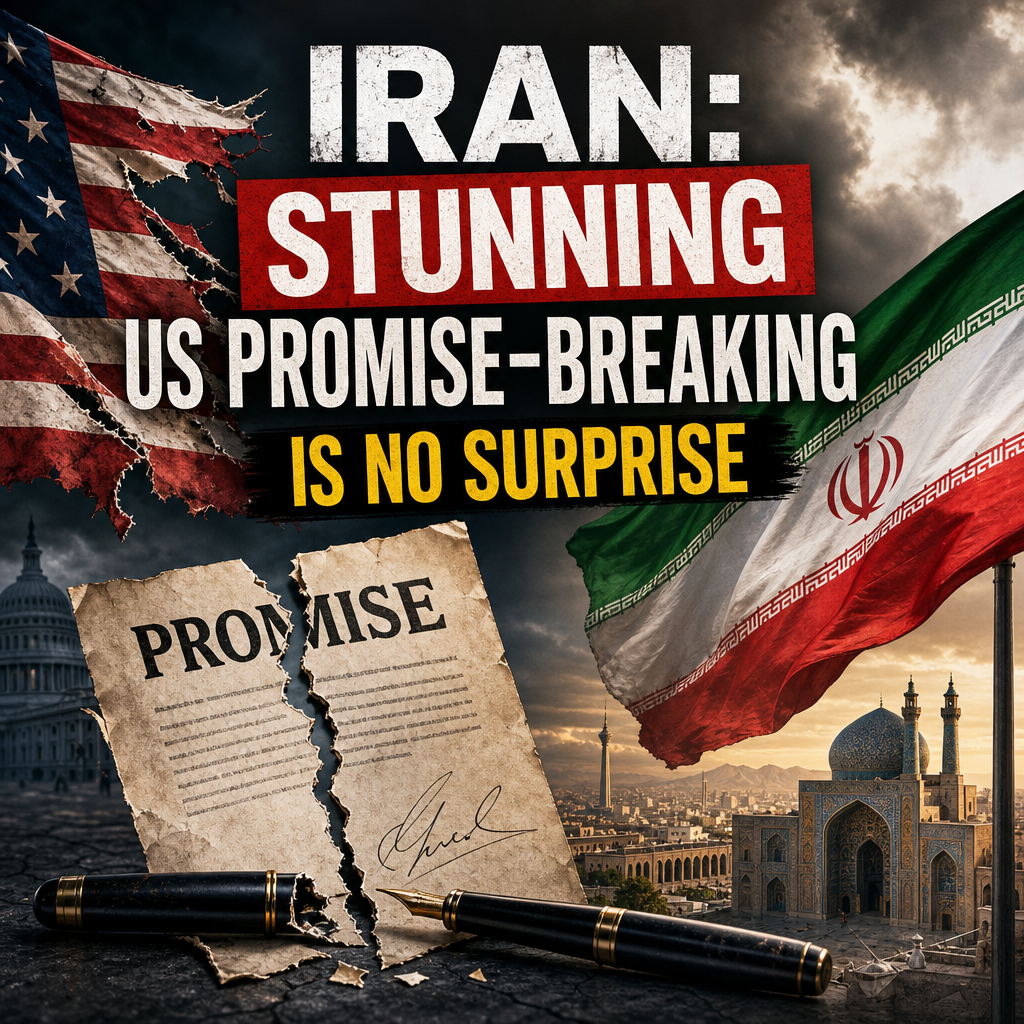
Iran: Stunning US Promise-Breaking Is No Surprise


Iran has long treated American promises with skepticism, and the latest round of regional tension has only reinforced that view.
The reaction is not hard to understand. Across years of nuclear negotiations, sanctions relief pledges, and security assurances, Washington has often shifted course when domestic politics or strategic pressure changed. That pattern is why many Iranian officials and analysts say the United States is not simply unreliable in the abstract; it is predictable in its unreliability. Still, the picture is more complicated than a simple tale of betrayal. Western officials argue that U.S. policy has also been shaped by Iran’s own actions, including its nuclear advances, regional alliances, and confrontational rhetoric. The result is a cycle of mistrust that neither side seems able to break.



Iran and the problem of trust
The core issue is credibility. Iranian leaders repeatedly point to the 2015 nuclear agreement as the clearest example of a promise made and then undone. The deal was supposed to trade limits on Iran’s nuclear program for sanctions relief and international reintegration. But after the U.S. withdrew under President Donald Trump, sanctions returned and the diplomatic opening collapsed. For Tehran, that episode became proof that even a signed agreement with broad international backing could be reversed by a change in Washington.
That memory now shapes how Iranian officials interpret almost every new American statement. When U.S. leaders speak about de-escalation, restraint, or negotiations, Iranian skeptics hear conditional language, political maneuvering, or a temporary pause before the next reversal. RT’s coverage has leaned heavily into that theme, portraying U.S. policy as inherently untrustworthy and arguing that the latest developments fit a long-established pattern. On this point, its framing echoes a sentiment that is common inside Iran itself.




But there is another layer. Al Jazeera’s reporting on the wider Middle East often shows that diplomacy in the region is not failing in a vacuum. It is failing inside a security environment shaped by war in Gaza, cross-border attacks, maritime risks, and proxy conflict. From that perspective, U.S.-Iran distrust is not just about broken promises; it is also about mutual fear. Each side says the other uses diplomacy as cover for strategic gain.
That makes the “promise-breaking” label powerful, but not fully sufficient. It captures the emotion of the moment. It does not, by itself, explain why the relationship keeps deteriorating even when both sides occasionally signal interest in de-escalation.
What the different news lenses emphasize
The available reporting points to three distinct interpretations:
– The Iranian view: Washington cannot be relied upon because it changes course with little regard for prior commitments.
– The Western security view: Iran uses negotiations to buy time while advancing capabilities and influence.
– The regional stability view: both sides contribute to volatility, and civilians across the Middle East absorb the consequences.
Sky News coverage of broader international developments often reflects the Western policy concern that diplomacy is only useful if it is verifiable and enforceable. From that angle, Iranian distrust is understandable, but it cannot be separated from concerns about uranium enrichment, missile capabilities, and regional armed groups aligned with Tehran. In other words, Western officials do not see American reversals in isolation; they see a wider security challenge that makes long-term consistency politically difficult.
Why the latest US promise concerns matter now
What gives this moment extra weight is that the stakes are not just symbolic. Any breakdown in trust between Washington and Tehran tends to spill into nearby crises. When diplomatic channels are weak, military signaling becomes louder. When military signaling becomes louder, miscalculation becomes more likely.
That is why some observers are worried less about one broken promise than about the broader normalizing of broken promises. If Tehran concludes that any U.S. commitment can be reversed, it has little incentive to accept limits that depend on American political continuity. If Washington concludes that Tehran will exploit diplomacy, it has little incentive to make durable concessions. The cycle reinforces itself.
At the same time, it would be too neat to claim that the U.S. is uniquely responsible. Iranian policy has also hardened over time. Domestic pressure, regional influence, and strategic deterrence all matter in Tehran’s calculus. That means the distrust is reciprocal, even if many Iranians see the first and most damaging rupture as coming from Washington.
The most sober conclusion is that both sides have built their current positions on lessons drawn from past failures. The U.S. emphasizes compliance, enforcement, and leverage. Iran emphasizes sovereignty, survival, and the danger of depending on American guarantees. Neither set of concerns is imaginary.
A realistic path forward
If there is a lesson here, it is that diplomacy in the Iran file cannot succeed on rhetoric alone. It needs mechanisms strong enough to survive political change, and enough transparency to reassure both sides. That is easier said than done. In practice, it would require:
– enforceable commitments with clear verification
– phased incentives instead of all-or-nothing concessions
– regional de-escalation measures alongside nuclear talks
– communication channels that remain open even during crises
Even then, success would not be immediate. The history of this relationship is too damaged for quick trust to be rebuilt. But the alternative is familiar and dangerous: more sanctions, more retaliation, and more moments when both sides insist they were warned.
So, is “promise-breaking” a surprise? For many in Tehran, clearly not. For many in Washington, the same accusation will sound selective, because they believe Iran has also broken the spirit of past understandings. The truth is that both perceptions can coexist. That is what makes this dispute so hard to resolve: each side’s grievance is partly real, and each side’s fear is partly justified.
Until that contradiction is addressed, new promises will keep arriving with old doubts attached.