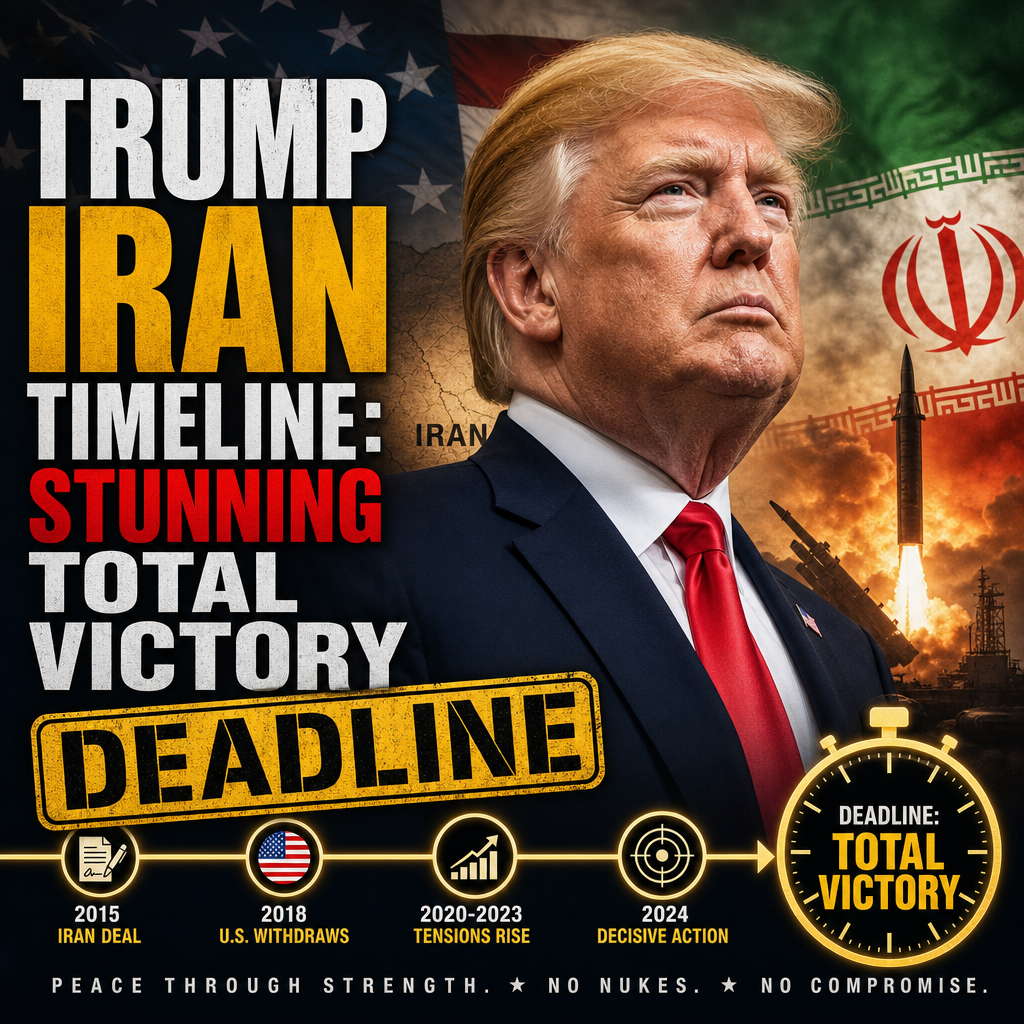
Trump Iran Timeline: Stunning Total Victory Deadline


Trump Iran Timeline is the latest example of how quickly Washington’s posture toward Tehran can shift from warning to negotiation to open threat, and the current debate over a “deadline” for a breakthrough shows just how uncertain the path forward remains.
At the center of the story is a familiar but volatile dynamic: President Donald Trump’s preference for dramatic pressure, Iran’s long-standing resistance to being seen as capitulating, and the wider Middle East’s fear that miscalculation could turn a political standoff into a military one. Different outlets frame the moment differently, but there is broad agreement on one point: the stakes are high, and the window for diplomacy looks narrower than ever.



Trump Iran Timeline: Pressure, deadlines, and uncertainty
Trump’s approach to Iran has always relied heavily on leverage. In practice, that has meant sanctions, public ultimatums, and the suggestion that “total victory” is possible if the other side folds before the clock runs out. Supporters of this style argue that hard deadlines force action and prevent endless bargaining. Critics say they often produce the opposite: a cycle of escalation that makes compromise politically harder.
That tension is reflected in how the story is covered. Russian state media tends to emphasize the idea that Washington is bullying Tehran into submission, often presenting U.S. policy as reckless or self-defeating. By contrast, Gulf and Western reporting more often frames the issue as a test of whether Iran will take concrete steps to ease concerns over its nuclear program and regional activities. Al Jazeera’s broader regional coverage usually adds another layer: the impact on civilians, neighboring states, and the fragile diplomacy already under strain from wars and proxy conflicts.




The current timeline matters because deadlines can shape behavior even when they are not formally binding. If Trump or his advisers suggest that a certain date marks the end of patience, that can affect:
– market expectations, including oil prices
– military posturing in the Gulf
– domestic politics in both Washington and Tehran
– the tone of any back-channel negotiations
Even if no one says the word “ultimatum” outright, that is often how such moments are read on the ground.
What the main outlets agree on
Despite different editorial lenses, the sources converge on several points.
First, Iran remains under intense pressure. Whether the pressure comes through sanctions, diplomatic isolation, or threats of further action, the message is that the U.S. wants visible concessions.
Second, the timeline is politically useful. Trump has long favored the optics of decisive action, and deadlines fit that style. They create a sense of urgency and keep the story in constant motion.
Third, there is no guarantee that pressure will produce the intended result. That is the biggest uncertainty. Iran has a record of absorbing pain while avoiding a full break with the international system. Sometimes it retaliates directly; sometimes it waits, and sometimes it uses ambiguity as leverage.
That mix makes any claim of “stunning total victory” sound more like a political slogan than a settled outcome. In reality, victory in this context could mean several different things: a tougher deal, a temporary pause in escalation, or simply forcing Iran into a narrower set of choices.
Why the deadline strategy can backfire
Deadlines can be powerful, but they can also corner both sides. If Trump sets a line in the sand, then backing away may look weak. If Iran gives only partial concessions, Washington may declare failure. And if neither side wants to be the one seen blinking first, the result can be stalemate with a higher risk of confrontation.
This is why analysts often caution against reading every dramatic statement literally. In high-stakes diplomacy, public threats are sometimes designed to influence bargaining behind the scenes. The risk is that the public messaging itself becomes so aggressive that it leaves little room for face-saving compromise.
The regional picture is bigger than Washington and Tehran
One reason this dispute draws so much attention is that it does not stay bilateral for long. Iran’s relationships with allied militias, regional rivals, and global powers mean that any change in U.S. policy can ripple outward quickly. Sky News and other international outlets tend to highlight the knock-on effects: shipping routes, energy security, and the possibility of broader instability if rhetoric turns into action.
For Middle Eastern states, the concern is often not whether Trump sounds strong, but whether the situation becomes less predictable. Some governments prefer a tougher U.S. line on Iran, hoping it curbs Tehran’s influence. Others fear that pressure without a clear diplomatic off-ramp could trigger retaliation across the region.
That is why the “deadline” framing matters so much. It suggests a moment of decision, but the real world rarely offers clean endings. More often, it produces a messy sequence of moves and counter-moves.
A fair reading of the current moment
The most balanced conclusion is that Trump’s Iran strategy still depends on an unresolved contradiction. It seeks a dramatic win, but the path to such a win likely requires the kind of patient negotiation that headline-driven politics often undermines.
If the deadline is real, then the next phase could bring one of three outcomes:
– a renewed diplomatic push
– a symbolic Iranian gesture that allows both sides to claim progress
– a sharper confrontation if neither side wants to yield
What seems less likely is a neat, total victory in the way political rhetoric sometimes implies. Iran is too entrenched, the regional stakes are too high, and the history of failed pressure campaigns is too long.
So while the Trump Iran Timeline may be built around a decisive deadline, the deeper story is one of uncertainty. The strongest evidence from the reporting is not that a final solution is near, but that both sides are still trying to shape the terms of the next move.