Iranians Struggle: Stunning, Best Survival Amid War


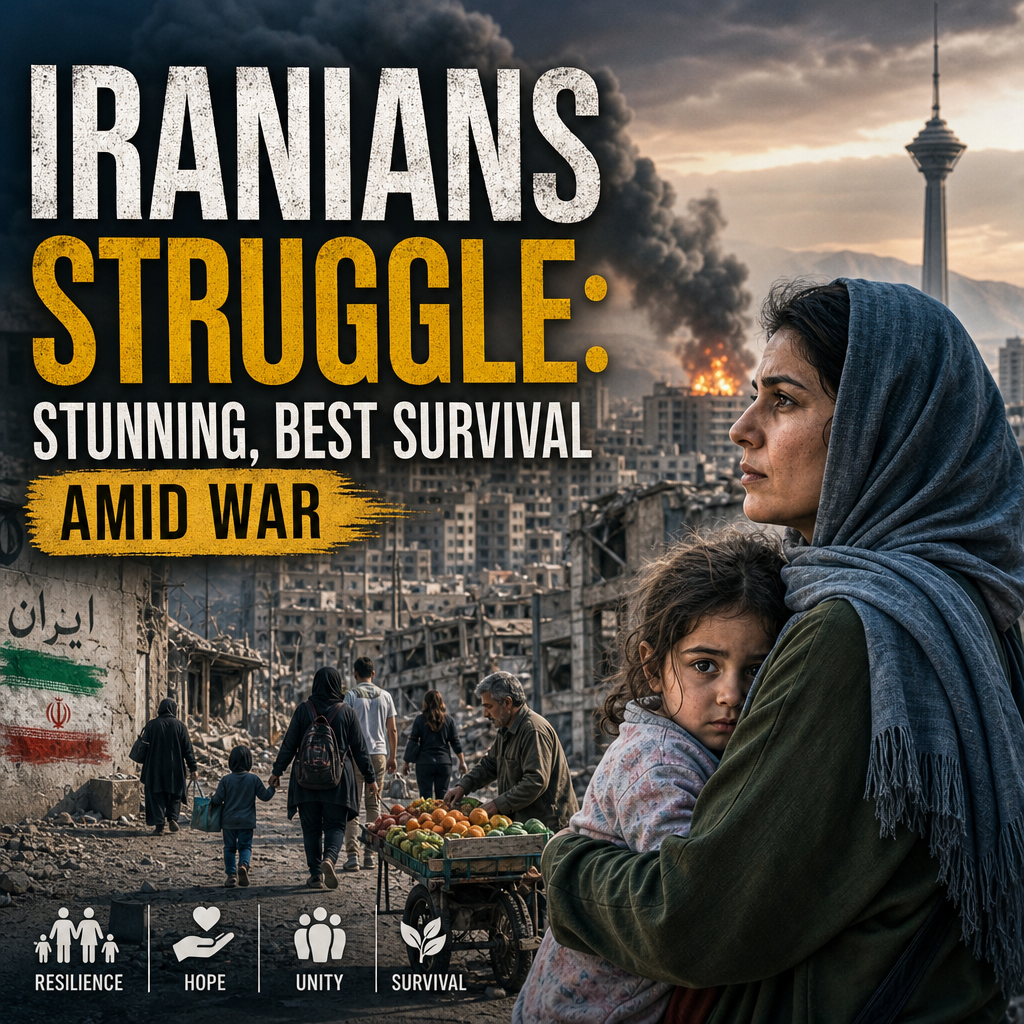
Iranians Struggle to make ordinary life work as conflict, sanctions, inflation, and political pressure converge, and the result is a daily reality that is far more complicated than headlines about missiles, diplomacy, or military escalation can capture.
Across reporting from international outlets, one theme is consistent: the people most exposed to the shock of war are rarely the decision-makers. Families, workers, students, and small business owners absorb the consequences first. In the middle of regional violence and domestic strain, even basic routines can become unstable — getting paid, buying food, arranging transport, finding medicine, or simply planning for next week.



Iranians Struggle as war reaches everyday life
The clearest picture emerging from the coverage is not of a single crisis, but of several overlapping ones. War raises fear and uncertainty. Sanctions and weakened trade squeeze the economy. Domestic governance problems deepen public frustration. Together, they create an atmosphere in which “normal” life becomes a privilege rather than an expectation.
Reporting from Al Jazeera highlights how hard it has become for many Iranians to get by amid external conflict and internal pressures. The emphasis is not only on military developments but also on the human cost: inflation, shortages, and the strain of living with constant uncertainty. That perspective is important because it reminds readers that wartime suffering often looks less like battlefield destruction and more like a slow erosion of stability.




Sky News’ international reporting tends to frame the crisis through security and diplomacy, focusing on the broader regional implications and the risk of escalation. From that angle, Iran is not just a country under pressure; it is also a pivotal actor in a wider confrontation involving the United States, neighboring states, and armed groups across the region. This view helps explain why the situation remains so volatile, but it can also leave less room for the economic and social reality inside Iran.
RT, by contrast, often approaches such conflicts with an emphasis on geopolitical rivalry and the effects of Western policy. In that framing, sanctions, military threats, and foreign intervention are presented as central drivers of Iranian hardship. Even when one does not agree with every part of that interpretation, it reinforces a legitimate point: external pressure can worsen conditions for civilians and narrow the space for recovery.
Taken together, these viewpoints suggest a balanced conclusion: Iran’s hardship is not caused by one factor alone. External conflict and internal mismanagement reinforce each other, and ordinary people are left navigating the fallout from both.
What daily survival looks like now
For many households, survival is less about dramatic crisis moments and more about constant adjustment. That can mean:
– cutting back on food or household essentials
– delaying medical care because costs are too high
– depending on informal work or unstable income
– losing savings to inflation and currency weakness
– coping with anxiety about escalation, displacement, or further disruption
These conditions do not affect everyone equally. Urban middle-class families, low-income households, rural communities, and young people all experience the pressure differently. But the common thread is fragility. When prices rise quickly and confidence in the future falls, even small setbacks can become major problems.
It is also worth noting that public endurance should not be mistaken for public contentment. In many societies under strain, people develop coping strategies: informal networks, shared resources, side jobs, or reduced expectations. That resilience is real and deserves recognition. But resilience has limits. It should not be romanticized as proof that suffering is sustainable.
The political and moral cost of prolonged pressure
One of the hardest questions in this story is whether outside pressure is helping ordinary Iranians or hurting them more than it helps. Supporters of sanctions and military deterrence argue that pressure is necessary to limit dangerous behavior by the state. Critics argue that such measures often fail to change leadership calculations while deepening hardship for civilians.
The available reporting suggests there is no simple answer. Security concerns are real, and regional tensions are not imaginary. At the same time, the burden of conflict rarely falls evenly. When food prices rise, jobs vanish, or medical supplies become harder to obtain, it is civilians — not strategists — who pay first.
There is also a political cost inside the country. Prolonged external pressure can strengthen hardline narratives, reduce room for reform, and make compromise look politically dangerous. That does not absolve domestic authorities of responsibility. In fact, it makes governance even more important. When a state is under pressure, competent economic management and social trust matter more, not less.
A situation without clean winners
The most honest reading of the coverage is that there are few clean victories here. Military escalation may satisfy hardliners temporarily, but it usually deepens insecurity. Sanctions may signal resolve, but they also spread pain. Domestic repression may preserve control in the short term, but it erodes legitimacy over time. Meanwhile, the public is left trying to survive in a system that keeps asking them to absorb shocks they did not create.
That is why the phrase “Iranians Struggle” captures more than hardship; it captures endurance under uncertainty. Many people are not choosing between comfort and discomfort, but between adaptation and further decline. Their response is often quiet, pragmatic, and exhausted.
The most responsible conclusion, then, is not that one side’s narrative fully explains the crisis. It is that Iran’s current suffering reflects a convergence of war, diplomacy, sanctions, and domestic dysfunction. Any serious attempt to understand the country’s future has to begin with the people living through that convergence — and with the uncomfortable fact that for them, survival itself has become a daily act of negotiation.