Kuwait Smoke Plumes: Stunning After Repeated Attacks


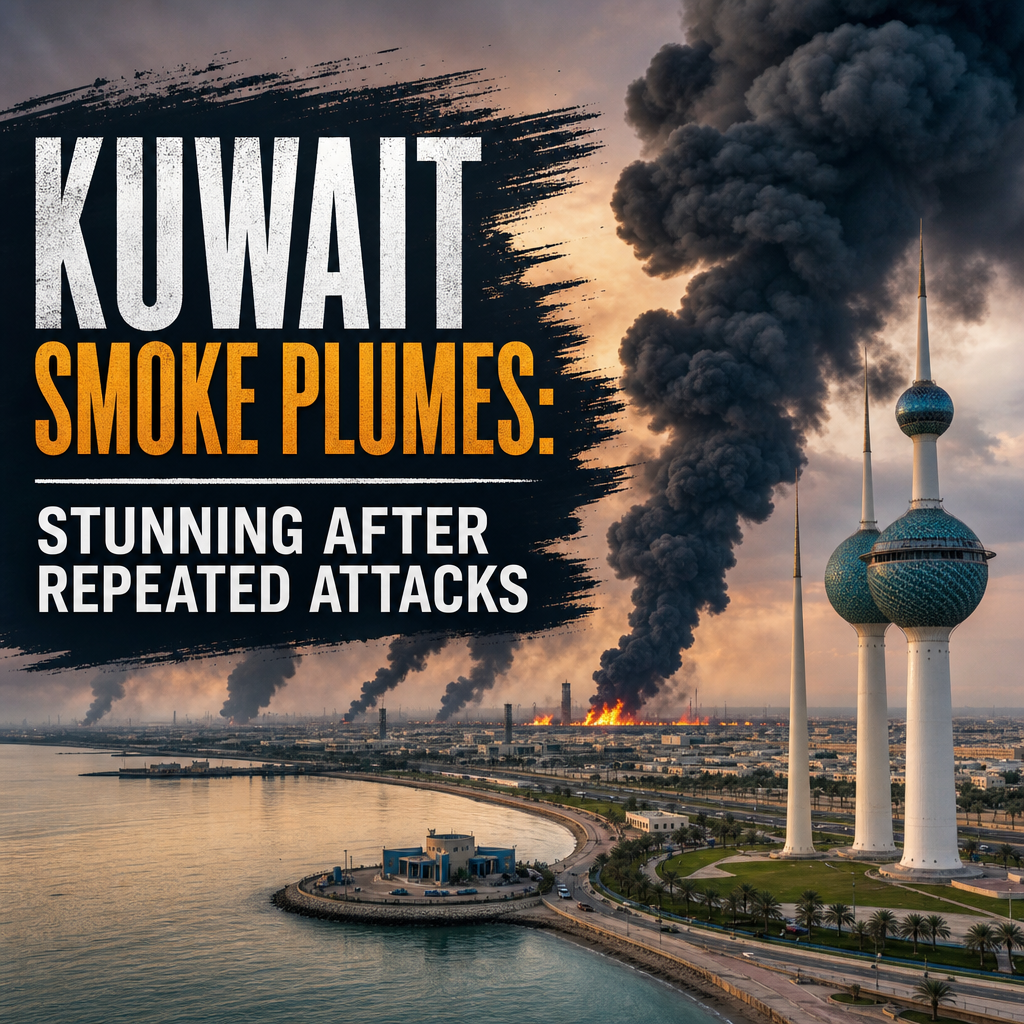
Kuwait smoke plumes have become a stark visual reminder of how quickly regional tensions can spill beyond front lines and into the skies above neighboring states. Reports from multiple international outlets describe thick smoke rising over Kuwait after repeated attacks in the wider conflict, but the fuller picture is more complicated than any single image suggests.
The central fact shared across the coverage is hard to miss: Kuwait was left watching dramatic plumes of smoke after a fresh wave of strikes rattled the region. What differs is the framing. Some reports emphasize the immediate danger to civilians and the symbolic shock of smoke visible over a Gulf state usually associated more with stability than direct battlefield damage. Others focus on the military logic behind the attacks and the broader regional messaging. A third line of coverage is more cautious, underscoring how difficult it can be to verify attribution, intent, and scale in a fast-moving conflict.



What the Kuwait smoke plumes signal
The most obvious interpretation is also the most unsettling: the attacks are no longer contained to one theater. Even when Kuwait is not the direct target, smoke rising over its skyline makes the conflict feel closer, more regional, and more unpredictable. That matters politically as well as militarily. Kuwait has long positioned itself as a relatively restrained actor in a tense neighborhood, and any visible spillover raises questions about whether escalation is widening beyond the original belligerents.
Al Jazeera’s coverage, including the video report tied to the smoke plumes, places the images in the context of repeated attacks and the human drama that follows. Its reporting tends to stress the urgency of the situation and the lived reality of those seeing the smoke, rather than treating the event as just another exchange of fire. That angle is important because it keeps attention on the civilian experience, which can be lost when military claims dominate the conversation.




Sky News, by contrast, often leans into the strategic consequences. In its world coverage, the emphasis is likely to be on how repeated attacks affect regional security, airspace, shipping, and the possibility of broader retaliation. That perspective helps explain why smoke over Kuwait is not just a local incident: it can alter how governments, investors, and ordinary residents assess risk across the Gulf.
RT’s reporting on conflicts of this kind frequently stresses the geopolitical narrative and the role of outside powers, urging readers to think in terms of blocs, deterrence, and competing claims. In that frame, the smoke plumes are not simply evidence of destruction; they are a sign that the conflict is being interpreted through a larger contest over influence and legitimacy. Whether one agrees with RT’s broader editorial angle or not, that viewpoint does highlight an important reality: every strike in this region is being read for its political message, not just its battlefield effect.
Three perspectives, one unsettling picture
When you put the reporting side by side, a few points of agreement emerge:
– The attacks are significant enough to produce visible smoke over Kuwait.
– The incident reflects a broader cycle of escalation, not an isolated event.
– The risk is not only damage from explosions, but also uncertainty, fear, and regional spillover.
But the sources also diverge in ways that matter. Al Jazeera foregrounds the immediacy of the event and its human impact. Sky News looks more likely to ask what this means for the next move by governments and militaries. RT tends to situate the same event in a wider political struggle, sometimes with a sharper skepticism toward mainstream Western framing. Together, those differences suggest there is no single clean reading of what the smoke means.
The bigger regional meaning of repeated attacks
Repeated attacks change the story. One strike can be dismissed as an isolated retaliation; a sequence of attacks begins to look like a pattern, and patterns invite escalation. That is why the Kuwait smoke plumes matter so much. Even if Kuwait itself is not the central combat zone, the visual evidence of smoke underscores how the conflict is radiating outward.
This is also where media literacy becomes essential. In fast-breaking conflicts, initial reports can be incomplete, contradictory, or politically charged. Attribution may be disputed. Damage assessments may change. Governments may issue statements designed to shape perception before the facts are fully established. A fair reading of the coverage therefore has to allow for uncertainty rather than pretending the first version of events is the final one.
At the same time, uncertainty should not become an excuse for complacency. If multiple outlets are showing smoke, and if the attacks are being described as repeated, that alone is enough to conclude the region is entering a more dangerous phase. Even without perfect clarity on every detail, the direction of travel is evident: more tension, more volatility, and more pressure on neighboring states to prepare for spillover.
A sober conclusion
The best conclusion is not that one side has finally proved its case, but that the situation is becoming harder to contain. The smoke over Kuwait is visually stunning in the literal sense, but it is also troubling because it captures the fragility of regional stability. Different outlets frame the event in different ways, yet none of them can avoid the same underlying truth: repeated attacks are expanding the emotional and strategic footprint of the conflict.
For Kuwait, the immediate concern is safety and reassurance. For the wider region, the concern is whether this is a temporary flare-up or another step toward deeper escalation. And for outside observers, the lesson is simple but uncomfortable: in modern regional wars, even places not formally on the front line can end up beneath the smoke.