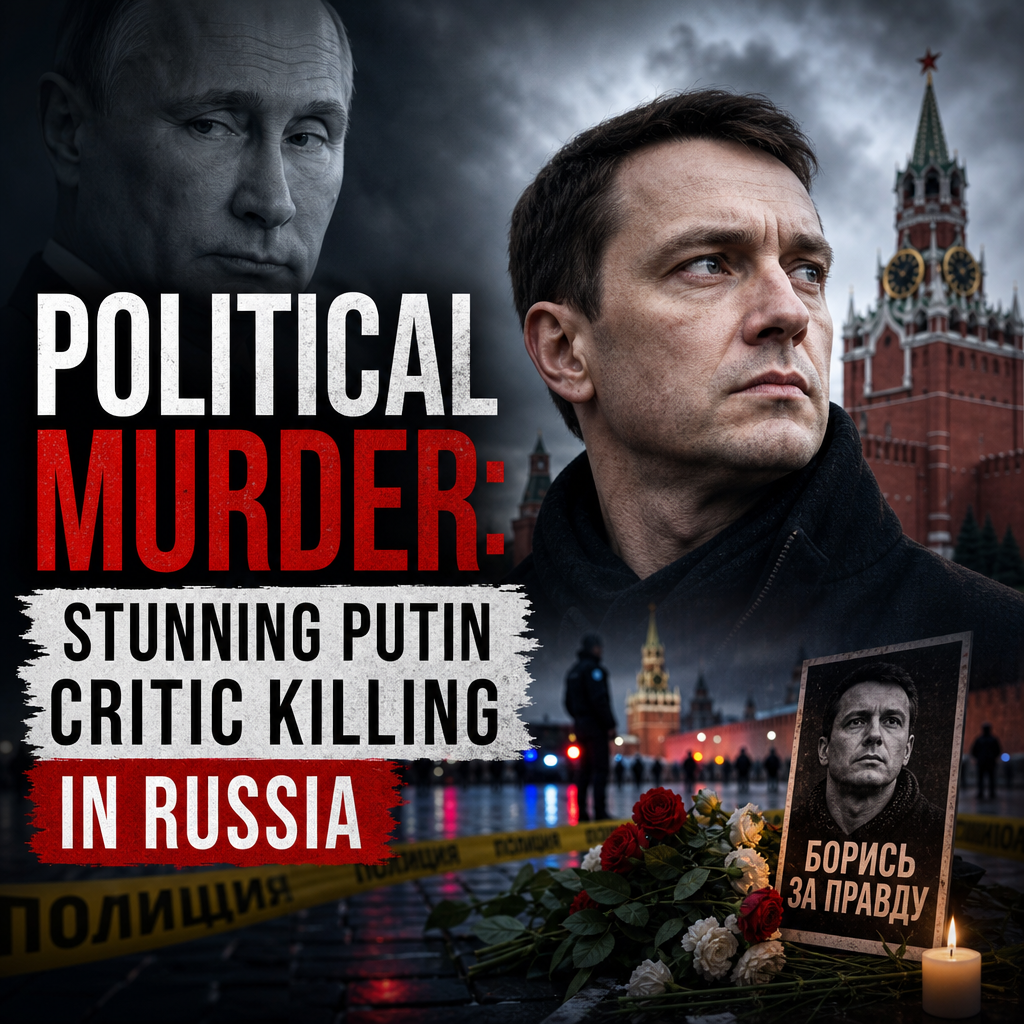
Political Murder: Stunning Putin Critic Killing in Russia


Political murder allegations have once again put Russia’s treatment of dissent under the microscope after the killing of a well-known Russian artist and outspoken critic of Vladimir Putin triggered an international backlash. The case is still developing, but the language surrounding it has been unusually severe: Poland’s prime minister described the death as bearing the “hallmarks of political murder,” while other reports have focused on the wider climate of intimidation in Russia and the difficulty of separating fact, motive, and propaganda in a deeply polarized information war.
Political murder accusations and the wider political climate
What makes this killing so explosive is not only the identity of the victim, but also the timing and setting. In the months since Russia’s full-scale war in Ukraine began, critics of the Kremlin have faced a shrinking space for dissent, with arrests, censorship, exile, and unexplained deaths feeding the sense that public opposition has become increasingly dangerous.



From the perspective of Polish officials and many Western commentators, the symbolism is hard to ignore. A prominent anti-Kremlin figure dying violently in Russia naturally raises suspicions of a targeted act, especially in a political environment where independent voices have repeatedly reported harassment or worse. The Polish prime minister’s statement reflects that broader fear: that the line between state power, political intimidation, and outright murder has become dangerously blurred.
At the same time, caution matters. Allegations of political violence can be justified, but they can also outrun confirmed evidence. Until investigators release clear findings, the exact motive remains uncertain. That uncertainty is important, because in high-profile cases like this, public narratives often harden before the facts do.




What the competing narratives are saying
Different media ecosystems are already framing the killing in sharply different ways:
– Western-aligned coverage tends to emphasize the pattern of repression around Putin’s Russia, placing the death in a broader context of silencing critics.
– Russian state-aligned outlets and commentators are more likely to question the political framing, suggesting that premature conclusions serve geopolitical interests.
– Regional voices, including Poland’s leadership, see the killing as part of a wider threat to security and democratic opposition in Europe, especially given the war in Ukraine and Russia’s hostility toward critics abroad.
That contrast is not surprising. In an information environment shaped by war, sanctions, espionage concerns, and diplomatic distrust, every major incident becomes a test of credibility. The facts matter, but so does the audience’s preexisting trust in the messenger.
Why the killing resonates far beyond one case
The killing matters because it taps into a deeper fear: that opposition to Putin can carry lethal consequences, whether through direct targeting, coercion, or a climate that discourages dissent without needing explicit orders. Over the years, Russia has seen a troubling list of journalists, activists, defectors, and opposition figures harmed under suspicious circumstances. Some cases have been solved only partially; others remain contested for years.
That history does not prove that every violent death is politically ordered. But it does explain why so many observers react quickly when another Kremlin critic is killed. The burden of proof is high, yet the baseline level of suspicion is also high, because previous cases have taught critics to expect opacity.
The problem of evidence in politically charged deaths
A fair assessment requires separating three questions:
1. Was the death violent and suspicious?
Reports suggest yes, and that alone justifies serious scrutiny.
2. Was the victim politically targeted?
That is possible, but it requires evidence: motive, perpetrators, and links to power structures.
3. Does the case reflect a broader pattern of repression?
On this point, many independent observers would say there is strong reason for concern, even if the specific facts of this death are not yet settled.
This distinction is essential. It is easy to leap from “suspicious death” to “state assassination.” Sometimes that leap is correct. Sometimes it is not. Responsible reporting should hold both realities at once: the political atmosphere is undeniably hostile, but conclusions about the specific crime should wait for verification.
Political murder, propaganda, and the struggle over meaning
The reaction from RT and other Russian-aligned voices is likely to emphasize skepticism toward Western interpretations, perhaps portraying them as opportunistic or politically motivated. That response is predictable, but it does not automatically invalidate all doubts about the political framing. In fact, the existence of competing narratives is itself a clue to how high the stakes are.
Sky’s reporting, along with broader international coverage, has helped place the killing in a wider European security context. Al Jazeera’s broader reporting on Russia and the region often highlights the human and political costs of conflict while also emphasizing the difficulty of establishing certainty in a heavily managed media space. Taken together, these perspectives suggest a sober conclusion: even if investigators ultimately identify a nonpolitical trigger, the death still reflects an atmosphere in which Russian critics live under extraordinary pressure.
What is most disturbing is not only the possibility of political murder, but the normalization of such suspicion. When a violent death is immediately seen through a political lens, that tells us something profound about the state of public trust. It signals that many people no longer expect transparent justice, whether in Russia or in the international system surrounding it.
In the end, the strongest fair-minded view is this: the killing deserves urgent, independent investigation, and the political context makes the allegations credible enough to treat seriously. But credibility is not the same as proof. Until the facts are established, the most responsible response is to recognize both the pattern of repression that fuels suspicion and the need to avoid turning uncertainty into certainty too soon.