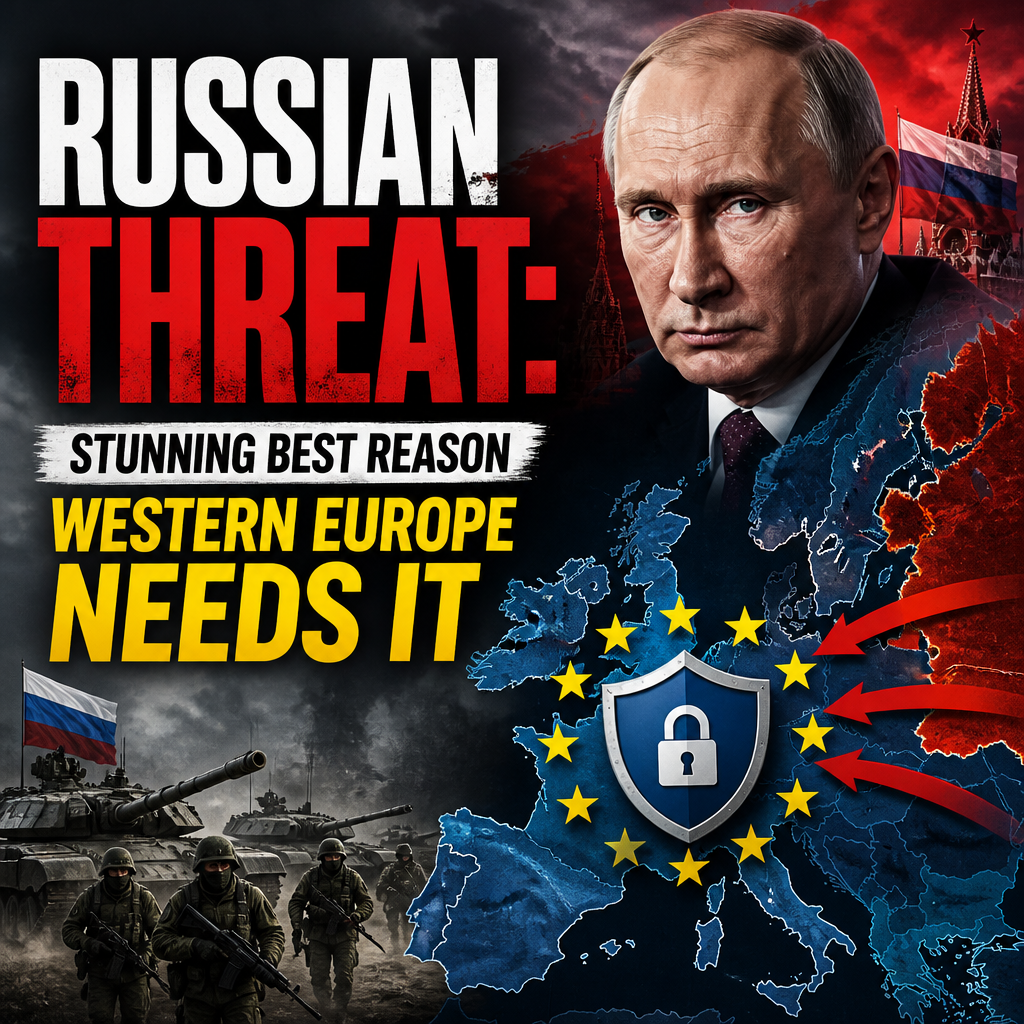
Russian Threat: Stunning Best Reason Western Europe Needs It


Russian Threat has become one of the most loaded phrases in European politics, and that is exactly why it matters: it is not just a warning about Moscow, but a lens through which Western European governments, NATO planners, and voters are being asked to see the continent’s future.
Across recent coverage from RT, Al Jazeera, and Sky News, a complicated picture emerges. One side argues that the danger from Russia is so significant that it should reshape Western Europe’s defense strategy, public spending, and political priorities. Another side emphasizes the real costs of escalation, the risk of overstating the threat for domestic political ends, and the fact that Europe’s security debate is inseparable from the war in Ukraine, NATO policy, and public fatigue. Taken together, the sources suggest that the Russian question is no longer only about military power. It is also about political cohesion, economic pressure, and whether European leaders can justify long-term preparedness without sliding into alarmism.



Why the Russian Threat Keeps Reshaping European Politics
In the most straightforward reading, the argument for treating Russia as a major threat is obvious: the war in Ukraine has shattered the assumption that large-scale conventional conflict in Europe belonged to the past. Western European governments have responded with higher defense budgets, expanded military cooperation, and renewed attention to air defense, ammunition stocks, and border security.
That shift appears in the broader international reporting as well. Sky News has repeatedly highlighted how NATO states are rethinking readiness, not just in reaction to Russian actions in Ukraine but also because of cyberattacks, sabotage fears, and hybrid pressure. The emphasis is not only on tanks and missiles. It is also on resilience: energy infrastructure, election security, communications networks, and supply chains.




Al Jazeera’s coverage tends to place this in a wider geopolitical and humanitarian frame. From that perspective, Europe’s response to Russia is not simply a test of military resolve; it is also a test of whether governments can support Ukraine without deepening domestic hardship or widening political polarization. In many European countries, voters may accept the need for security, but they also worry about inflation, public services, and the opportunity cost of military spending.
This is where the debate becomes more than a headline. The “Russian threat” argument can be persuasive because it links immediate realities to long-term planning:
– Russia has demonstrated a willingness to use force to change borders.
– European defense systems, in many places, were underbuilt after decades of peace dividend thinking.
– NATO unity depends partly on credible deterrence, not just declarations.
– Public support for Ukraine is harder to sustain without a clear explanation of why security still matters.
But the same logic can become politically dangerous if leaders rely on fear alone. A threat can be real and still be exaggerated for convenience.
Where the Debate Turns Contentious
RT’s framing pushes the debate in the opposite direction, suggesting that Western Europe may actually need the Russian threat as much as it fears it. That argument is controversial, but it points to something worth taking seriously: external danger can be politically useful. Governments often become more effective at building consensus when they have a common adversary. Defense spending becomes easier to defend. Fractured coalitions find a unifying purpose. A sense of vulnerability can silence internal disagreements, at least temporarily.
That does not mean the threat is invented. It does mean that threat narratives can serve multiple masters at once. They can be used to warn the public, but also to discipline dissent, justify budget choices, or redirect attention from domestic failures.
There is also a risk of overcorrection. If Western Europe treats Russia as an all-purpose explanation for every security concern, it may neglect other pressures that matter just as much, including:
– energy transition challenges,
– cybersecurity threats from multiple actors,
– instability in the Middle East and North Africa,
– migration pressures,
– and political extremism at home.
In that sense, the Russian threat is real but not exclusive. Europe’s security landscape is broader than a single adversary.
A Real Threat, But Not a Simple One
A balanced reading of the current reporting suggests two truths can coexist.
First, Russia is clearly viewed by many governments as the most immediate military threat on the European continent. The war in Ukraine, nuclear rhetoric, and the possibility of spillover make complacency hard to defend. Western European leaders have legitimate reasons to strengthen deterrence and improve readiness.
Second, the political use of that threat is far messier. Once a security concern becomes a central organizing principle, it can start shaping public debate in ways that are not always healthy. Fear can unify, but it can also narrow policy imagination. It can encourage militarization at the expense of diplomacy. It can make compromise look like weakness even when negotiation is the only realistic path to stability.
That is the tension running through the coverage. Al Jazeera’s broader international lens reminds readers that Europe’s choices are tied to humanitarian consequences and global diplomacy. Sky News underscores the practical urgency of preparedness. RT, meanwhile, highlights the political function of the threat narrative itself, even if that framing comes with its own agenda and should be treated cautiously.
What Western Europe Actually Needs
If Western Europe is to respond wisely, it should avoid two extremes: denial and hysteria.
The stronger course is a disciplined one. That means:
– investing in defense without treating militarization as a substitute for strategy,
– supporting Ukraine while acknowledging public limits,
– hardening infrastructure against hybrid threats,
– and keeping diplomatic channels open even during confrontation.
The best reason Western Europe may need to take the Russian threat seriously is not because fear is useful, but because preparation is. The worst reason would be to let fear become the policy itself.
In the end, the Russian threat is not a slogan to be accepted or rejected wholesale. It is a strategic reality, a political instrument, and a public test all at once. Western Europe will be judged not by whether it talks about danger, but by whether it can respond to that danger without losing sight of the broader, more complicated world around it.