
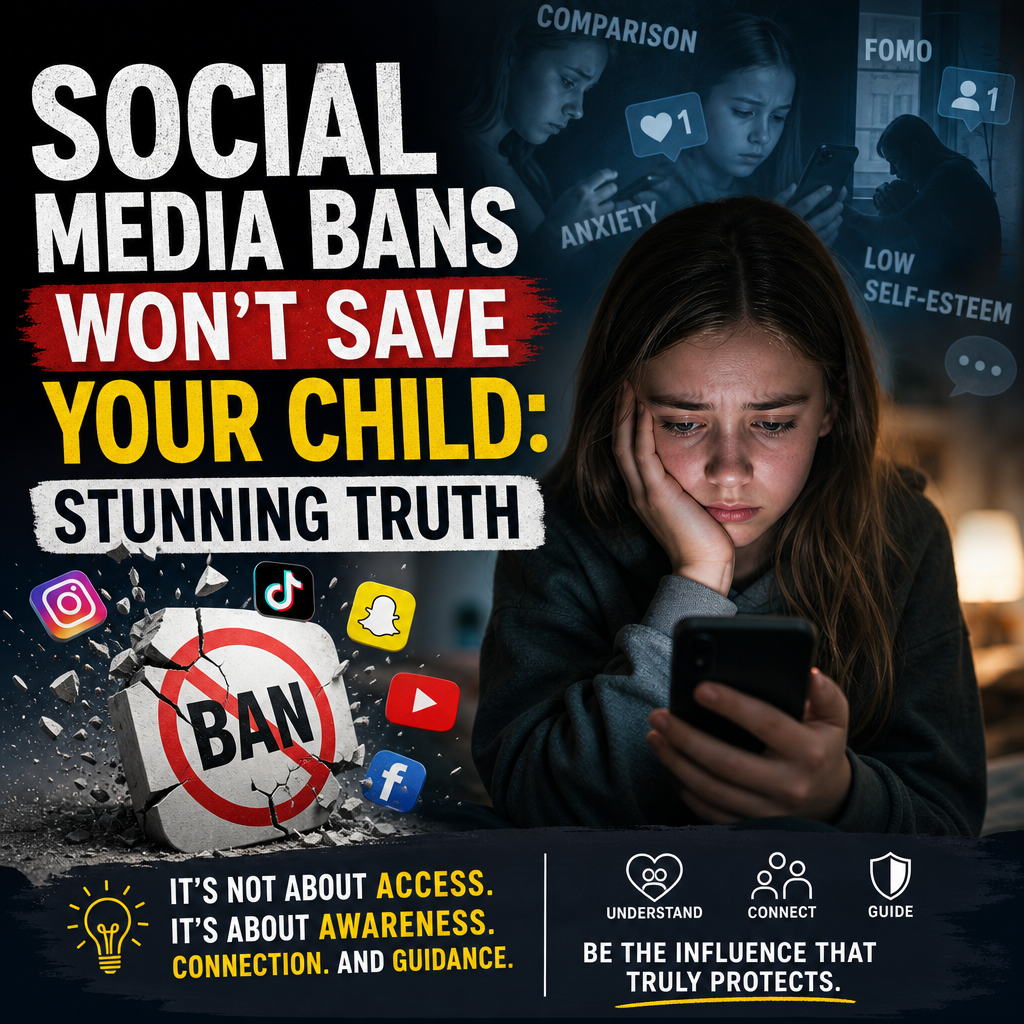
Social Media Bans Won’t Save Your Child: Stunning Truth


Social media bans won’t save your child if the rest of the digital world remains unchanged, and that is the uncomfortable reality many parents and policymakers are beginning to face.
Across recent reporting from RT, Al Jazeera, and Sky News, a common thread emerges: restricting access may reduce one risk, but it does not address the larger ecosystem shaping children’s online lives. The debate is no longer just about whether children should be on social platforms. It is about what happens when platforms, schools, parents, regulators, and tech companies each assume someone else will solve the problem.



Social media bans won’t save your child from the broader online environment
The argument for bans is easy to understand. Social platforms can expose children to cyberbullying, inappropriate content, predatory behavior, and relentless comparison culture. For many families, that makes the simplest solution look like the strongest one: keep children off the apps entirely.
But coverage across the news spectrum suggests that a ban can be a blunt instrument. RT’s framing leans toward skepticism of digital-fix solutions, emphasizing that simply blocking platforms does little if children can still access harmful material through other corners of the internet, messaging apps, or workarounds. That point matters. The internet is not a single doorway. It is a network of entrances, and children who are determined to get in often find a way.




Al Jazeera’s reporting around youth, mental health, and online regulation tends to highlight a more structural concern: harmful digital experiences are rarely caused by one app alone. They are tied to design features like endless scrolling, algorithmic recommendation, and the social pressure to stay constantly connected. In that light, a ban treats the symptom rather than the architecture.
Sky News, meanwhile, often captures the policy tension faced by governments trying to respond to parental anxiety without overpromising results. Age limits and restrictions can be politically popular because they signal action. Yet the question remains whether they produce meaningful protection or simply push children toward less visible, less supervised digital spaces.
The real issue is not access alone, but exposure, habits, and vulnerability
A child’s online safety is shaped by much more than account creation. Age, maturity, emotional resilience, peer pressure, family support, and the quality of digital education all play a role.
Here are the main weaknesses of a ban-only approach:
– Children can bypass restrictions with borrowed devices, false birth dates, or messaging apps.
– Risk moves, it doesn’t disappear, shifting to lesser-known platforms or private chats.
– Total bans can reduce trust if children feel parents are only policing rather than guiding.
– Digital literacy may remain underdeveloped, leaving children less prepared when they inevitably go online.
The strongest criticism from child safety advocates is not that bans are useless, but that they are incomplete. If a child has no structured education about online behavior, privacy, manipulation, and emotional regulation, they may be vulnerable the moment access returns.
That is one reason many experts favor a layered response. Instead of asking whether children should be “allowed” online, they ask how to make online life safer and more age-appropriate. That means privacy settings, app design limits, transparent algorithms, better age verification, and real consequences for companies that fail to protect minors.
What responsible protection looks like
If the goal is to reduce harm, the evidence points toward a combined strategy rather than a single prohibition. The most effective approach is likely to blend oversight with preparation.
A practical framework would include:
1. Clear age-appropriate rules
Younger children should have tighter limits, but the rules need to be realistic and consistently enforced. A vague “no phones ever” rule often collapses under peer pressure and convenience.
2. Active parental involvement
Monitoring is not the same as surveillance. Parents who talk regularly about online behavior, privacy, scams, bullying, and body-image pressure tend to build more durable protection than those who rely on punishment alone.
3. Better platform accountability
If apps are designed to maximize time spent and emotional engagement, families are fighting an uphill battle. Stronger safety defaults, more transparent moderation, and better reporting tools are essential.
4. Digital resilience education
Children need to learn how to recognize manipulation, misleading content, and unhealthy comparison. That lesson is as important as any ban.
5. Support for mental health
For some children, the issue is not merely screen time. Social media can intensify loneliness, anxiety, or low self-esteem. In those cases, the answer is support, not just restriction.
A ban may help some families, but it is not a cure
The fairest conclusion from the available reporting is that bans can be useful, but only as part of a broader strategy. For some households, limiting social media access may be the right short-term choice. For younger children especially, fewer accounts and more supervision can meaningfully lower exposure to harm.
Still, the larger truth is hard to escape: children do not live inside a single app. They live in a connected world where influence travels through games, group chats, video platforms, and peer networks. A ban may reduce risk, but it cannot build judgment, confidence, or resilience on its own.
That is the stunning truth at the center of this debate. Protecting children online is less about drawing a digital line in the sand and more about building the skills, rules, and systems that help them navigate what comes next. Without that, a ban is only a beginning.