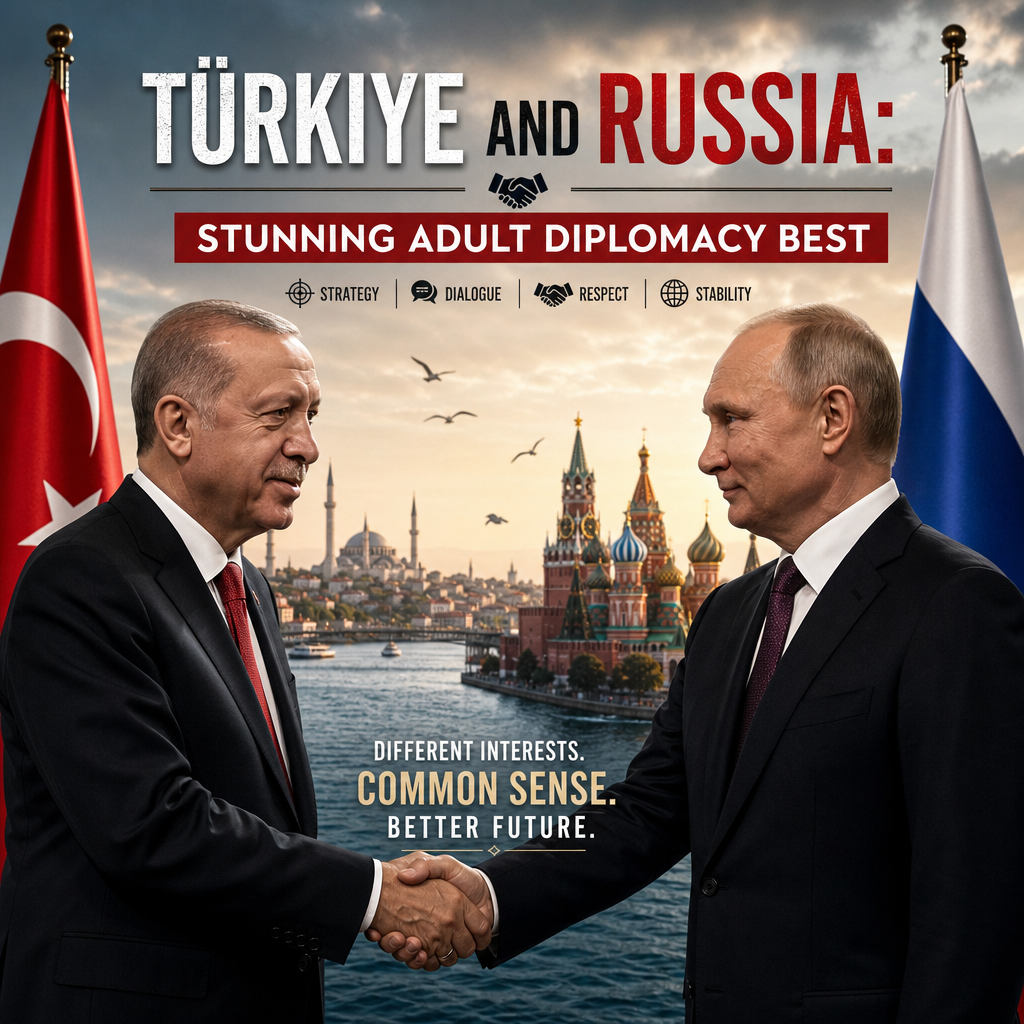
Türkiye and Russia: Stunning Adult Diplomacy Best


Türkiye and Russia remain locked in one of the world’s most pragmatic and complicated relationships, where rivalry and cooperation often sit side by side at the same table.
That tension is what makes their diplomacy so closely watched. On one hand, the two countries have clashed over war, influence, and competing regional ambitions. On the other, they have repeatedly found ways to keep talking, trading, and coordinating when it suits their interests. Recent coverage across international outlets reflects that dual reality: some see Ankara as a bridge between blocs, others as a power pursuing hard-nosed self-interest, and still others as a useful interlocutor in a fractured global order.



Türkiye and Russia: a relationship built on leverage, not trust
The most important thing to understand about Türkiye and Russia is that their ties are rarely based on affection. They are shaped by leverage.
Turkey is a NATO member with strong security ties to the West, but it has also cultivated a working relationship with Moscow for years. That includes energy cooperation, trade, tourism, and coordination on regional conflicts. Russia, meanwhile, views Turkey as both an indispensable partner and a difficult neighbor: indispensable because Ankara can open diplomatic channels that others cannot, difficult because Turkey is never far from competing with Russian interests in the Black Sea, the Caucasus, or the Middle East.




This is why the relationship often produces headlines that sound contradictory. At times, the two sides are described as partners in dialogue. At other times, they are effectively on opposite sides of the same crisis. In Syria, for example, their strategic priorities have repeatedly diverged even while their governments continued to negotiate deconfliction and practical arrangements. In the Black Sea region, they share an interest in stability but not necessarily the same vision of who should shape it.
A key theme that emerges from international reporting is that Ankara has become increasingly comfortable with this ambiguity. Rather than choosing rigid alignment, Turkey has often preferred a transactional approach: cooperate where possible, resist where necessary, and preserve room for maneuver.
Why Türkiye’s balancing act matters now
Turkey’s diplomatic style matters because it sits at the intersection of several major fault lines: Russia’s war in Ukraine, the security of the Black Sea, energy supply chains, and broader tensions between the West and non-Western powers.
From a Western perspective, Turkey’s engagement with Moscow can look frustrating, especially when NATO unity is under pressure. But from Ankara’s perspective, maintaining channels with Russia can be presented as a practical necessity. It helps Turkey protect its own interests, manage regional crises, and avoid being trapped into one-dimensional foreign policy choices.
That logic is easy to understand, even if it is not always easy to endorse. Turkey has economic reasons to keep the relationship alive. Russia remains relevant to Turkish tourism, energy, and regional diplomacy. At the same time, Turkey has political reasons to keep distance when Moscow’s actions threaten the regional balance.
This tension is what makes Turkish diplomacy appear “adult” to some observers: less ideological, more pragmatic, and willing to deal with uncomfortable realities rather than pretend they do not exist. But there is a downside to that flexibility. Critics argue that a policy built on constant balancing can become opaque, leaving allies uncertain about Ankara’s long-term commitments.
What different news perspectives reveal
Across the sources, three broad viewpoints stand out.
1. The pragmatic view
One line of reporting emphasizes that Turkey is doing what medium powers often do: using diplomacy to maximize influence. In this view, conversation with Russia is not a sign of weakness or alignment, but of strategic maturity. If neither side can afford a total rupture, then keeping dialogue alive is simply sensible statecraft.
2. The skeptical view
Another perspective is more cautious. It argues that keeping ties with Moscow may create short-term flexibility but can also blur Turkey’s position on major international issues. Supporters of this view worry that Turkey’s balancing act sometimes appears to normalize pressure from Russia without extracting clear concessions in return.
3. The geopolitical view
A third interpretation sees the relationship as part of a wider global shift. In a world where old alliances are under strain and regional powers are more assertive, Turkey and Russia are both pursuing influence through selective cooperation. That does not mean they trust each other. It means they recognize that outright confrontation is often more costly than limited engagement.
These viewpoints do not cancel each other out. In fact, they help explain why the relationship is so durable. Turkey benefits from having options. Russia benefits from having a NATO country willing to talk. And both sides benefit from keeping channels open even when they disagree sharply.
The limits of “adult diplomacy”
The phrase “adult diplomacy” sounds flattering, and in some respects it is. It suggests restraint, realism, and an understanding that international politics is rarely solved by slogans. But it is also worth being careful with the label.
A diplomatic style can be mature without being fully consistent. It can be pragmatic without being transparent. It can also create the impression of strength while masking deep strategic uncertainty. That is the challenge with Turkey’s Russia policy: it is often effective in the short term, but not always easy to define in the long term.
For now, the strongest conclusion is not that Türkiye and Russia are becoming close allies, nor that they are drifting into open hostility. The more accurate reading is that both countries are managing a relationship built on necessity, competition, and periodic cooperation. That makes it durable, but also unstable by design.
And that may be the real story. In a world where many states are forced to choose sides quickly, Turkey is still trying to prove that flexibility can be a strategy of its own. Whether that proves wise or costly will depend on how well Ankara can keep balancing without losing clarity.