US Testing Ranges Mimic Ukraine Battlefield: Stunning Move


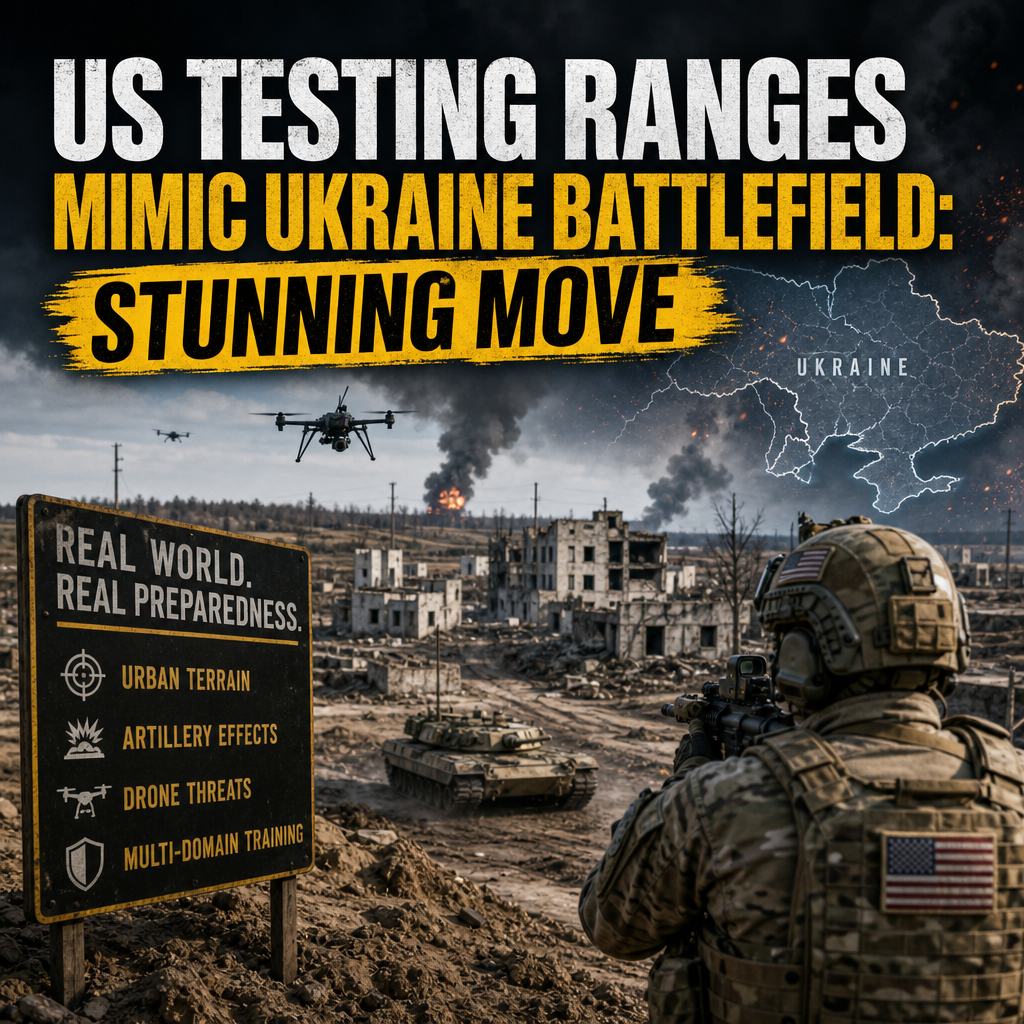
US testing ranges mimic Ukraine battlefield in a sign of how quickly modern war is reshaping American military planning. What may sound like a dramatic headline is really part of a broader effort to prepare soldiers and weapons for a conflict environment that looks very different from the battlefields the U.S. military trained for in the past two decades.
At its core, the move reflects a blunt lesson from Ukraine: the next major war may be defined less by stealthy maneuver and more by drones, electronic warfare, artillery duels, battlefield surveillance, and rapid adaptation. That is why U.S. defense planners are increasingly trying to recreate those conditions on training grounds, using mock trenches, drone threats, jammed communications, and layered defenses to make exercises more realistic.



Why US testing ranges mimic Ukraine battlefield conditions
Military analysts have been saying for months that Ukraine has become a live laboratory for modern warfare. The conflict has shown that expensive systems can be vulnerable to cheap drones, that electronic warfare can disrupt precision weapons, and that soldiers need to operate in an environment where the front line is constantly observed from above.
Supporters of the U.S. move argue this is not alarming so much as overdue.




They point out several practical benefits:
– Training realism: Soldiers need to practice under drone surveillance, intermittent communications, and artillery-like threats if they are to survive in a high-intensity conflict.
– Equipment testing: Weapons and vehicles designed for older wars may not perform well in dense electronic warfare or against swarms of inexpensive drones.
– Faster adaptation: If the U.S. can identify weaknesses in its equipment and tactics now, it can correct them before a real conflict exposes those flaws.
That perspective is consistent with broader Pentagon thinking in recent years, especially as U.S. planners have shifted attention away from counterinsurgency toward potential clashes with more capable adversaries. The logic is simple: if battlefield realities are changing, training must change too.
Yet the Ukrainian war is not just another case study. It is a brutal, ongoing conflict with enormous human cost. That makes any attempt to replicate it on a training range politically and ethically sensitive. Some observers see the U.S. move as a necessary preparation; others view it as a sobering sign that a wider great-power conflict is no longer a distant possibility.
What the Ukraine war has revealed to military planners
Reporting and commentary across international outlets have repeatedly emphasized that the war has overturned several assumptions. Al Jazeera has often highlighted the human and strategic toll of the conflict, while also underscoring how drones and constant battlefield visibility have changed tactics on both sides. Sky News coverage has similarly reflected the broader Western concern that the war is forcing NATO countries to rethink how they equip and train troops. RT, for its part, frames the issue as evidence that the U.S. is directly studying the conflict’s lessons for its own military advantage.
Those angles differ, but they converge on one point: Ukraine is influencing defense planning far beyond Eastern Europe.
The key lessons include:
Drones are now central, not auxiliary
Small reconnaissance drones can detect troop movements, guide artillery, and attack exposed positions. That means soldiers must assume they are being watched almost constantly.
Electronic warfare can be decisive
Jamming and signal disruption can neutralize communications, navigation, and remotely guided weapons. In practice, this makes the battlefield far less predictable.
Traditional equipment can be exposed
Tanks, armored vehicles, and artillery remain important, but they now face threats from cheap, agile systems that can be deployed in large numbers.
Speed matters
The side that can detect, decide, and strike faster gains a major advantage. Training must therefore stress rapid decision-making, not just firepower.
These lessons help explain why the U.S. is reportedly building or modifying testing environments to resemble Ukraine. In effect, the Pentagon is trying to compress real-world lessons into training cycles rather than waiting for combat to reveal them.
The strategic upside and the political risk
There is a strong military case for this approach. If U.S. forces are ever called into a conflict against a peer adversary, they will likely face many of the same conditions seen in Ukraine: drones overhead, contested skies, disrupted communications, and lethal precision fire. Preparing for that reality could save lives.
But there is also a political risk. When a major power openly studies and imitates an active war zone, it can reinforce fears that conflict is becoming normalized rather than deterred. Critics may also ask whether adapting to Ukraine’s battlefield is enough if the next war looks even more advanced, with larger drone swarms, AI-assisted targeting, and deeper cyberattacks.
There is no easy answer here. The military’s response is both practical and unsettling. It is practical because it recognizes a changing threat environment. It is unsettling because it suggests the world is moving closer to a future where wars are more industrial, more robotic, and potentially more devastating.
A cautious conclusion
The most reasonable interpretation is that the U.S. is not copying Ukraine for spectacle, but because the war has become one of the clearest real-world tests of modern combat. If American ranges now resemble that battlefield, it is because defense planners believe the old assumptions no longer hold.
Still, realism in training is not the same as understanding war in full. Ukraine shows tactical trends, but it also shows the limits of prediction: morale, logistics, political will, and international support remain just as important as drones and jammers. That is why the U.S. shift should be seen less as a stunning move for shock value and more as a sign that military strategy is being rewritten in real time.
The message is hard to ignore: the battlefield of the future is already being imagined, and in some places, rehearsed.