
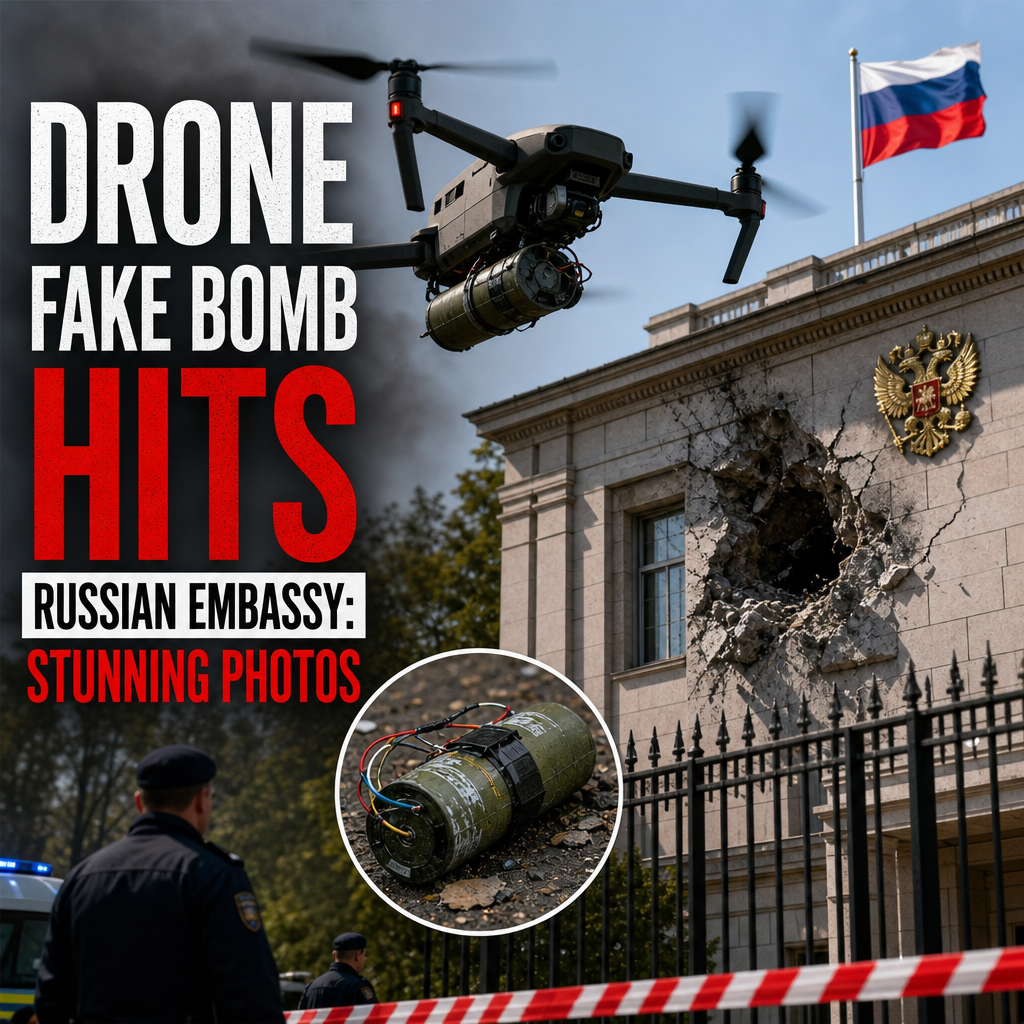
Drone Fake Bomb Hits Russian Embassy: Stunning Photos


Drone fake bomb incident at the Russian Embassy in Stockholm has become the latest flashpoint in a wider debate about security, symbolism, and the escalating use of drones in modern conflict and protest.
What makes this case stand out is not only the object itself — described as a fake explosive device — but also the setting. An embassy is supposed to be a heavily guarded diplomatic space, and any aerial breach immediately raises questions about motive, responsibility, and how much control authorities really have over the skies above sensitive sites.



What happened and why it matters
According to the account circulated by Russian state media, a drone dropped what appeared to be a fake bomb near the Russian Embassy in Sweden. The images accompanying the report show the object in dramatic detail, and the incident was presented as a deliberate act meant to intimidate or embarrass the embassy. That framing matters because it turns a local security event into a political message.
From the embassy’s perspective, the incident is not just a nuisance. It fits into a broader narrative of vulnerability, where diplomatic facilities can become targets for harassment even without a conventional attack. The fact that the device was fake may reduce the immediate danger, but it does not reduce the seriousness of the breach. In diplomatic terms, the symbolism can be as important as the physical threat.




Swedish authorities, meanwhile, are typically expected to treat such incidents carefully and procedurally. Even when there is no explosion, any object dropped by a drone near an embassy can trigger a police response, forensic checks, and questions about airspace restrictions. The absence of an obvious detonation does not mean the event is dismissed; it often means investigators have to determine whether it was a prank, a political stunt, a surveillance operation, or an act of intimidation.
The broader international media lens adds another layer. Outlets like Al Jazeera have repeatedly highlighted how drones are reshaping security politics, especially in war zones and contested spaces. What once required direct access can now be done from a distance, cheaply and quickly. That makes drones attractive not only to militaries but also to activists, provocateurs, and state-aligned actors looking for attention or leverage. In that context, the embassy incident looks less like an isolated curiosity and more like part of a growing pattern.
Drone fake bomb incident: more than a headline-grabbing stunt
It is tempting to treat the episode as a bizarre one-off — a strange image, a brief security scare, and then a return to normal. But that would miss the larger point. Drone incidents near embassies sit at the intersection of several risks:
– Diplomatic pressure: Embassies are symbols of national power, so even minor disruptions can have outsized political meaning.
– Airspace insecurity: Low-cost drones are hard to detect, especially in urban areas where many signals and obstacles interfere.
– Information warfare: A single image can spread quickly and shape public perception before facts are fully established.
– Escalation risk: Even a fake device can prompt a real response, and real responses can create diplomatic friction.
This is why reactions to such incidents often diverge. Russian officials and state media are likely to interpret the event as hostile or provocative, especially given the tense international environment. Swedish officials, by contrast, would be expected to focus on evidence, legality, and whether any law was broken. International observers often land somewhere in the middle, noting that while the object may not have been explosive, the use of a drone near a diplomatic site still represents a serious security lapse.
The bigger picture: drones, diplomacy, and public perception
One of the clearest lessons from this incident is that drones have changed the grammar of confrontation. They are small enough to be deniable, cheap enough to be accessible, and visible enough to be dramatic. That combination makes them ideal for sending messages — and for generating headlines.
Why the optics matter so much
A drone carrying a fake bomb is not just about the object. It is about the image of something falling from the sky onto a place associated with sovereignty and state power. In the age of social media, that image can travel faster than any official statement. The result is a contest over interpretation:
– Is this a symbolic protest?
– A security test?
– A political provocation?
– Or a low-level incident being amplified for strategic reasons?
That uncertainty is part of what makes the story powerful. Even without a clear answer, the incident forces governments and the public to confront how fragile perimeter security can be.
A measured conclusion
The most responsible reading of the incident is that it should be taken seriously without jumping to conclusions. There is enough here to justify concern: a drone, a diplomatic target, and a suspicious object that looked like a bomb. But there is also enough uncertainty to avoid overstating the threat before investigators establish who was behind it and what they intended.
What seems clear is that the event reflects a broader trend. Drones are no longer just tools of war or hobbyist gadgets. They are now instruments of messaging, disruption, and sometimes intimidation. When they are used near embassies, the stakes rise quickly because the target is not merely physical security but diplomatic trust.
In that sense, the fake bomb may not have been real, but the tensions it exposed certainly are.

























