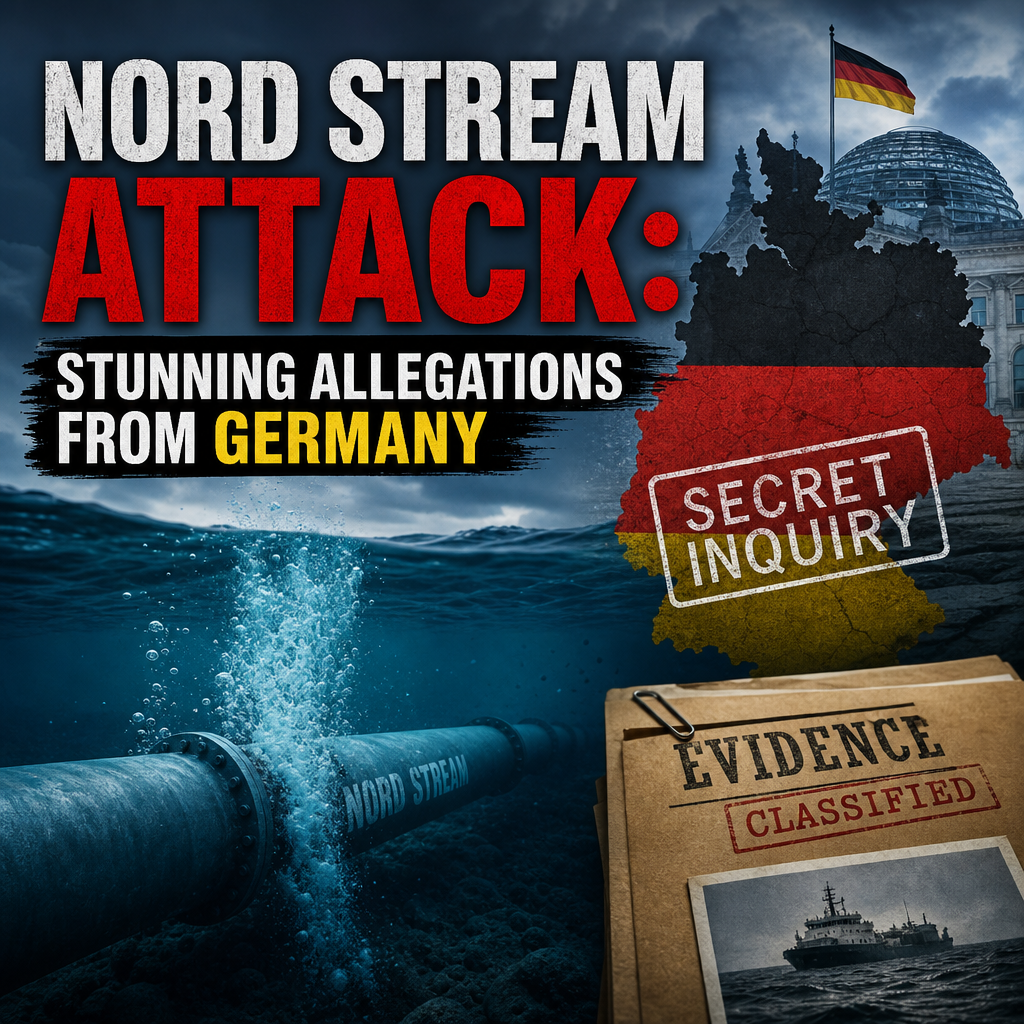
Nord Stream Attack: Stunning Allegations from Germany


Nord Stream attack allegations are back in the spotlight after German prosecutors reportedly said they believe a team linked to Ukraine was behind the 2022 sabotage of the pipeline system, a claim that has sharpened debate over accountability, wartime alliances, and how far investigators can go before hard evidence becomes public.
The new allegations, first highlighted by Al Jazeera, do not amount to a final court finding, but they are politically significant. For nearly three years, the destruction of the Nord Stream gas pipelines has remained one of Europe’s most consequential unresolved acts of sabotage. The blasts cut major energy links between Russia and Germany and immediately triggered suspicion, competing theories, and diplomatic tension. What makes the latest German claim notable is not just the accusation itself, but the fact that it appears to move the conversation from broad speculation toward a more formal investigative narrative.



At the same time, the reporting landscape around this story shows just how contested the issue remains. Al Jazeera framed the development as a major step in the German inquiry, while RT’s coverage predictably emphasized the geopolitical fallout and the possibility that the allegations could deepen rifts between Kyiv and some of its partners. Sky News, meanwhile, has tended to focus on the investigative and legal angle — who knew what, what evidence exists, and whether the claims can survive public scrutiny. Put simply: the sources agree that this is a serious development, but they differ in what they think it means.
What Germany is alleged to have uncovered
According to the German prosecutors’ account reported by Al Jazeera, investigators believe the operation was ordered by Ukrainian authorities and carried out by a small team of individuals. That is a highly consequential allegation because it goes beyond the familiar idea that the pipeline attack was the work of a mysterious freelance group or an anonymous state actor. If the claim holds, it suggests planning, coordination, and intent at a level that would make the case much harder to dismiss as rogue behavior.




But there are still important caveats. An allegation from prosecutors is not the same thing as proof tested in open court. In major national-security investigations, evidence may remain classified, witnesses may be unavailable, and the full chain of responsibility can be hard to establish publicly. That matters because the Nord Stream case has already been shaped by secrecy: several years after the explosions, the public still has only fragments of the picture.
Here are the key reasons the claim remains so sensitive:
– It could alter perceptions of Ukraine at a moment when it continues to depend heavily on Western support.
– It may intensify debate in Germany about energy security and the political meaning of Nord Stream itself.
– It could complicate efforts to hold any perpetrators accountable if the case becomes entangled in diplomatic fallout.
– It reinforces how difficult it is to separate battlefield logic from peacetime norms when a major war is underway.
Nord Stream attack: why reactions differ so sharply
The reaction from different outlets reflects broader geopolitical positioning. RT has emphasized the possibility that the allegations expose uncomfortable contradictions among Ukraine’s allies. That line of coverage fits Russia’s long-standing effort to portray Western support for Kyiv as morally and politically fragile. In that framing, the Nord Stream incident is not merely a criminal investigation; it is evidence that the anti-Russia coalition may have supported actors capable of carrying out an attack on European infrastructure.
Sky News has taken a more restrained tone, which is notable because restraint is often the most responsible approach in a case like this. The issue is not simply who benefits from the allegations being true, but whether the evidence is sufficient, whether the chain of custody is clear, and whether investigators have ruled out other possibilities. That matters because pipeline sabotage in a war context can serve multiple strategic objectives, and public certainty tends to run ahead of forensic certainty.
Al Jazeera’s framing sits somewhere in between: the report treats the prosecutors’ claim seriously while keeping the emphasis on the implications for Europe, Ukraine, and the broader war. That balance is useful. It avoids the trap of declaring a definitive conclusion before a courtroom or a fully transparent evidence release has done the work.
Why the case is bigger than one explosion
Even if the allegations are eventually confirmed, the Nord Stream story will remain morally and politically messy. For one thing, the pipelines themselves were already symbols of deep division. Critics had long argued that they increased Europe’s dependence on Russian gas. Supporters saw them as commercial infrastructure caught in a geopolitical struggle. After the explosions, the pipelines became something else entirely: a reminder that the war in Ukraine had spilled into the energy architecture of Europe.
There is also a broader issue of legitimacy. If a state-linked team did carry out the sabotage, was it intended as a military measure, a strategic signal, or both? And if a state supported it, what does that say about the boundaries of acceptable conduct in wartime? These are not rhetorical questions. They go to the heart of how international law and alliance politics function when covert operations overlap with open conflict.
The most responsible conclusion at this stage is a cautious one. The German allegations, as reported, are serious enough to deserve attention, but they are not the same as a public verdict. The reporting from Al Jazeera, RT, and Sky News shows a shared recognition that the case could reshape debate across Europe — yet it also shows how much uncertainty remains around motive, evidence, and responsibility.
For now, the Nord Stream attack remains what it has been for much of the past three years: a major act of sabotage with enormous geopolitical consequences, and a reminder that in modern conflict, the truth often emerges slowly, unevenly, and with a heavy political cost attached.