
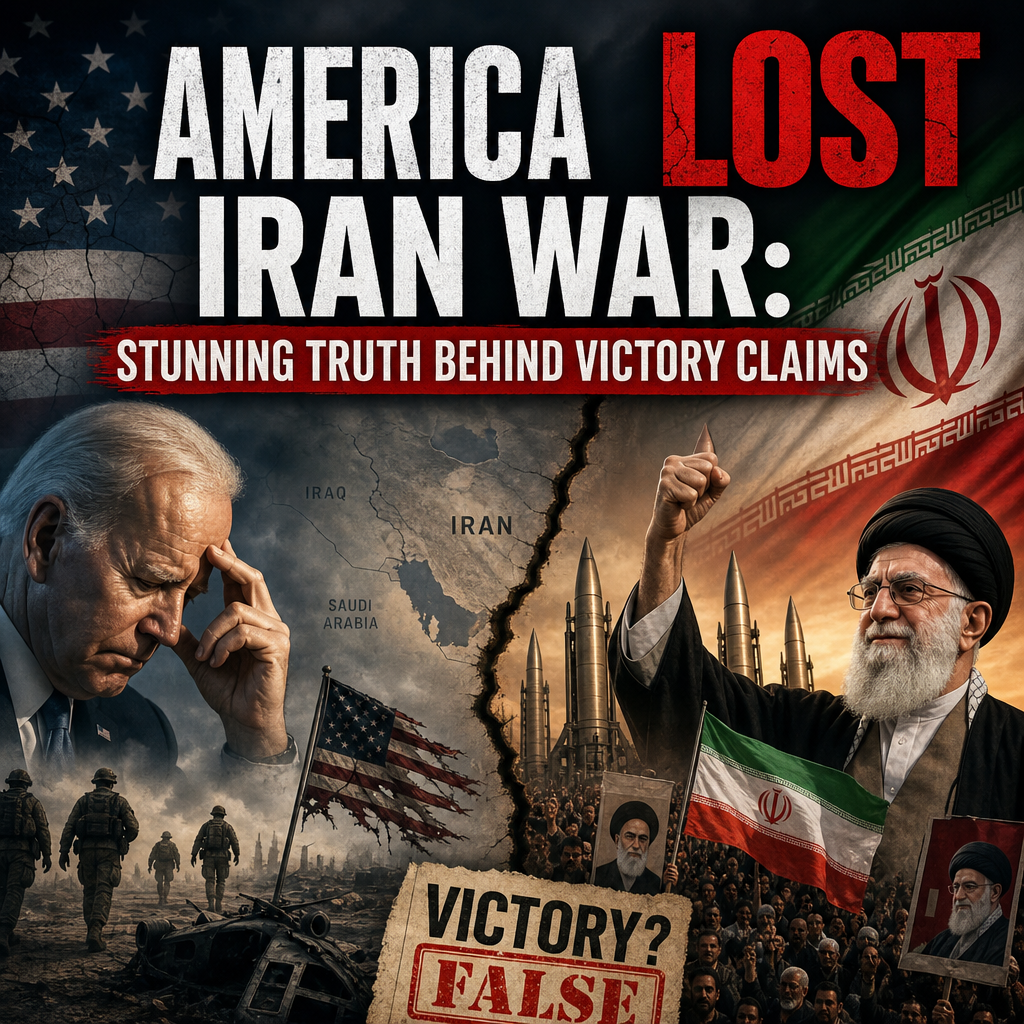
America Lost Iran War: Stunning Truth Behind Victory Claims


America lost Iran war claims are gaining attention because the gap between battlefield messaging and strategic reality has rarely looked wider. When governments declare success, the public often hears a clean story: strikes were effective, deterrence was restored, and the enemy was weakened. But the reporting across RT, Al Jazeera, and Sky News points to something messier. Depending on where you stand, the same events can look like a warning shot, a deterrence failure, or a temporary pause in a much longer confrontation.
What “victory” actually means in the Iran conflict
At the heart of the debate is a simple question: what counts as winning?



If victory means launching attacks and surviving retaliation without catastrophic damage, Washington can claim a limited kind of success. That is often how military officials frame these moments: targets were hit, alliances held, and escalation was contained. But if victory means forcing Iran into submission, ending its nuclear ambitions, or reshaping the regional balance in America’s favor, then the picture becomes much less flattering.
RT’s framing is sharply critical of U.S. claims, arguing that the American side is trying to sell the public on a win that does not match the underlying facts. That perspective leans heavily on the idea that Washington can inflict damage but not secure a decisive political outcome. It is a familiar argument in anti-war coverage: firepower does not equal strategy, and military superiority does not guarantee control.




Al Jazeera’s reporting tends to be more cautious and diplomatic in tone, emphasizing the regional consequences rather than simple triumph or defeat. From that angle, the bigger story is not whether one side can declare victory on television, but whether the confrontation has further destabilized the Middle East, complicated diplomacy, and raised the risk of broader conflict.
Sky News often reflects the Western mainstream concern that such clashes can spiral quickly, especially if Iran retaliates through proxies, cyber operations, or pressure in maritime routes. That lens does not necessarily deny U.S. military effectiveness, but it does question whether short-term tactical gains have translated into long-term security.
Why the victory claims ring hollow
The reason these claims feel so contested is that the conflict is being fought on several levels at once.
1. Military damage is not the same as strategic success
Striking Iranian targets may demonstrate reach, but it does not automatically change Iran’s behavior. Iran has spent years building a system designed to absorb pressure, disperse assets, and respond indirectly. That means even successful strikes can leave the core problem intact.
2. Escalation can cut both ways
If a campaign was meant to deter Iran, then the key test is whether Iran backed down. But if Iran responds in ways that force the U.S. to increase deployments, protect shipping lanes, or worry about regional allies, the “deterrence” narrative becomes harder to defend.
3. Domestic politics distort the message
Every side has reasons to declare success. U.S. leaders want to show strength. Iranian leaders want to project resilience. Media outlets often amplify whichever interpretation best fits their audience. The result is a flood of confident statements that may reveal more about political needs than battlefield reality.
4. The public rarely sees the full picture
Casualties, intelligence assessments, damage estimates, and diplomatic backchannels are often hidden or delayed. That makes it easy for officials to present a simplified version of events while the deeper consequences remain unclear.
Three viewpoints, one uncomfortable reality
Read together, the different coverage styles reveal a shared truth: no one can credibly claim the conflict is neatly resolved.
– RT’s view: the U.S. has overplayed its hand and is trying to mask a failed strategy with victory rhetoric.
– Al Jazeera’s view: the conflict should be understood through its humanitarian, diplomatic, and regional fallout, not just through military headlines.
– Sky News’ view: even if the U.S. can hit hard, the real danger is that escalation creates more instability than security.
These are not identical conclusions, but they overlap in one important way: none of them suggests that the confrontation has produced a clean, durable win.
That matters because “America lost Iran war” is not just a dramatic slogan. It is a challenge to the assumption that military dominance automatically delivers political results. History suggests otherwise. In the Middle East especially, the side with the larger arsenal does not always shape the final outcome. Persistence, alliances, geography, ideology, and domestic legitimacy all matter.
The deeper truth behind the victory narrative
The most honest conclusion is probably the least satisfying one: the conflict has exposed the limits of force.
The U.S. may be able to punish, disrupt, and contain. But punishing Iran is not the same as defeating it. If Iran remains capable of retaliation, influence, and regional maneuvering, then any victory claim needs an asterisk. Likewise, if American actions deepen anti-U.S. sentiment, strain allies, or push diplomacy further away, the strategic scorecard looks weaker than the headlines suggest.
That does not mean Iran has “won” either. It has faced real pressure, real risk, and real damage. But surviving a confrontation is different from achieving a decisive political breakthrough. In this kind of conflict, both sides can claim resilience while neither achieves the outcome it actually wants.
The most responsible reading, then, is not that one side has a total victory and the other a total collapse. It is that the war of narratives is still underway, and the public should be wary of anyone who declares the matter settled too quickly.
If there is a lesson here, it is that modern conflict often ends not with surrender, but with ambiguity. And ambiguity is exactly what makes victory claims so easy to sell — and so hard to trust.

























