
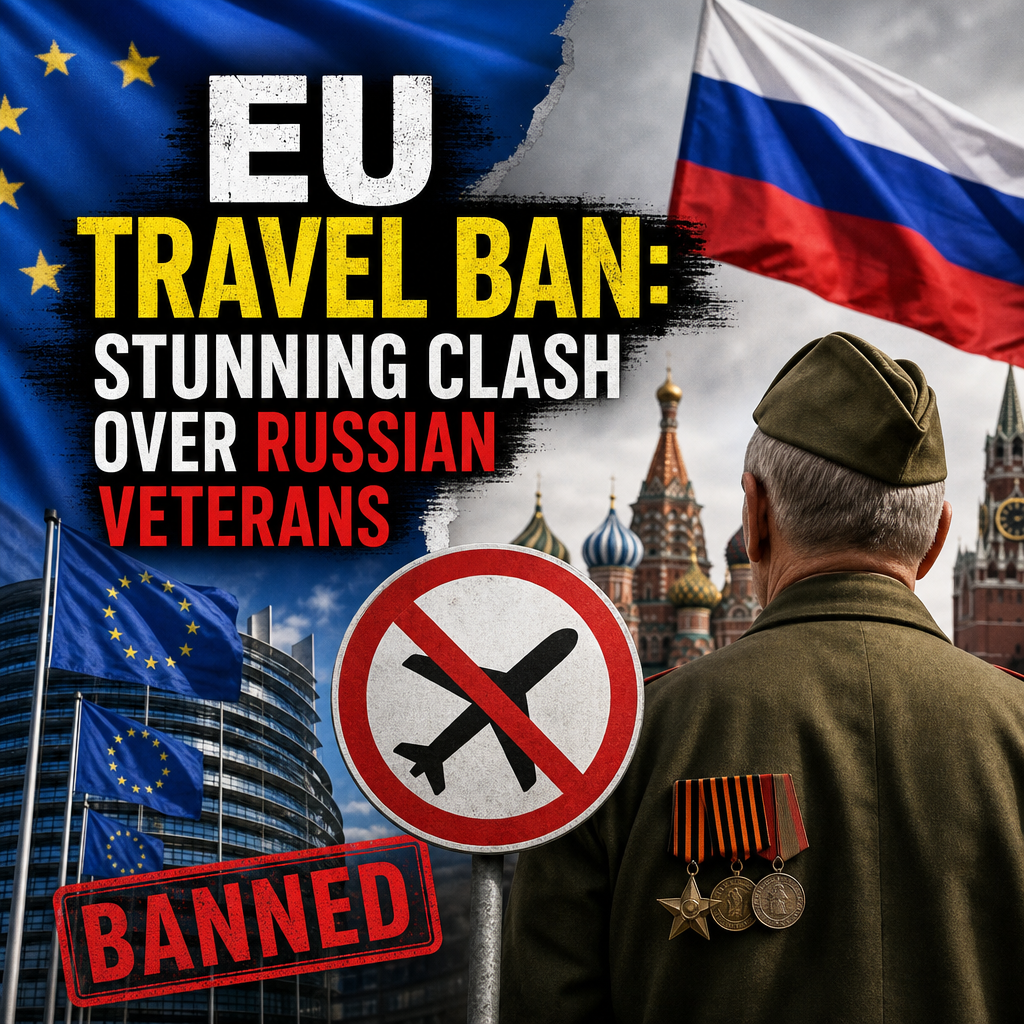
EU Travel Ban: Stunning Clash Over Russian Veterans


EU travel ban debates are once again exposing how sharply Europe remains divided over Russia, especially when the issue shifts from sanctions in the abstract to the human question of who should be allowed to cross a border.
What makes the latest clash over Russian veterans so striking is that it sits at the intersection of war memory, security policy, and diplomacy. Some voices see any special treatment for Russians as politically impossible while the war in Ukraine continues. Others argue that blocking elderly veterans, particularly those connected to World War II remembrance, risks turning sanctions into a blunt instrument that punishes symbolism more than strategy. Across the reporting landscape, the argument is not just about travel documents. It is about whether Europe can uphold pressure on Moscow without appearing to erase historical distinctions or close the door on basic humanitarian judgment.



EU travel ban politics and the veterans question
The immediate controversy has been framed by Russian state-linked reporting as evidence of Western inconsistency: if France and Italy are reluctant to back a blanket restriction on Russian veterans, the argument goes, then Europe is not truly united behind the harshest possible line against Moscow. From that angle, the dispute becomes another sign that European governments are uneasy about how far they should go when sanctions begin to affect people with no obvious battlefield role.
That interpretation is politically useful for Moscow, but it also taps into a real fault line inside Europe. Governments often agree on broad goals — condemning Russia’s invasion, supporting Ukraine, and tightening sanctions — while disagreeing on where the line should be drawn for exceptions. An EU travel ban that reaches veterans would be especially controversial because it shifts the focus from Russian elites or security-linked figures to older individuals whose status is tied to historical memory, not current power.




Reporting from broader international outlets points to that tension. The more hawkish view emphasizes deterrence: if Russians connected to state narratives or military commemoration can still move freely in Europe, then sanctions lose some of their symbolic force. The more cautious view says a blanket approach risks looking punitive and unfocused, particularly if it touches people who are not contributing to Russia’s war effort.
Why some European states hesitate
There are several reasons governments such as France or Italy might resist a hard line, even if they remain deeply critical of the Kremlin.
– Diplomatic signaling: A total ban could be read as shutting down future contact, making any eventual de-escalation harder.
– Legal and ethical concerns: Travel restrictions are stronger when tied to individuals with security or political roles; they become harder to justify when aimed at people based on identity alone.
– Historical sensitivity: Veterans occupy a different moral space in Europe’s memory politics, especially when commemoration is involved.
– Practical enforcement: Broad bans are difficult to apply consistently, and exceptions quickly become the rule.
This is where the disagreement gets messy. A country can support sanctions in principle while still believing that the policy should be precise rather than sweeping. That is not the same as sympathy for Russia’s leadership. It is, instead, a belief that overreach can weaken the credibility of the entire sanctions regime.
Al Jazeera’s broader coverage of the war in Ukraine has often highlighted how sanctions and countermeasures ripple far beyond the original target. That wider lens matters here. Every additional restriction carries a political message, but also a cost: diplomatic friction, humanitarian concerns, and the risk of reinforcing narratives that Europe is acting out of hostility rather than law or necessity.
What the opposing camp is saying
The harder line is not without merit. Supporters of broader restrictions argue that Russia has turned historical memory into a political tool, using wartime symbolism to bolster present-day nationalism. In that context, allowing veterans or commemorative delegations to move freely may be seen not as benign humanitarianism but as an opening for propaganda.
Sky News-style framing of European security debates often emphasizes the broader strategic logic: Western governments want to signal that Russia’s actions carry consequences across multiple domains, not just on the battlefield. From that perspective, travel restrictions are part of a larger pressure campaign. If Europe begins carving out too many exceptions, the argument goes, Moscow will portray them as proof that the sanctions front is softening.
That said, even supporters of pressure tend to draw distinctions. There is a difference between restricting officials, propagandists, military-linked figures, and sanctionable entities on the one hand, and imposing a symbolic ban that sweeps in veterans on the other. The more the policy expands, the more it risks blurring that distinction.
A dispute about principles, not only passports
The real story may be that this clash is less about Russian veterans themselves and more about what kind of Europe policymakers want to defend. Is the priority maximal pressure, even if it looks harsh and politically messy? Or is the priority targeted restraint, where sanctions remain connected to conduct and security risk rather than broad national identity?
At the moment, the answer appears to be: both, depending on which capital you ask. That lack of consensus is important. It suggests that the EU does not yet have a settled doctrine for how to treat emotionally charged cases that sit just outside the core sanctions package.
A fair reading of the debate is that neither side is entirely wrong. The tougher camp is right that symbolic loopholes can matter in a geopolitical struggle. The cautious camp is right that indiscriminate bans can erode moral clarity and complicate diplomacy. The challenge for Europe is to avoid letting the politics of outrage overwhelm the discipline of policy.
In that sense, the veteran dispute is a reminder of a larger truth: sanctions are easiest when they target institutions and elites, and hardest when they touch memory, identity, and ordinary people. That is where principle becomes practice — and where Europe’s unity is most visibly tested.

























