Iran Disputes US Claim on Frozen Funds: Stunning Rebuttal


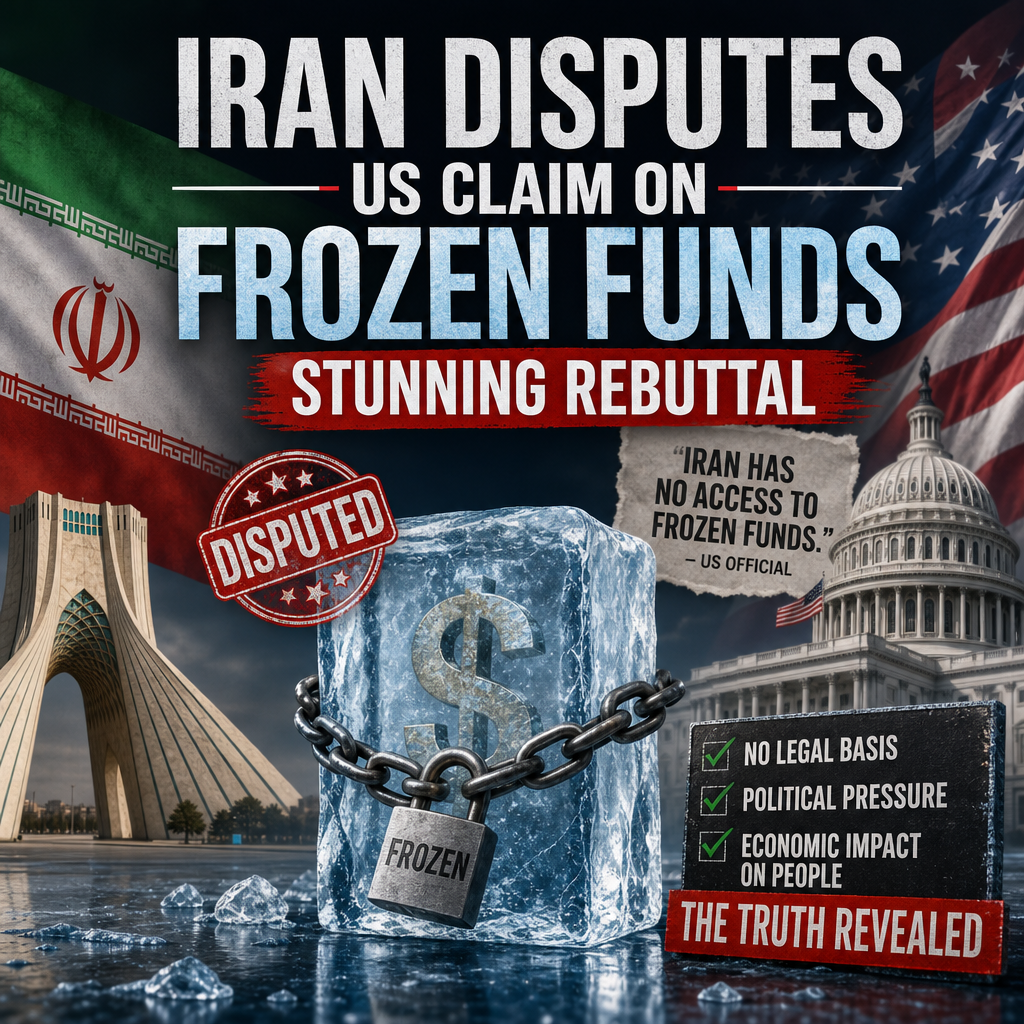
Iran disputes US claim on frozen funds, and the clash is about more than a single transfer of money — it is a reminder of how easily finance, diplomacy, and domestic politics can collide in the Middle East.
At the center of the dispute is a familiar pattern: Washington portrays the funds as evidence of pressure, leverage, or ongoing restrictions, while Tehran insists the reality is being distorted for political effect. That gap matters because frozen Iranian assets have long been tied to sanctions, prisoner exchanges, humanitarian waivers, and broader attempts to keep negotiations alive even when formal relations remain broken.



Why the frozen funds dispute matters
The immediate disagreement is not just about accounting. It reflects a deeper contest over who gets to define the meaning of any asset release, any transfer, and any diplomatic opening. Iranian officials have rejected the U.S. framing, saying Washington is turning a technical financial issue into political theater. In that sense, Tehran’s rebuttal is aimed at two audiences at once: foreign governments that may be watching the details closely, and an Iranian public that is often told the state is securing progress despite sanctions.
From the American side, claims about frozen funds are often used to signal that pressure on Iran remains in place. That message can serve several purposes:




– reassure domestic critics that sanctions have not been abandoned,
– show allies that Washington is still enforcing leverage,
– and prevent any perception that Iran has gained an unconditional financial win.
Iran, meanwhile, has every incentive to deny the U.S. version of events if it suggests weakness, dependence, or concession. By disputing the claim, Tehran can argue that it is not being managed by Washington’s terms and that any funds involved are tied to lawful or negotiated arrangements rather than a unilateral U.S. gesture.
What the different sources emphasize
The three outlets paint the issue from noticeably different angles.
RT: a political rebuttal framed as resistance
RT’s coverage leans heavily into the Iranian rebuttal, presenting the U.S. claim as overblown or misleading. That framing fits a broader editorial pattern: skepticism toward Washington’s narrative and a willingness to treat Iranian denials as a corrective to American messaging. The emphasis is less on the mechanics of the money and more on the idea that the U.S. is talking tough while Iran is pushing back.
Al Jazeera: the bigger diplomatic picture
Al Jazeera typically places these disputes within a wider regional and humanitarian context, and this issue is no exception. Rather than treating frozen funds as an isolated talking point, its reporting tends to highlight how such assets connect to nuclear diplomacy, sanctions relief, prisoner negotiations, and the ordinary lives of Iranians affected by restricted banking channels. That wider lens matters because it reminds readers that these are not abstract numbers on a government spreadsheet; they influence imports, access to medicine, and the credibility of any future deal.
Sky News: scrutiny and uncertainty
Sky News tends to approach these developments with a more cautious, verification-first style. That makes it useful in moments like this because the facts can be murky and the political claims are often ahead of the evidence. The uncertainty itself is part of the story. If the U.S. and Iranian accounts do not fully line up, the responsible reaction is not to choose a winner immediately, but to ask what exactly was transferred, under what authority, and whether the funds were ever truly “frozen” in the same sense being described publicly.
The problem with simplified narratives
It is tempting to reduce the story to a simple duel: the U.S. says one thing, Iran says another. But that misses the nuance. Frozen funds can mean different things in different contexts. Some assets may be restricted by sanctions, some may be held in foreign accounts, and some may be available only for specific uses such as humanitarian purchases. A release or transfer does not necessarily mean the broader sanctions regime has changed.
That is why the dispute feels so politically charged. Each side benefits from a simplified version:
– Washington can frame any movement of funds as controlled, limited, and conditional.
– Tehran can frame the same movement as proof that sanctions are failing or at least being loosened.
– Media outlets then decide whether to foreground confrontation, diplomacy, or ambiguity.
The result is a story that is easy to spin and hard to verify.
What seems most credible
The most credible reading is that both sides are selectively emphasizing facts that help their own political goals. The U.S. may be overstating its version of control, while Iran may be understating whatever restrictions still remain. That is not unusual in U.S.-Iran relations, where even small technical developments become symbolic victories or defeats.
The broader reality is that frozen funds remain a pressure point because they sit at the intersection of trust, sanctions enforcement, and negotiation strategy. Until there is a clearly documented, independently explained arrangement, any public statement from either side should be treated with caution.
The bottom line
Iran disputes US claim on frozen funds for reasons that go well beyond the funds themselves. Tehran wants to reject any narrative that suggests it is trapped by American leverage, while Washington has reasons to present the situation as tightly controlled and politically favorable. The truth likely lies somewhere in between: a restricted financial arrangement being interpreted through the lens of strategic rivalry.
What makes the dispute important is not just who is “right,” but how often the same event can be turned into opposite stories. In that sense, the controversy says as much about the state of U.S.-Iran relations as it does about the money involved.