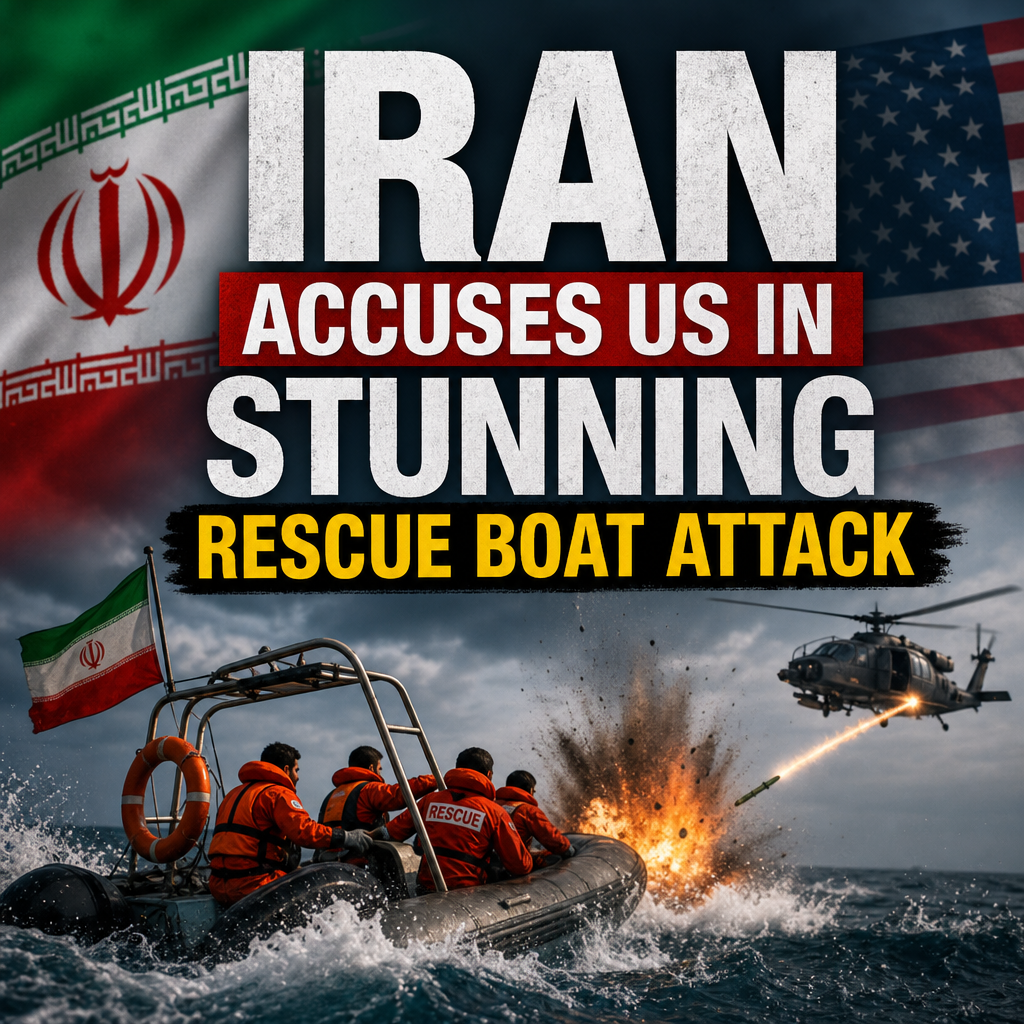
Iran Accuses US in Stunning Rescue Boat Attack


Iran accuses US of a deadly attack on rescue boats, but the full picture is still blurred by competing claims, regional tensions, and the lack of independently verified details.
The allegation has quickly become the latest flashpoint in a long-running confrontation between Tehran and Washington, one that is shaped as much by politics and maritime strategy as by the facts of any single incident. Iranian officials say emergency responders were targeted while trying to carry out rescue work; US officials, at least in the public reporting available so far, have not accepted that framing. In between those positions, international coverage shows a familiar pattern: each side presenting its own account while outside observers struggle to confirm what happened on the water.



Iran accuses US: what is being claimed
According to Iranian statements reported by state-linked and international outlets, the incident involved rescue boats that were allegedly struck in a way Tehran says can only be explained as a deliberate attack. The accusation is serious because it moves beyond a standard military confrontation and into the realm of protected humanitarian activity. If rescue craft were indeed hit while responding to an emergency, that would raise immediate questions under the laws of armed conflict and maritime rules.
But the most important detail here is also the least settled one: independent verification appears limited. In fast-moving incidents in the Gulf region or nearby waters, initial reports often arrive through official channels before satellite imagery, vessel tracking data, or third-party testimonies can be fully assembled. That means the public is often asked to choose between narratives before the evidence is complete.




A careful reading of reporting across international outlets suggests three things are true at once:
– Iran is presenting the event as a hostile act against civilian or rescue personnel.
– The US side has not publicly endorsed that version of events.
– Independent confirmation is not yet robust enough to remove doubt.
That uncertainty matters. In geopolitics, disputed incidents are rarely just about the incident itself. They are often used to reinforce a broader message.
Why this incident matters beyond the boats
The timing of the allegation gives it extra weight. US-Iran relations remain strained over sanctions, nuclear negotiations, regional proxy conflicts, and maritime security. Any attack claim involving emergency responders is likely to be seen through that wider lens. For Tehran, the accusation can reinforce a narrative that the US acts aggressively in the region and endangers ordinary lives. For Washington, responding too strongly risks escalating a situation that may still be unclear; responding too weakly risks appearing dismissive if further evidence supports Iran’s account.
That tension is exactly why international coverage tends to diverge in tone:
The Iranian perspective
Iranian officials tend to frame such incidents as proof of external pressure and hostility. In this reading, the alleged strike is not an isolated event but part of a broader pattern of confrontation aimed at deterring Iran or weakening its regional influence. That perspective resonates strongly at home and among audiences already skeptical of US intentions.
The US perspective
From Washington’s side, maritime incidents in the region are often treated cautiously, especially when allegations surface amid broader strategic disputes. The US has historically pushed back against claims it sees as politically motivated or lacking evidence. If the boats were connected to any security operation, the US may argue that the full context matters as much as the casualty claims.
The international perspective
Outlets outside the immediate conflict tend to focus on verification, restraint, and the risks of miscalculation. In this reading, the biggest danger is not only what happened, but how quickly a disputed event can become a rallying cry. That is especially true in a region where naval encounters, drone allegations, and proxy clashes can escalate before facts are established.
Iran accuses US, but evidence will decide credibility
The credibility of the accusation will ultimately depend on evidence that can be independently examined. Useful questions include:
– Where exactly did the incident occur?
– What type of rescue boats were involved?
– Were there survivors, witnesses, or video recordings?
– Did radar or vessel-tracking data show nearby military activity?
– Was there any warning, exchange of fire, or prior confrontation?
Until those questions are answered, certainty remains out of reach. It is entirely possible that Iran has a legitimate grievance. It is also possible that the story is being shaped by the politics of deterrence and blame. In either case, the truth will require more than rhetoric.
The challenge for readers is to avoid two easy traps: assuming every Iranian allegation is propaganda, or assuming every accusation against the US is automatically true. The history of the region shows that both governments have strategic incentives to present events selectively. That does not mean the facts are unknowable; it means they must be treated carefully.
The bigger risk: escalation before clarity
The real danger in episodes like this is that they can harden positions before facts are settled. Once an allegation involving rescue boats enters the diplomatic bloodstream, it can affect naval patrols, political messaging, and even future negotiations. A single disputed strike can become proof of bad faith for one side and a test of credibility for the other.
That is why measured reporting is so important. The most responsible conclusion at this stage is not that one side is unquestionably right, but that the region has entered another moment where accusation, uncertainty, and strategic rivalry are colliding. If credible evidence emerges, it should be assessed on its merits. If it does not, the allegation may remain part of the larger propaganda war that shadows US-Iran relations.
For now, the incident stands as a reminder of how fragile maritime security can be when trust is low and every confrontation is interpreted through the lens of a larger conflict. The facts may still change, but the underlying reality is already clear: in this rivalry, even rescue work can become politically explosive.