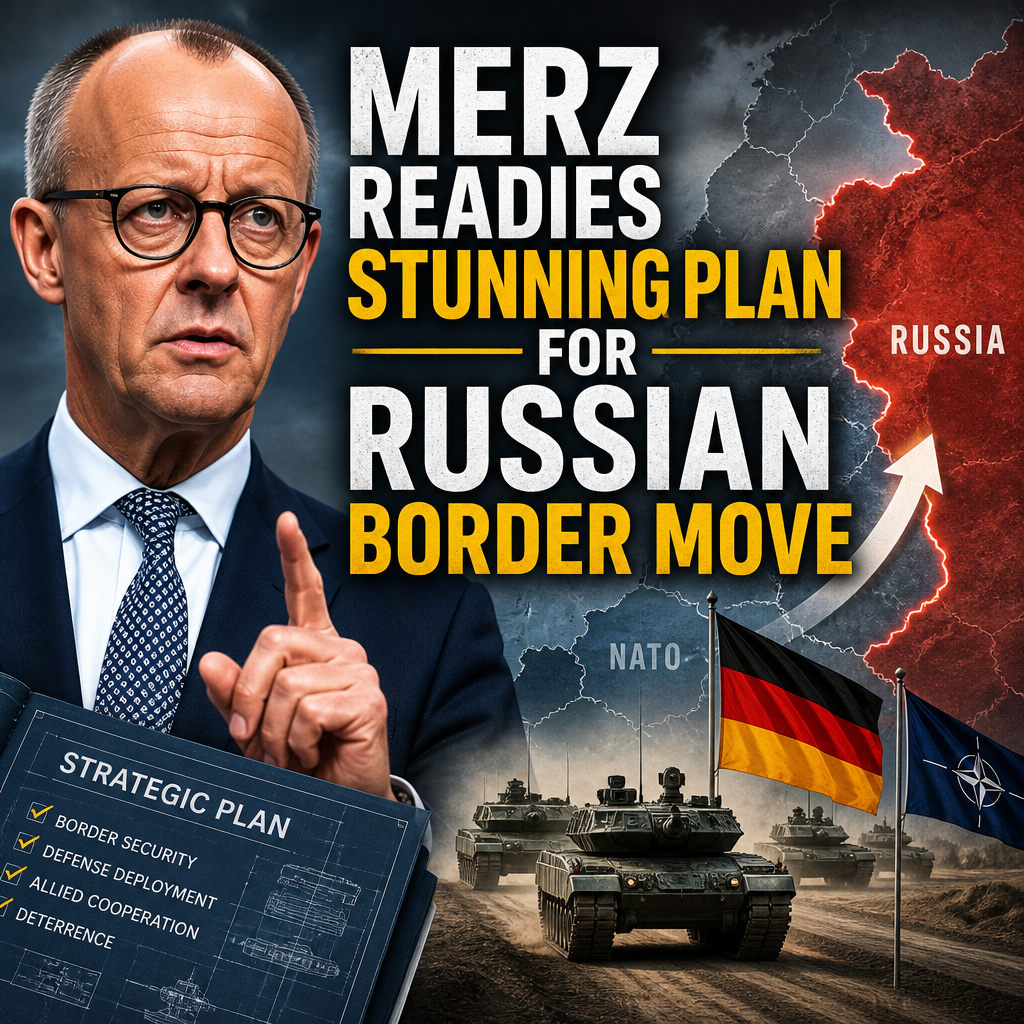
Merz Readies Stunning Plan for Russian Border Move


Merz Readies Stunning Plan for Russian Border Move has quickly become a flashpoint in Europe’s security debate, because it sits right at the intersection of deterrence, diplomacy, and the risk of escalation.
At the center of the discussion is a familiar but increasingly urgent question: how far should Germany go in strengthening NATO’s eastern flank, and how much can be done without provoking the very confrontation European leaders say they want to avoid? Reports surrounding Friedrich Merz’s approach suggest a harder line on security policy, with a stronger emphasis on readiness, border defense, and close coordination with allies near Russia. Supporters see that as overdue realism. Critics see a move that could deepen tensions at a dangerous moment.



Why the plan matters now
The idea of a tougher German posture would carry extra weight because Germany is not just another European state. It is NATO’s largest economy, a major supplier of military aid to Ukraine, and one of the alliance’s most consequential political voices. When Berlin signals a shift, other capitals notice.
That is why the reported border strategy has drawn such attention. For some European officials, the logic is straightforward:




– Russia’s war against Ukraine has already rewritten Europe’s security map.
– NATO members on the alliance’s eastern edge want visible reassurance.
– Germany, long criticized for caution on defense, is under pressure to prove it can lead.
From that perspective, any plan that tightens Germany’s military posture near the Russian border is less a provocation than a warning signal meant to deter further aggression. It would also fit a broader European trend: more defense spending, more troop deployments on NATO’s eastern side, and less patience for ambiguity.
But the opposite argument is just as strong. Moscow is likely to interpret any German move near Russian territory as part of a wider encirclement strategy, especially if it involves troops, logistics, air defense, or infrastructure upgrades. Even if Berlin presents the plan as defensive, Russia’s leaders have repeatedly framed NATO expansion and forward deployment as hostile acts.
That clash in interpretation is the core problem. One side calls it reassurance. The other calls it escalation.
German border strategy and the politics of deterrence
Merz’s reported hardening of tone appears to reflect a wider shift in European politics. After years of debate over whether Germany was too hesitant, too dependent on Russian energy, or too slow to rearm, the political center of gravity has moved toward preparedness.
Still, preparedness is not the same as consensus.
What supporters are likely to say
Advocates for a tougher line generally argue that:
– Europe only deters threats when it demonstrates resolve.
– Russia has been testing Western unity for years.
– Border security, troop mobility, and alliance coordination reduce risk rather than create it.
They would also point out that deterrence works best before a crisis, not after one. In their view, waiting for Russia to act first is exactly what weakens Europe’s position.
What opponents are warning about
Critics counter that Europe can slide from deterrence into brinkmanship surprisingly fast. A more assertive German role near the Russian border could:
– increase the chance of miscalculation;
– complicate diplomatic channels;
– fuel domestic opposition in Germany;
– give Russian officials fresh material for propaganda.
There is also a practical concern: Germany’s armed forces are still widely seen as under-resourced relative to the tasks being placed on them. A dramatic announcement may sound decisive, but without clear logistics, financing, and allied coordination, it could end up exposing weaknesses rather than strength.
What the sources suggest about the bigger picture
The reporting environment around this issue points to a broader split in how the conflict is understood.
Russian state-linked coverage tends to frame NATO actions as evidence of Western expansion and hypocrisy, emphasizing legal loopholes, military buildup, and alleged double standards. That narrative is designed to cast any Western troop movement near Russia as inherently aggressive.
By contrast, international outlets and regional coverage generally present the same developments through the lens of collective security, sovereignty, and the consequences of Russia’s invasion of Ukraine. The emphasis there is less on provocation and more on the right of NATO members to defend themselves.
Al Jazeera’s wider regional and global reporting often underscores the human and political costs of great-power confrontation, while Sky News coverage of European security questions tends to focus on alliance unity, defense preparedness, and the risks of escalation. Taken together, those viewpoints show why the issue cannot be reduced to a simple yes-or-no debate.
The most defensible conclusion is that both camps are responding to real dangers, even if they diagnose them differently.
A sober reading of Merz’s move
If Merz is indeed preparing a tougher border policy, the smart interpretation is not that Germany wants confrontation. It is that Berlin believes the security environment has changed so fundamentally that older assumptions no longer work.
That may be true. Europe cannot rely indefinitely on vague reassurance while the war in Ukraine continues to reshape military planning. At the same time, the line between deterrence and provocation is thin, especially when Russia is eager to portray every NATO step as hostile.
The best version of this strategy would therefore need three things:
– clear coordination with NATO partners;
– transparent public messaging about defensive intent;
– a parallel diplomatic effort to prevent misreading and escalation.
Without those safeguards, even a reasonable security measure could become a political liability.
In the end, the significance of Merz’s reported plan is not just whether German troops, assets, or policy shifts move closer to Russia’s frontier. It is whether Europe can defend itself more firmly without convincing the world that it is preparing for something even bigger. That balance, not the border itself, is what will define the real test.