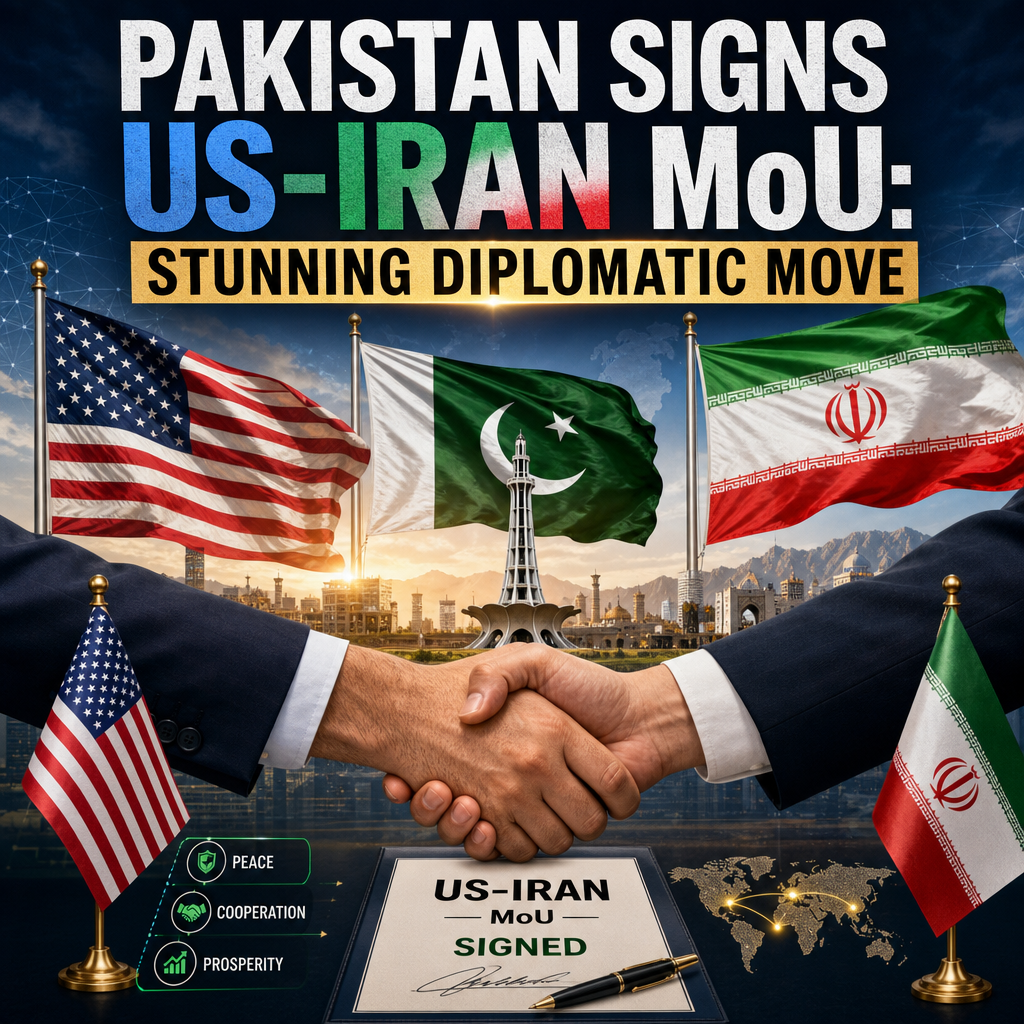
Pakistan Signs US-Iran MoU: Stunning Diplomatic Move


Pakistan Signs US-Iran MoU has quickly become one of the most talked-about diplomatic developments in the region, but the significance of the move depends on what exactly is inside the agreement and how Washington, Tehran, and Islamabad choose to frame it. On the surface, any formal understanding involving Pakistan, the United States, and Iran is notable because these three countries sit at the intersection of security, trade, and regional influence. Yet the reaction should be measured: symbolic breakthroughs can be easier to announce than to implement, especially when they touch long-running tensions between the US and Iran.
Why the agreement matters
Pakistan occupies a uniquely sensitive place in South Asia and the broader Middle East. It borders Iran, has long balanced ties with the United States, and depends heavily on regional stability for trade and energy. That makes any memorandum involving both Washington and Tehran more than a routine diplomatic gesture. It suggests an attempt to preserve channels of communication at a time when direct US-Iran engagement remains fragile.



From a strategic perspective, a memorandum of understanding can serve several purposes:
– It can create a diplomatic opening without requiring immediate political recognition or a full treaty.
– It can signal that backchannel talks have matured enough to be made public.
– It can allow Pakistan to present itself as a broker or bridge between rival powers.
– It can reduce the risk of miscalculation if the parties agree on limited cooperation areas.




At the same time, an MoU is not the same thing as a binding agreement. That distinction matters. In volatile regions, governments sometimes announce memorandums to show momentum even when the practical details remain vague. If the reported deal is mainly about dialogue, logistics, or confidence-building, it may be important diplomatically but modest in operational terms.
Pakistan Signs US-Iran MoU: a rare balancing act
For Pakistan, the appeal of this move is easy to understand. Islamabad has often tried to maintain workable relations with competing powers, even when their interests clash. A Pakistan-mediated framework involving the US and Iran could help Pakistan demonstrate relevance on the diplomatic stage while also advancing its own interests in energy security, border management, and regional trade.
Still, the balancing act is delicate. Pakistan has historically faced pressure to align more closely with the United States on security issues, while Iran’s sanctions-hit economy and friction with Washington make any shared initiative politically sensitive. That means Islamabad will likely face questions from multiple directions:
– From Washington: Is Pakistan helping facilitate de-escalation, or giving Iran room to maneuver?
– From Tehran: Does the deal protect Iranian interests, or merely widen US influence?
– From domestic critics: Is Pakistan overpromising on diplomacy that may never translate into tangible gains?
These questions are not trivial. Pakistan’s foreign policy often has to account for internal economic strain, border security concerns, and the political costs of appearing too close to any one bloc. A successful agreement would therefore depend less on headlines and more on patient implementation.
What the broader news landscape suggests
Coverage across international news outlets tends to treat US-Iran relations as a test of whether diplomacy can survive mutual distrust. That broader context is important here. Some reporting emphasizes the value of dialogue and incremental steps, arguing that even limited understandings can prevent escalation. Other coverage is more skeptical, noting that political mistrust, sanctions, and regional proxy conflicts often derail carefully crafted openings.
That tension is why observers should resist both extremes of interpretation. It would be premature to describe a memorandum as a historic reset. But it would also be shortsighted to dismiss it as empty symbolism. In diplomacy, small procedural steps can matter if they create regular contact, establish rules of engagement, and lower the temperature around disputed issues.
The most useful way to view the reported agreement is as a signal of intent rather than a final verdict. If the parties involved can define a narrow, realistic agenda, the MoU could be the start of a broader process. If not, it may become another short-lived announcement remembered more for its optics than its outcomes.
The risks are real, and so are the opportunities
There are at least three major risks attached to any US-Iran-related initiative involving Pakistan:
1. Implementation gaps — A paper agreement can collapse if there is no roadmap, timeline, or mechanism for follow-up.
2. Regional backlash — Rival states or political factions may interpret the move as a shift in alignment.
3. Expectation inflation — Public optimism can outpace the actual diplomatic substance.
But the opportunity is equally real. Even limited cooperation could help address practical issues such as border tensions, maritime security, energy transit, or crisis communication. For a region that has too often relied on confrontation, a formalized channel for conversation is itself a useful achievement.
A cautious but important development
The right conclusion is neither triumphal nor dismissive. If Pakistan truly has helped engineer a US-Iran memorandum, the move reflects diplomatic creativity at a time when few actors are willing to take political risks for dialogue. It also shows that middle powers can sometimes create openings where larger powers cannot.
Still, the real test begins after the announcement. The value of the agreement will depend on whether it leads to sustained talks, specific deliverables, and a reduction in tensions rather than just a moment of surprise. For now, the development deserves attention because it hints at possible re-engagement between longstanding adversaries. It deserves caution because the region has seen many promising diplomatic gestures fade before they produced lasting change.
In other words, the report is important not because it settles anything, but because it may mark the beginning of a conversation that has been missing for too long.