
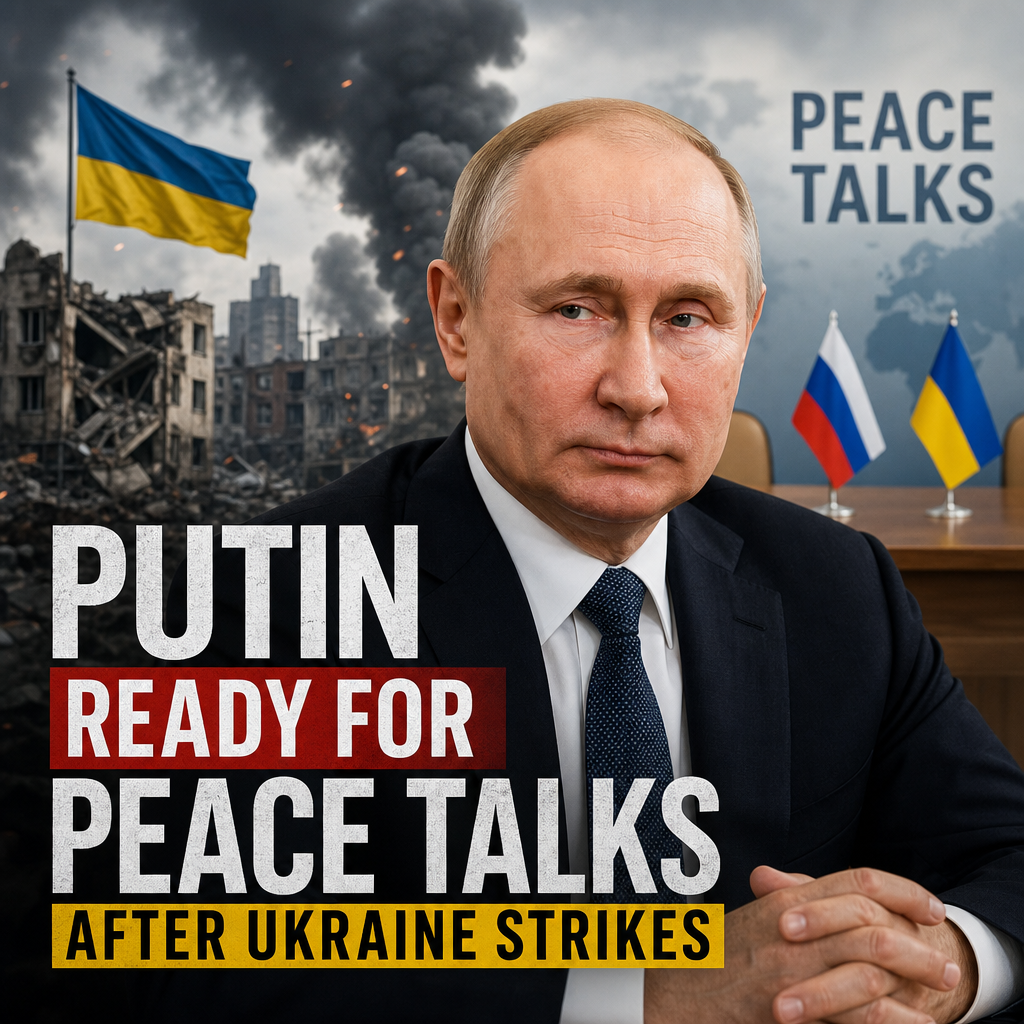
Putin Ready for Peace Talks After Ukraine Strikes


Putin ready for peace talks after Ukraine’s refinery strikes, but the statement lands in a war that is still being driven as much by battlefield pressure as by diplomacy.
Russia’s president has said Moscow is prepared to return to peace negotiations with Ukraine, a message that follows a new round of Ukrainian drone attacks on Russian oil facilities. The timing matters. These strikes have done more than damage infrastructure: they have underlined how vulnerable Russia’s rear areas have become, even as the Kremlin continues to project confidence in its military position.



What makes the latest remarks significant is not that peace talk language has suddenly appeared, but that it has appeared alongside signs of strain. Across the coverage from Sky News, Al Jazeera, and Russian state-aligned outlets such as RT, the same basic facts are presented through very different lenses. One side emphasizes the impact of Ukraine’s long-range pressure campaign on Russia’s war economy. Another focuses on Moscow’s insistence that it remains open to dialogue. A third frames the moment as proof that Russia is still in control and merely waiting for conditions more favorable to it.
Putin ready for peace talks after Ukraine’s refinery strikes: what the timing suggests
The immediate backdrop is Ukraine’s campaign against Russian fuel and energy assets. Refinery strikes are not simply symbolic. They can disrupt supplies, raise costs, and create headaches for a state that depends heavily on energy infrastructure both for revenue and for sustaining the military effort. Even when the physical damage is repaired, the broader signal is harder to ignore: Ukraine still has ways to hit deep behind the front line.




That helps explain why the peace-talk language is being watched so closely. It is possible to read Putin’s comments in at least two ways:
– as a genuine opening, however limited, toward negotiations;
– or as a political signal aimed at shaping international opinion while Russia continues military operations.
A careful reading of the available reporting suggests the second interpretation cannot be dismissed. Moscow has repeatedly said it is open to talks, but usually on terms that would require Ukraine to accept territorial and political realities that Kyiv has consistently rejected. In that sense, “ready for peace” can mean very different things depending on who is listening.
Sky News’ framing centers on the tension between the diplomatic statement and the refinery strikes that preceded it. Al Jazeera’s broader coverage of the war tends to place such remarks within the wider human and political cost of a conflict that has dragged on with no decisive breakthrough. RT, by contrast, typically highlights Russia’s resilience and treats Ukrainian attacks as evidence that Kyiv is escalating rather than seeking compromise. Put together, the three perspectives suggest not a simple shift toward peace, but a war narrative in which each side is trying to claim the moral and strategic high ground.
Why refinery strikes matter beyond the immediate damage
Oil infrastructure has become a central part of the war’s economic dimension. Ukraine has used drones to target refineries, storage sites, and other facilities in an effort to erode Russia’s war capacity. Even when the attacks do not cause long-term shutdowns, they force Moscow to spend resources on defense, repair, and logistics.
That matters because modern wars are not won only on the front line. They are also fought through:
– supply chains;
– fuel availability;
– domestic public tolerance for disruption;
– and the ability to keep military operations running at scale.
In that context, the refinery strikes give Ukraine a way to pressure Russia without waiting for large territorial gains. But they also raise difficult questions for outsiders who want a negotiated end to the war. If one side believes it can increase leverage through strikes, while the other believes it can outlast the damage, neither has much incentive to soften its position.
Is peace closer, or just better messaging?
This is where the uncertainty becomes important. There is no clear evidence from the current reporting that a serious, mutually acceptable peace process is about to begin. The statement from Putin may sound constructive, but the gap between rhetoric and reality remains wide.
Kyiv’s leadership has long argued that any meaningful settlement must preserve Ukraine’s sovereignty and territorial integrity. Moscow, meanwhile, continues to insist on outcomes that would leave Ukraine permanently weakened. Those positions are still far apart. Even if informal channels exist, the public messaging suggests both governments are still using peace language partly to influence allies, domestic audiences, and neutral states.
That doesn’t mean diplomacy is impossible. It does mean that talk of negotiations should be treated carefully. In conflicts like this, “ready for peace talks” can be a diplomatic signal, a pressure tactic, or a way to appear reasonable without making real concessions.
The bigger picture
A balanced reading of the reporting points to three conclusions.
1. Ukraine’s strikes are having strategic effects, even if they are not decisive.
Hitting refineries and energy infrastructure adds pressure on Russia’s economy and war machine.
2. Russia’s peace talk language should not be taken at face value.
The Kremlin has an interest in sounding open to diplomacy while maintaining its military objectives.
3. A negotiated breakthrough still looks distant.
The core demands on both sides remain incompatible, and neither appears ready to accept a deal that would look like defeat.
In other words, the latest comments are important, but they are not proof of a real thaw. They are better understood as part of a war in which military pressure and political messaging now move together. Ukraine’s strikes may be making Moscow talk more about peace, but the reporting suggests they have not yet made it genuinely closer.