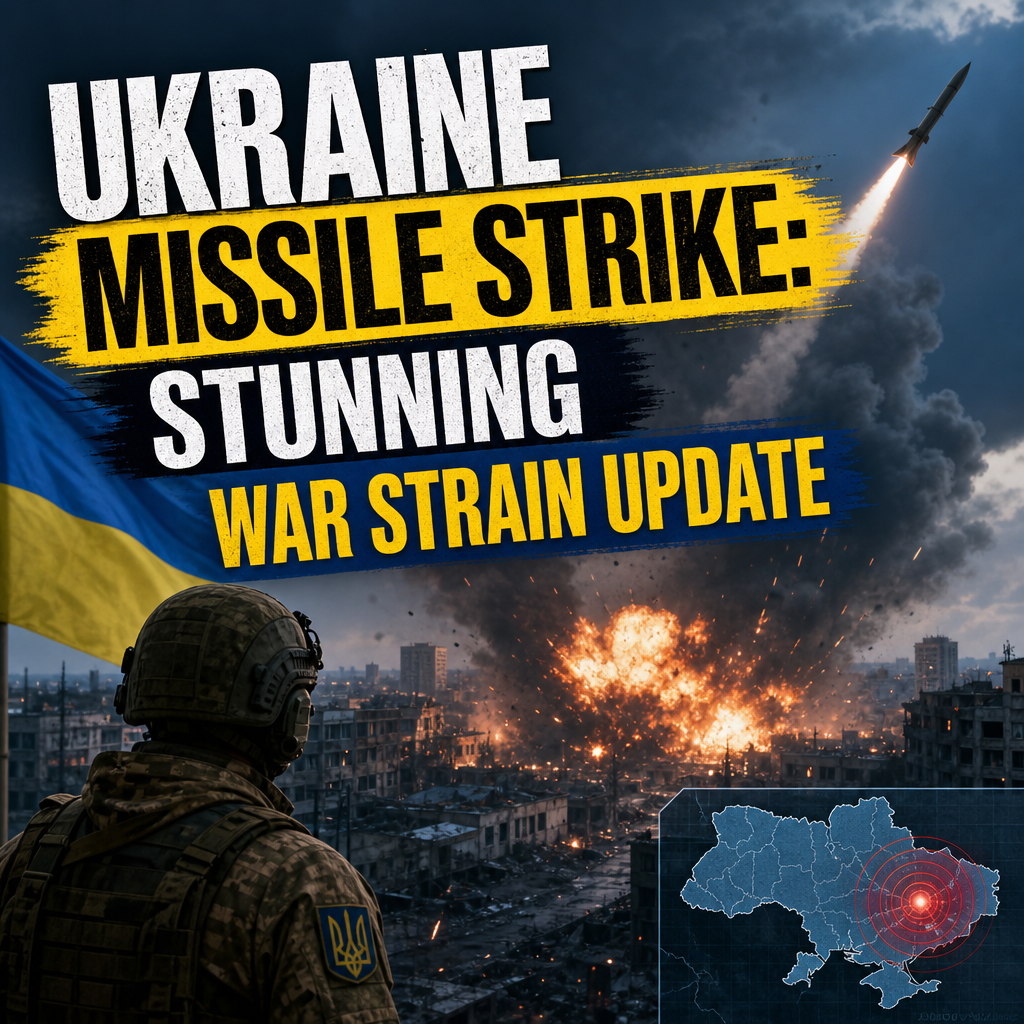
Ukraine Missile Strike: Stunning War Strain Update


Ukraine missile strike has once again put the human and economic cost of the war into sharp focus, with fresh reports of deaths in Ukraine alongside signs that Russia is feeling increasing strain at home. What makes this moment notable is not just the destruction from the strike itself, but the broader picture emerging across international coverage: battlefield violence continues, even as the war’s pressure spreads deeper into both societies and their economies.
The latest reports point to a familiar but unsettling pattern. On one side, Ukrainian communities continue to face deadly missile attacks that disrupt daily life, damage infrastructure, and force authorities to keep responding to repeated emergencies. On the other, Russia appears to be contending with a war that is no longer just a military operation but an economic burden with wider consequences. Together, those developments suggest a conflict that remains brutally active while also becoming harder for both sides to sustain.



Ukraine missile strike and the human toll
The most immediate and visible consequence of the latest attack is the loss of life. Even when casualty numbers are relatively small compared with the largest wartime tragedies, each strike reinforces the same grim reality: civilians remain exposed, air defenses are constantly tested, and the front line of danger often reaches far beyond the battlefield.
That is the part of the story that tends to unite international reporting. Whether the emphasis is on military developments, humanitarian concerns, or political messaging, there is no escaping the basic fact that missile strikes continue to exact a heavy civilian price. For families living under threat, the war is not an abstraction or a negotiating point. It is the sound of warnings, the rush to shelter, and the aftermath of shattered homes and lives.




At the same time, the attack also fits into a larger strategic picture. Ukraine has repeatedly sought to show that it can absorb pressure while maintaining resilience, but repeated strikes still strain emergency services, energy systems, and public morale. The damage may be localized in one incident, yet the cumulative effect is national.
What the strike says about the war right now
Several themes stand out:
– Civilian safety remains precarious, even far from the most intense ground fighting.
– Air defenses may limit damage, but they cannot eliminate the risk of missile attacks.
– Every new strike reinforces the war’s long-term psychological burden.
– The conflict continues to shift between military momentum and economic endurance.
That combination matters because it shows the war is now being fought on more than one front. Russia and Ukraine are still contesting territory and battlefield advantage, but they are also locked in a battle of resilience.
Russia’s economic strain adds a new layer
The broader significance of the reporting is the suggestion that Russia is feeling the pressure of a prolonged war economy. Coverage pointing to economic strain matters because it challenges the idea that wartime endurance depends only on weapons and manpower. Sanctions, labor shortages, inflation, budget pressure, and uneven consumer conditions can gradually reshape the political and social environment around the war.
This does not mean Russia is nearing collapse. That would be too simplistic, and the available reporting does not support such a conclusion. But it does suggest that the war’s costs are becoming more visible. A country can sustain military operations for a long time while still absorbing economic damage that eventually affects households, industries, and state finances.
That is why analysts often watch for signs such as:
– slower growth or overheating in war-related sectors
– rising budget pressure from military spending
– reduced consumer purchasing power
– strains in labor markets as workers are pulled into the defense economy
– increasing dependence on state support or redirected industrial output
Put plainly, war can create a strange kind of economic momentum at first, especially when defense production expands. But that momentum is often deceptive. Over time, it can mask deeper weakness, particularly if the broader economy becomes distorted by conflict priorities.
Different media lenses shape the picture
One reason this story is worth reading carefully is that the same event can look very different depending on the source. Al Jazeera’s framing tends to place civilian suffering and geopolitical consequences at the center, while also connecting the strike to the wider cost of war. Sky News, in its global coverage, often emphasizes the immediate developments and their implications for international security and diplomacy. RT, by contrast, frequently presents the war through a Russian state-aligned lens, which can shift emphasis toward military necessity, Western responsibility, or the economic pressures imposed by sanctions.
Those differences do not make every account equally persuasive, but they do matter. They remind readers to separate the facts on the ground from the interpretation layered on top of them. The fact of a missile strike killing civilians is not in dispute. The debate begins when sources explain what it means, who is responsible for escalation, and whether economic strain will alter the war’s trajectory.
A fair reading of the reporting is that all three broad perspectives help reveal something useful:
– Al Jazeera highlights the humanitarian and geopolitical cost.
– Sky News places the event within a wider global security context.
– RT reflects how Russian audiences may be told to understand the war’s pressures and justification.
Taken together, they show a conflict that is being narrated as fiercely as it is being fought.
A war entering a more difficult phase
The strongest conclusion from the available reporting is not that the war is nearing an end, but that it is entering a more difficult phase of endurance. Missile strikes still kill and destabilize. Economic pressure is beginning to shape the environment in which the war is being sustained. And both sides continue to face the challenge of maintaining public support while absorbing losses.
What remains uncertain is how quickly economic strain might translate into political or military change. History offers many examples of states enduring hardship longer than expected, especially when leadership frames survival as a national duty. At the same time, prolonged wars often erode confidence in ways that are not immediately visible from the outside.
For now, the clearest picture is one of grim continuity: civilians remain vulnerable, military pressure continues, and the economic consequences are widening. That makes the latest update important not because it changes the war overnight, but because it reveals how the conflict is deepening into every part of life.
In that sense, the real story is not only the missile strike itself. It is the increasingly complicated strain of a war that is still active, still devastating, and still reshaping both countries in ways that may outlast the fighting.