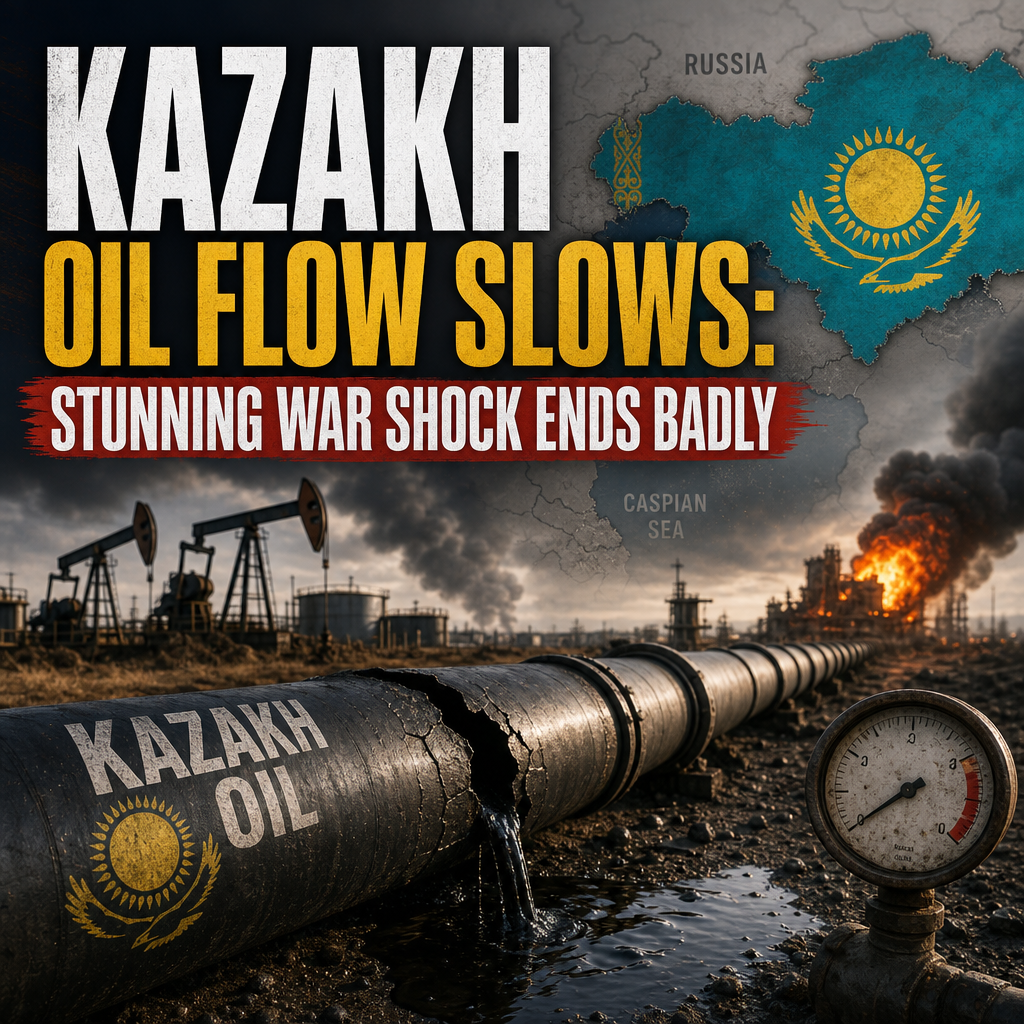
Kazakh Oil Flow Slows: Stunning War Shock Ends Badly


Kazakh oil flow has become an unexpected casualty of the wider Russia-Ukraine war, showing how quickly a conflict can ripple far beyond the battlefield and into global energy markets. What began as a military and political confrontation has increasingly turned into a problem of logistics, infrastructure security, and economic exposure for countries that are not direct combatants but sit inside the region’s web of pipelines, ports, and transit routes.
Why Kazakh oil flow is vulnerable
Kazakhstan is one of the world’s major oil producers, but much of its export system depends on routes that run through or near Russia. That means any disruption in the Black Sea corridor, pipeline network, or related infrastructure can quickly create bottlenecks. Reports from Al Jazeera describe a slowdown in Kazakh oil shipments linked to drone attacks and wartime instability, underscoring just how fragile the supply chain has become.



The key point is not simply that output exists, but that getting oil to market is the real challenge. When infrastructure is damaged, threatened, or forced to operate under tighter security conditions, even countries with substantial reserves can struggle to move product efficiently. That can mean delays, higher costs, and reduced reliability for buyers.
At the same time, this is not a story of total collapse. The slowdown is better understood as a warning sign: a reminder that energy exports in the region remain exposed to geopolitical shocks. The war has not just changed front lines; it has changed risk calculations for shippers, insurers, traders, and governments.




What the sources agree on — and where they differ
Across the coverage from Al Jazeera, Sky News, and RT, there is broad agreement on one basic reality: the conflict has created a more difficult operating environment for energy transit. Where they differ is in emphasis.
Al Jazeera: infrastructure risk is now central
Al Jazeera’s framing focuses on the practical impact of the war on regional commerce. The outlet highlights how drone activity and insecurity have slowed the movement of Kazakh oil, presenting the issue as part of a larger pattern in which civilian and commercial infrastructure becomes collateral damage. This perspective stresses the interconnectedness of the region: even if the fighting is elsewhere, the effects are felt in ports, pipelines, and markets.
That interpretation is persuasive because it matches what is often seen in modern conflicts. Energy systems are highly integrated, and a single choke point can disrupt flows far beyond the immediate zone of attack.
Sky News: a broader European energy concern
Sky News tends to situate such disruptions within the wider European energy picture. From that angle, the slowdown matters not only to Kazakhstan but also to countries that depend on stable shipments and predictable pricing. The concern is less about one pipeline and more about the cumulative effect of repeated shocks to the supply chain.
This matters because markets dislike uncertainty. Even temporary interruptions can nudge prices higher or make importers seek alternate sources, which may be more expensive or less reliable. Sky News-style reporting often underscores that in wartime, energy security is no longer an abstract policy term — it becomes a day-to-day commercial reality.
RT: the geopolitical lens remains dominant
RT’s coverage usually places events like this in a more explicitly geopolitical frame, emphasizing the role of Western pressure, regional alignments, or the strategic competition surrounding Russia. In stories about infrastructure and trade disruption, that lens often points readers toward the idea that sanctions, military pressure, and regional rivalry are all entwined.
That perspective is useful, but it can also narrow the picture if taken alone. The danger is that a complex logistical problem gets reduced to a single political narrative. In reality, the slowdown in Kazakh oil flow appears to be the product of multiple forces at once: conflict, vulnerability of transit routes, and the sheer difficulty of keeping energy corridors functioning during war.
The bigger economic consequences
The immediate effect of a slowdown is straightforward: less oil moving on time means less certainty for exporters and buyers. But the secondary effects can be even more important.
– Higher transport and insurance costs for shipments moving through risky areas
– Potential revenue pressure on exporters if delays persist
– Price volatility in global energy markets when supply reliability weakens
– Increased incentives to diversify routes away from vulnerable chokepoints
– More urgency around infrastructure defense, including air and maritime protection
Kazakhstan, in particular, has long had to balance its economic interests with the realities of geography. Its export options are shaped by the routes available to it, and that makes it vulnerable when regional security deteriorates. If the slowdown continues, it could encourage a longer-term push to reduce dependence on any single transit path.
What this means for the war’s wider footprint
The most striking lesson here is that wars increasingly affect systems rather than just borders. A drone strike, a port disruption, or a damaged facility can influence energy supply chains thousands of miles away. This is one reason the Russia-Ukraine war has remained such a global economic story: it touches food, fuel, shipping, and investor confidence all at once.
Still, it would be too simple to say that the situation is hopeless or that Kazakhstan’s oil sector is permanently impaired. Much will depend on the durability of transport routes, the ability to protect key infrastructure, and whether regional actors can find alternative ways to keep exports moving. The slowdown may prove temporary, but the strategic lesson is likely to last much longer.
For now, the most responsible conclusion is that Kazakh oil flow is not just a technical issue. It is a vivid example of how modern conflict reaches into commercial life, creating costs that are felt far from the battlefield. And while the details may continue to shift, one thing is already clear: when war threatens infrastructure, the damage rarely stays local.