US-Iran Strikes: Stunning Crisis Sparks Civil War Warning


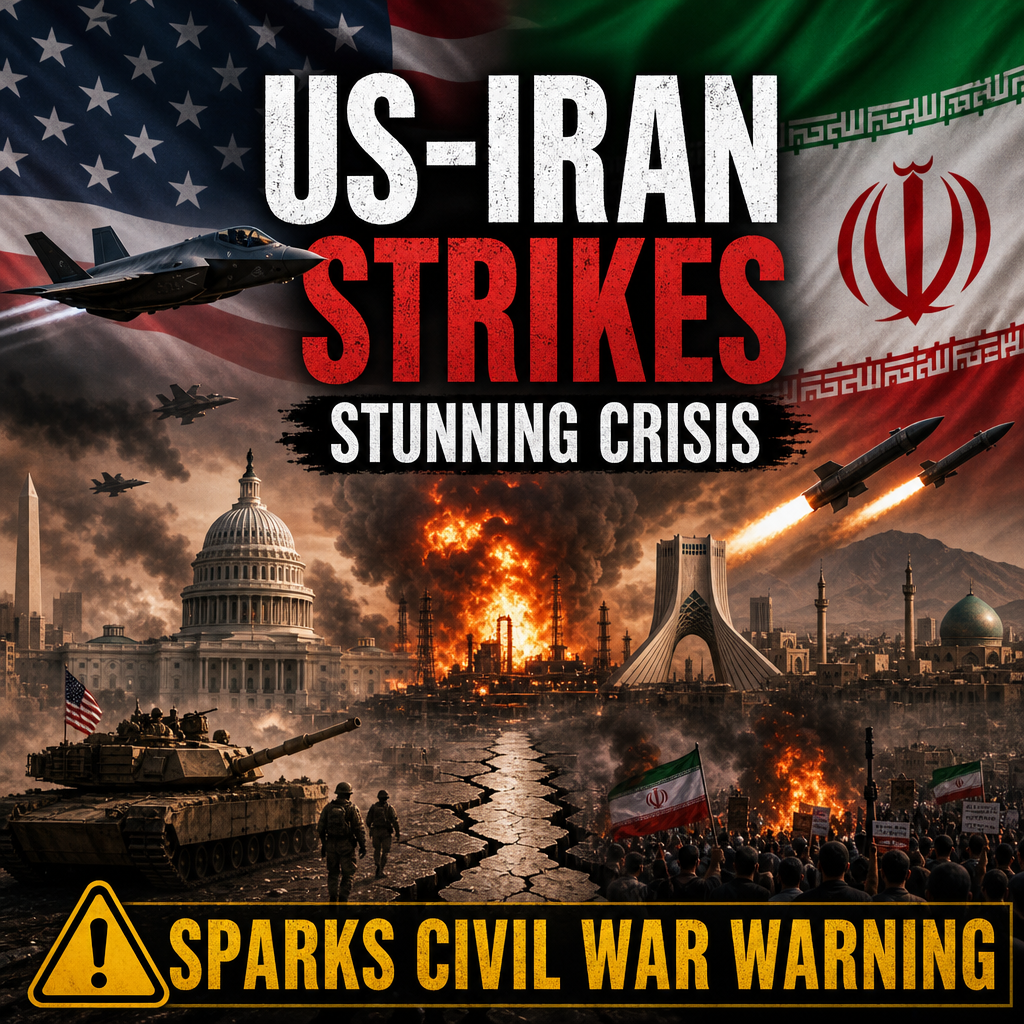
US-Iran strikes have pushed an already volatile Middle East into a new and unsettling phase, with warnings that the confrontation could widen into a broader regional conflict if diplomacy fails to catch up with events on the ground. The immediate picture is one of escalation and fear: military action has triggered retaliatory rhetoric, governments are urging restraint, and public anger is spilling into the streets in several countries. Yet the deeper story is more complicated than a simple cycle of attack and response. What happens next depends not only on Washington and Tehran, but also on allied militias, regional governments, and the willingness of outside powers to restrain the crisis before it hardens into something far harder to stop.
US-Iran strikes and the risk of a wider breakdown
The most alarming element in the current standoff is not just the strikes themselves, but the uncertainty around where escalation ends. In coverage from multiple international outlets, a common thread is that each side presents its actions as defensive, while critics argue that the strikes risk crossing a threshold that can no longer be managed by deterrence alone. That is where the phrase “civil war warning” enters the conversation: not necessarily as a precise prediction, but as a shorthand for the fear that fragile states and divided societies in the region could become the arenas in which a larger confrontation is fought indirectly.



This is why analysts are paying close attention to Lebanon, Syria, Iraq, and other flashpoints where armed groups already operate with varying degrees of autonomy. If the conflict between the United States and Iran intensifies, those networks could be drawn in through missile attacks, drone launches, border clashes, or political pressure on already shaky governments. The danger is that local grievances, sectarian tensions, and economic desperation could merge with the larger geopolitical crisis.
There is also a domestic dimension. In several countries, street protests and public frustration reflect more than anger at one strike or another. They signal exhaustion with endless instability. People living through economic crisis, displacement, and political deadlock are often less concerned with abstract strategy than with the immediate risk of power cuts, food shortages, and another wave of violence.




Why some observers see deterrence, not disaster
Not everyone reads the situation as the start of a full regional collapse. Some security voices argue that forceful action can restore deterrence and prevent even larger attacks later. From this perspective, limited strikes are meant to signal red lines, not launch a war. Governments backing this view often claim that hesitation invites further aggression, especially when armed groups have already shown they can operate across borders with relative impunity.
Supporters of this approach also point out that regional actors have incentives to avoid an all-out war. Iran has little interest in a direct confrontation that could damage its infrastructure and economy. The United States, meanwhile, would face enormous political and military costs in any prolonged campaign. Several Arab states, too, would likely prefer containment over escalation, because a wider war would threaten trade routes, oil markets, and internal stability.
Still, deterrence only works if all sides believe the boundaries are clear. The trouble in the current moment is that the boundaries look increasingly blurred.
Al Jazeera, Sky News and RT reflect very different readings
The contrast in coverage from major international outlets shows just how differently the crisis is being framed. Al Jazeera’s reporting tends to emphasize the humanitarian and political consequences, especially for civilians caught in the middle and for governments trying to keep order amid public anger. That lens highlights the human cost and the structural fragility of the region.
Sky News, by contrast, typically centers the strategic and diplomatic angle: whether the strikes will trigger a broader war, how allies respond, and whether leaders can step back before a miscalculation becomes irreversible. This framing is useful because it places the crisis in a wider geopolitical context, but it can sometimes understate the lived reality of people in places where instability is already normal.
RT coverage often spotlights the anti-Western critique and the argument that U.S. actions are fueling instability rather than preventing it. That perspective resonates with audiences skeptical of American military intervention, though it can also flatten the complexity of regional politics by treating all escalation as one-sided. Even so, it is valuable as a counterweight to more official Western narratives, because it reminds readers that many outside the United States see the crisis as a repeat of earlier interventions that produced long-term damage.
Taken together, these viewpoints suggest there is no single clean interpretation of what is happening. The dispute is at once military, political, psychological, and symbolic.
What the crisis may mean next
The most realistic short-term scenario is not necessarily immediate regional war, but a dangerous chain of smaller escalations. That could include:
– retaliatory strikes by proxy groups
– increased pressure on U.S. bases and interests in the region
– domestic unrest in countries already under strain
– intensified diplomatic standoffs at the United Nations and among regional powers
– disruption to shipping, markets, and energy supplies
This is where the “civil war warning” deserves careful handling. It should not be read as a certainty, but it should not be dismissed either. In fragile states, external shocks can deepen internal fractures. A strike that seems limited on paper can become catalytic when it lands in a society already close to breaking point.
The stronger conclusion, then, is that the crisis is less about one dramatic moment than about accumulated pressure. Years of mistrust, proxy conflict, failed diplomacy, and regional polarization have made the system highly combustible. If leaders continue to frame escalation as strength, the room for a negotiated off-ramp will shrink fast.
For now, the balance of evidence points to a dangerous standoff rather than a settled outcome. That uncertainty is exactly what makes the situation so alarming. The region has seen crises before, but the combination of military action, public unrest, and overlapping political fault lines means the margin for error is unusually thin. If cooler heads do not prevail soon, the warning signs could become the story itself.