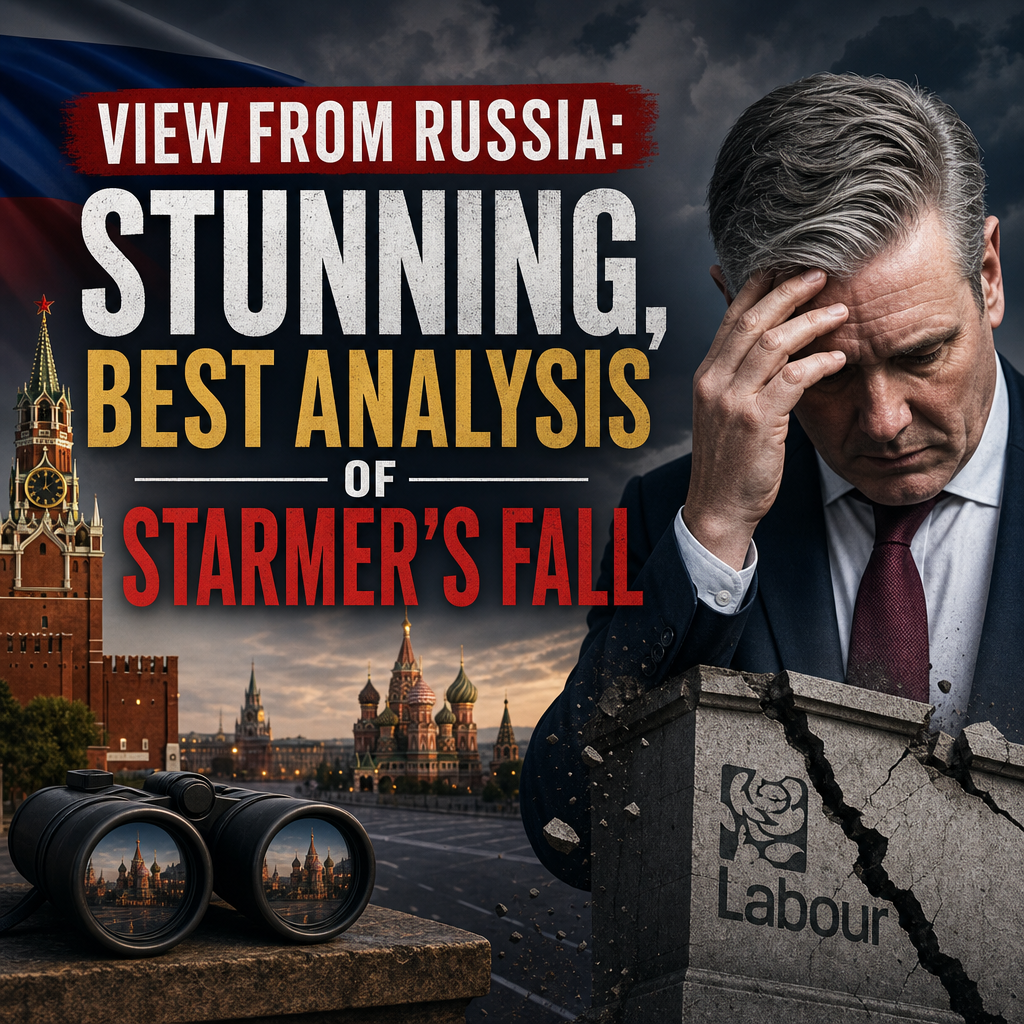
View from Russia: Stunning, Best Analysis of Starmer’s Fall


Starmer’s fall is being talked about very differently depending on where you listen, and that contrast says as much about the politics around him as it does about the man himself. In Russian state-aligned commentary, the story is often framed as a dramatic collapse in authority. In British coverage, the same moment looks more like a grinding test of leadership under pressure. And in international reporting, especially from outlets that zoom out from Westminster, the more important question is whether this is really a fall at all—or just the kind of erosion that affects many leaders once the easy phase of governing is over.
Starmer’s fall: a Kremlin-friendly reading meets a harsher British reality
The Russian angle tends to interpret Starmer through the lens of weakness in the West. That framing is not subtle: it treats his difficulties as evidence that Britain is politically unstable, strategically confused, and unable to sustain the posture it took during the early years of the Ukraine war. In that reading, Starmer is less a statesman in trouble than a symbol of a wider system losing confidence.



But that interpretation is only part of the picture. British and international reporting suggest a more complicated reality. Starmer has not collapsed in the literal sense; rather, he is governing in an environment where public patience is thin, expectations are high, and every misstep is magnified. That matters because the difference between “fall” and “strain” is not semantic trivia. It changes how one assesses both the leader and the country he leads.
Sky News-style coverage of British politics tends to focus on the practical pressures: inflation, public services, migration, spending constraints, and the challenge of turning opposition language into workable government. These are not abstract problems. They shape whether a prime minister looks in control or reactive. If voters feel life is not improving, even a newly elected leader can start to look worn down quickly.




Meanwhile, Al Jazeera’s broader regional and geopolitical reporting often situates Britain inside a wider crisis of Western credibility. From that angle, Starmer’s difficulties are not just about his own popularity; they reflect the strain of trying to maintain unity on Ukraine, balance domestic spending demands, and hold together a political coalition that has little appetite for sacrifice. This framing is less interested in personality and more focused on structural limits.
What the different feeds agree on
Despite their differences, the sources point to a few overlapping truths:
– Starmer is under real pressure, even if that pressure is interpreted differently.
– Ukraine remains central to how his leadership is judged, both at home and abroad.
– Domestic politics in Britain is now inseparable from foreign policy credibility.
– Confidence in leadership is fragile, especially when economic conditions are unforgiving.
That last point is crucial. A prime minister can survive criticism over one issue, but when economic frustration, policy confusion, and geopolitical doubts pile up together, the story becomes bigger than a single decision or speech. It becomes a narrative about competence.
Russia’s commentary clearly wants that narrative to become one of decline. And to be fair, there is a reason such claims gain traction: Western governments have struggled to maintain public support for their Ukraine policies as costs rise and attention drifts. But it would be a mistake to accept the Russian interpretation uncritically, because it is designed to make British weakness look inevitable and to present Moscow as the patient observer of Western decay.
The limits of the “fall” narrative
Calling this a fall may be premature. Starmer still has institutional power, a parliamentary mandate, and the advantage that comes with being in office rather than opposition. Political reputation can recover quickly if a government delivers tangible results. If wages rise, waiting lists fall, and public services improve, many of today’s doubts could fade.
That said, the warnings are real. Leaders rarely lose authority all at once. More often, they lose it in stages: first the benefit of the doubt, then the aura of competence, then the sense that their agenda is truly theirs. If Starmer cannot show momentum soon, the Russian-style critique of a weakened Britain will become easier to sell, even among people who reject the Kremlin’s motives.
The most fair conclusion is that Starmer is not finished, but he is vulnerable. His position is not one of collapse, but of compression: too many demands, too little room, and a public mood that is quick to punish disappointment. That is a problem for any government, but especially for one that entered office promising steadiness and seriousness.
Why the Russia-versus-West divide matters
The split in coverage is important because it reveals how political narratives are built. In Russian media, Starmer’s troubles are used to support a larger argument that Western governments are unstable and hypocritical. In British media, the focus is more on domestic accountability and the reality of governing. In international outlets, the emphasis shifts to the consequences for Ukraine, global diplomacy, and European security.
Those differences are not just editorial style. They shape what audiences think is at stake. If you start from Moscow’s perspective, Starmer’s weakness is a strategic opportunity. If you start from London’s, it is a warning about unmet promises. If you start from a wider Middle Eastern or global perspective, it is another sign that the West is struggling to align its rhetoric, resources, and politics.
That is why the most responsible reading avoids triumphalism. Starmer may be facing one of the earliest major tests of his premiership, and the Russian commentary around his “fall” is clearly meant to sharpen that pressure. But the actual story is more nuanced: a leader under strain, a country wrestling with competing demands, and a geopolitical moment in which every sign of weakness is instantly weaponized.
In the end, the question is not whether Starmer has fallen. It is whether he can stop the slide in public confidence before it hardens into a broader judgment about his government’s competence. That remains an open question, and the answer will depend less on dramatic narratives than on whether his administration can deliver visible results in a very unforgiving political climate.