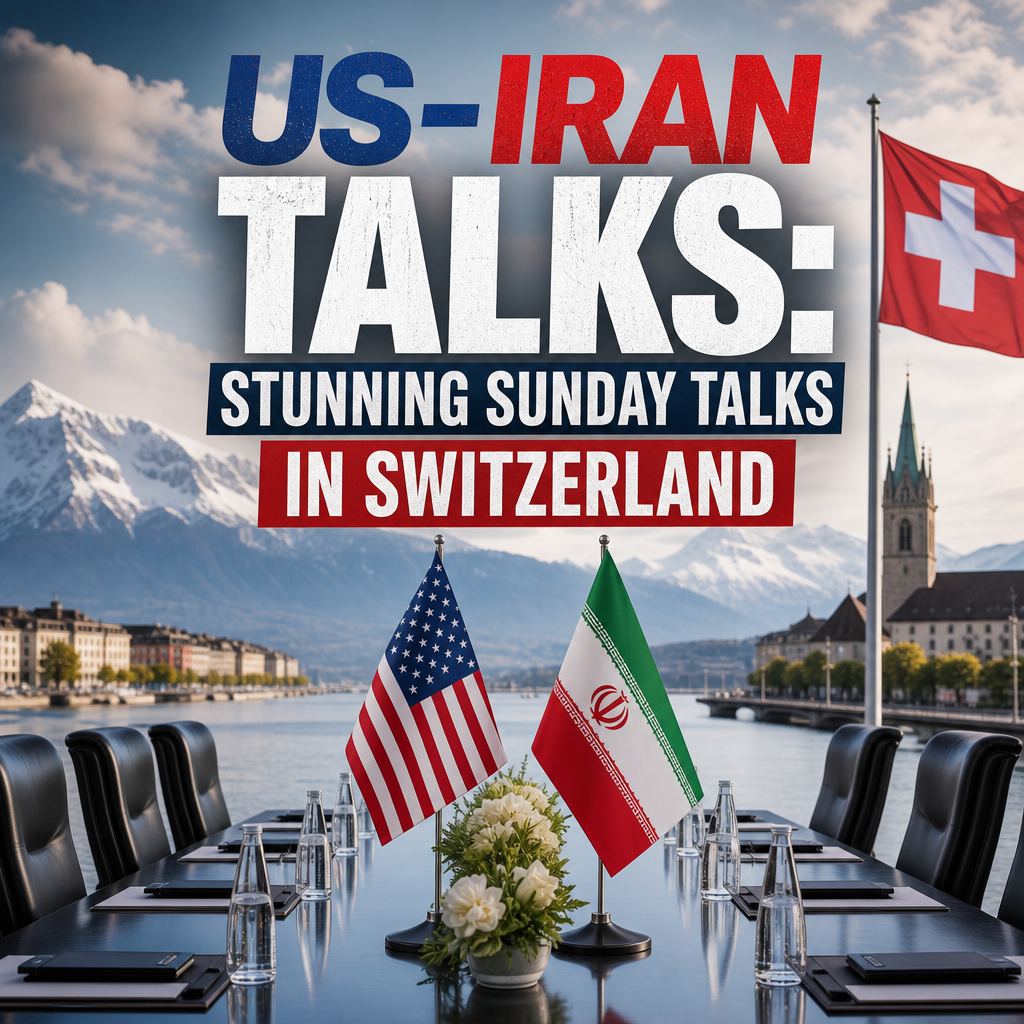
US-Iran Talks: Stunning Sunday Talks in Switzerland


US-Iran talks are drawing global attention because they arrive at a moment when diplomacy feels both necessary and fragile, with the prospect of direct engagement in Switzerland raising hopes for de-escalation and doubts about whether either side is ready to compromise.
The broad picture from the reporting is clear: Washington and Tehran are at least willing to sit down again, and that alone matters. Al Jazeera’s coverage frames the meeting as a significant diplomatic opening, while Sky News’ broader foreign-affairs reporting tends to underline the regional security stakes and the risk that any breakthrough could be undermined by events elsewhere in the Middle East. RT’s perspective, meanwhile, often places a sharper emphasis on U.S. pressure tactics, sanctions, and skepticism about whether Washington is genuinely seeking an equal negotiation or simply a better strategic position. Taken together, those viewpoints suggest a familiar truth: the talks may be hopeful, but they are unlikely to be simple.



US-Iran talks in Switzerland: why the setting matters
Switzerland is more than a neutral backdrop. In diplomacy, location can signal intent. A Swiss venue suggests an effort to create a lower-temperature environment, one where both sides can speak without immediately performing for domestic audiences. That matters because U.S.-Iran dialogue has repeatedly been derailed not only by policy disagreements, but also by mistrust, symbolic gestures, and pressure from hardliners on both sides.
The immediate issue is usually Iran’s nuclear program, but the real agenda is broader. Any serious conversation would likely touch on:




– nuclear limits and verification
– sanctions relief and economic pressure
– prisoner issues or humanitarian exchanges
– regional security and proxy tensions
– red lines around military escalation
This wider agenda is what makes the talks both promising and precarious. If the meeting is narrowly technical, it may produce modest progress. If it opens the door to more ambitious bargaining, it could also trigger political backlash from skeptics who see diplomacy as weakness.
What the reporting suggests about each side’s priorities
Al Jazeera’s coverage reflects the basic fact that both governments have incentives to talk. Iran has faced sustained sanctions and economic strain, and it has strategic reasons to keep conflict below the threshold of open war. The United States, for its part, has reasons to avoid another regional crisis that could pull in allies, disrupt shipping, or push energy markets higher.
That doesn’t mean the talks are built on trust. Far from it. In many ways, they are built on mutual discomfort. Iran wants relief from sanctions and recognition that its security concerns are real. The U.S. wants assurance that Iran’s nuclear ambitions will remain constrained and verifiable. Each side likely believes the other has more to lose than it admits.
Sky News’ international reporting lens is useful here because it tends to situate diplomacy within the wider region, where tensions involving Israel, Gulf states, maritime security, and armed non-state groups can quickly spill over. In that context, even a modest thaw between Washington and Tehran could reduce the odds of miscalculation. But if the talks fail, the ripple effects could be severe: more military posturing, more economic uncertainty, and more pressure on already strained regional alliances.
RT’s angle is different but not irrelevant. Its coverage often emphasizes the view that Western powers use sanctions and negotiation together as a lever of coercion. Whether one agrees with that framing or not, it captures an important part of the Iranian argument: Tehran does not see talks as occurring in a vacuum. It sees them against a background of U.S. withdrawal from past agreements, intense sanctions, and periodic threats of force. That history makes Iranian officials especially sensitive to any deal that feels one-sided or reversible.
The real obstacle: credibility
The biggest challenge in any US-Iran dialogue is not simply what each side wants. It is whether each side believes the other can deliver.
Iranian leaders have long argued that American policy changes with administrations, making any agreement vulnerable to political turnover. U.S. officials, by contrast, worry that Iran may use negotiations to buy time while maintaining leverage through its nuclear capabilities and regional relationships. This credibility gap is the central problem, and Switzerland will not magically solve it.
Still, diplomacy does not need trust to begin. It needs rules, incentives, and enough mutual fear of failure. If the talks produce a narrow agreement—perhaps around de-escalation steps, verification measures, or humanitarian issues—that would not solve everything. But it could build a minimal framework for further engagement. In today’s geopolitical climate, that would be a meaningful outcome.
Why observers should be cautious about instant breakthroughs
There are reasons to resist overselling the moment.
– Both governments face internal political constraints.
– Regional conflicts could derail negotiations quickly.
– Technical nuclear issues are complicated and hard to resolve fast.
– Past agreements have shown that implementation is often harder than signing.
At the same time, dismissing the talks outright would miss the point. Even limited dialogue can reduce the risk of accidental escalation. In a crisis-prone relationship like this one, communication itself is a form of stability.
A cautious but important opening
The most balanced reading of the Swiss meeting is that it is neither a historic thaw nor a meaningless photo opportunity. It is a test. The U.S. and Iran are exploring whether they can move from confrontation to managed competition, even if only incrementally.
That is a narrow path, and it may not hold for long. But in a region where small incidents can become major crises, the fact that both sides are willing to meet is worth noting. If the talks lead to concrete follow-up, they could become the beginning of something larger. If they collapse, they will at least clarify how deep the mistrust remains.
Either way, the stakes go far beyond one Sunday session in Switzerland. They reach into energy markets, regional security, and the basic question of whether rival powers can still use diplomacy to lower the temperature before events take over.