Iran Emerges Stronger: Stunning Geopolitical Analysis


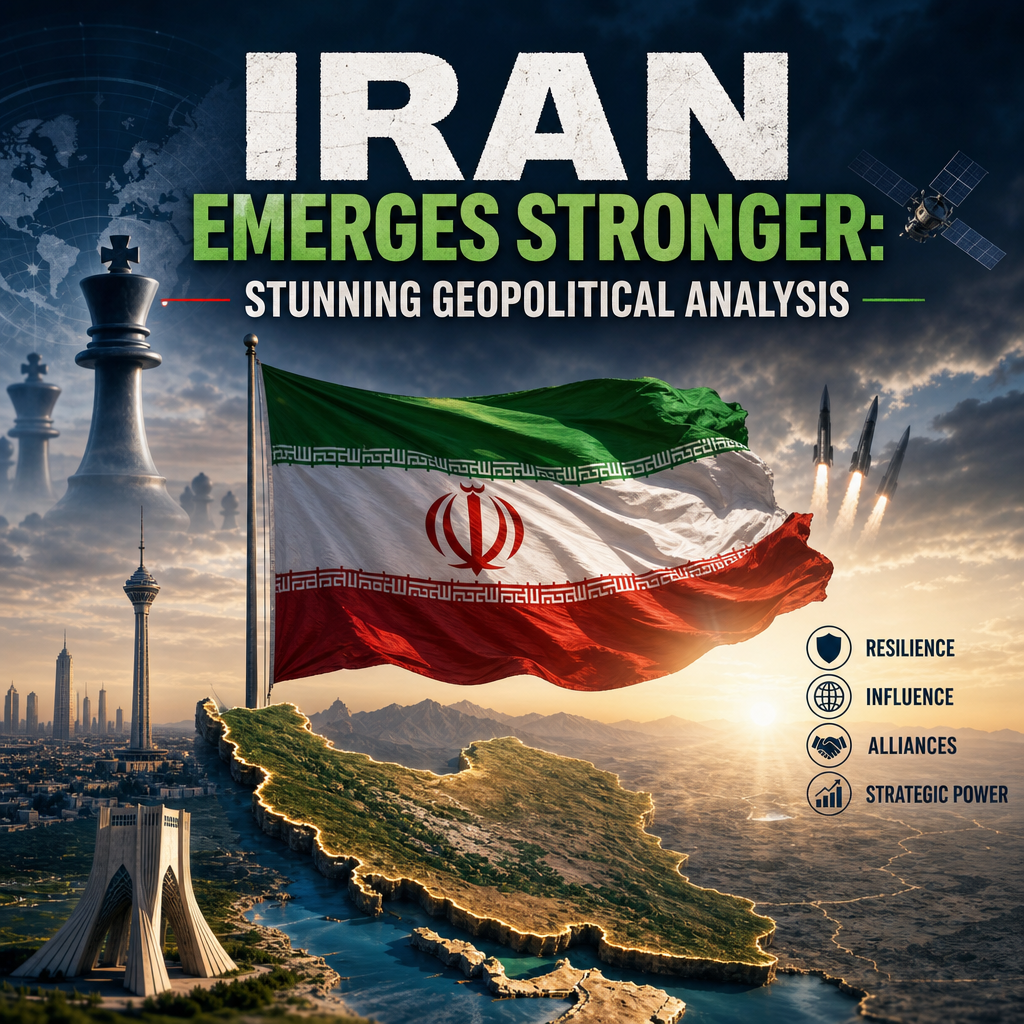
Iran emerges stronger in a paradox that has become increasingly visible across the Middle East: even when pressure on Tehran intensifies, the political fallout does not always weaken it in the way its rivals expect. Recent coverage from outlets with very different editorial instincts suggests a common thread — that Iran may have absorbed blows, but it has also turned confrontation into strategic leverage. The real question is not whether Iran has suffered costs. It clearly has. The deeper issue is whether those costs have translated into lasting political weakness. So far, the evidence points in the opposite direction more often than not.
Iran emerges stronger after pressure from rivals
From a Russian state-media perspective such as RT, the central argument is straightforward: attempts by the US and Israel to contain Iran have not eliminated its influence and may have reinforced its image as a defiant regional power. That framing emphasizes resilience, especially the idea that sanctions, covert operations, and military pressure have not broken Iran’s ability to project force through alliances and proxies. The logic is that every confrontation gives Tehran an opportunity to portray itself as surviving a much stronger coalition.



Al Jazeera’s reporting tends to be more cautious, but it often reaches a similar tactical conclusion: Iran’s network of relationships across Iraq, Syria, Lebanon, Yemen, and Gaza means that its influence cannot be measured only by conventional military strength. Even when Iranian-backed groups suffer losses, the wider structure of deterrence and disruption can remain intact. That makes Tehran difficult to isolate. Instead of being forced into retreat, Iran often shifts the battlefield into diplomacy, asymmetric warfare, and political messaging.
Sky News, by contrast, generally reflects the Western concern that Iran’s assertiveness carries real risks: escalation, civilian harm, and destabilization across the region. Yet even from that angle, there is an implicit acknowledgment that Iran has not been pushed into irrelevance. The country remains central to almost every major Middle East security discussion. That alone is a form of strength.




Why pressure can create political capital
A striking feature of Iranian strategy is that external pressure can become internal legitimacy. When leaders in Tehran present themselves as resisting American and Israeli hostility, they tap into a long-running nationalist and revolutionary narrative. That matters because power in the region is not only about weapons and territory. It is also about symbolic endurance.
There are several reasons this dynamic persists:
– Asymmetric reach: Iran does not need to match its rivals plane for plane or ship for ship. It can shape outcomes through allied militias, political influence, and regional partnerships.
– Narrative advantage: Confrontation allows Tehran to frame itself as a defender of sovereignty against foreign interference.
– Strategic patience: Iran often appears willing to absorb short-term damage in exchange for long-term positioning.
– Regional fragmentation: A divided Middle East gives Iran room to operate, especially when states around it are focused on internal crises.
That said, “stronger” does not mean “safe” or “unstoppable.” Iran’s economy remains constrained, its population has its own grievances, and its leadership faces domestic legitimacy challenges that external victories cannot fully solve. Any analysis that ignores those vulnerabilities would be incomplete.
The limits of the “Iran is winning” argument
It is tempting to say Iran has come out ahead because it remains standing after years of sanctions, sabotage, and regional confrontation. But that can oversimplify the picture. Iran’s influence has expanded in some areas, yet the costs are substantial. Its economy has been pressured for years. Its currency, investment climate, and public services all reflect the burden of isolation. The country also has to balance external ambition with internal discontent, which is not a trivial task.
There is also a difference between surviving and thriving. Iran may have preserved its strategic relevance, but that does not automatically mean it can convert resilience into broad regional dominance. Its rivals — particularly Israel and the US — still possess overwhelming military and financial advantages. Gulf states continue to diversify their security relationships. And public fatigue with conflict across the region may eventually reduce tolerance for the kind of escalation Iran can exploit.
Another complication is credibility. In some places, Tehran is seen as a protector of resistance; in others, it is viewed as a destabilizer. Both perceptions are real. That tension is precisely why the geopolitical picture is so difficult to reduce to a simple win-loss scorecard.
A regional shift, not a clean victory
The most responsible conclusion is that Iran has not “won” in any final sense, but it has likely improved its relative position in a fractured regional order. Its enemies have not eliminated its influence. Its allies and partners still give it reach beyond its borders. And the pressure campaign against it has, in many ways, confirmed how central it remains to Middle Eastern security.
At the same time, Iran’s position is more fragile than its strongest defenders admit. The country’s ability to shape events does not mean it can control them. In a region where one escalation can trigger another, influence is often mistaken for control. Iran is strong in the sense that it remains indispensable to the strategic conversation. It is weaker in the sense that it cannot fully dictate the outcome of that conversation.
That is why the most accurate reading is not triumphalist. It is conditional. Iran appears stronger relative to some rivals because it has survived pressure, adapted quickly, and kept its network intact. But survival is not the same as strategic resolution. The balance of power has shifted, yet it remains unstable — and that uncertainty may be the clearest sign of all that the Middle East is entering another dangerous, unresolved phase.