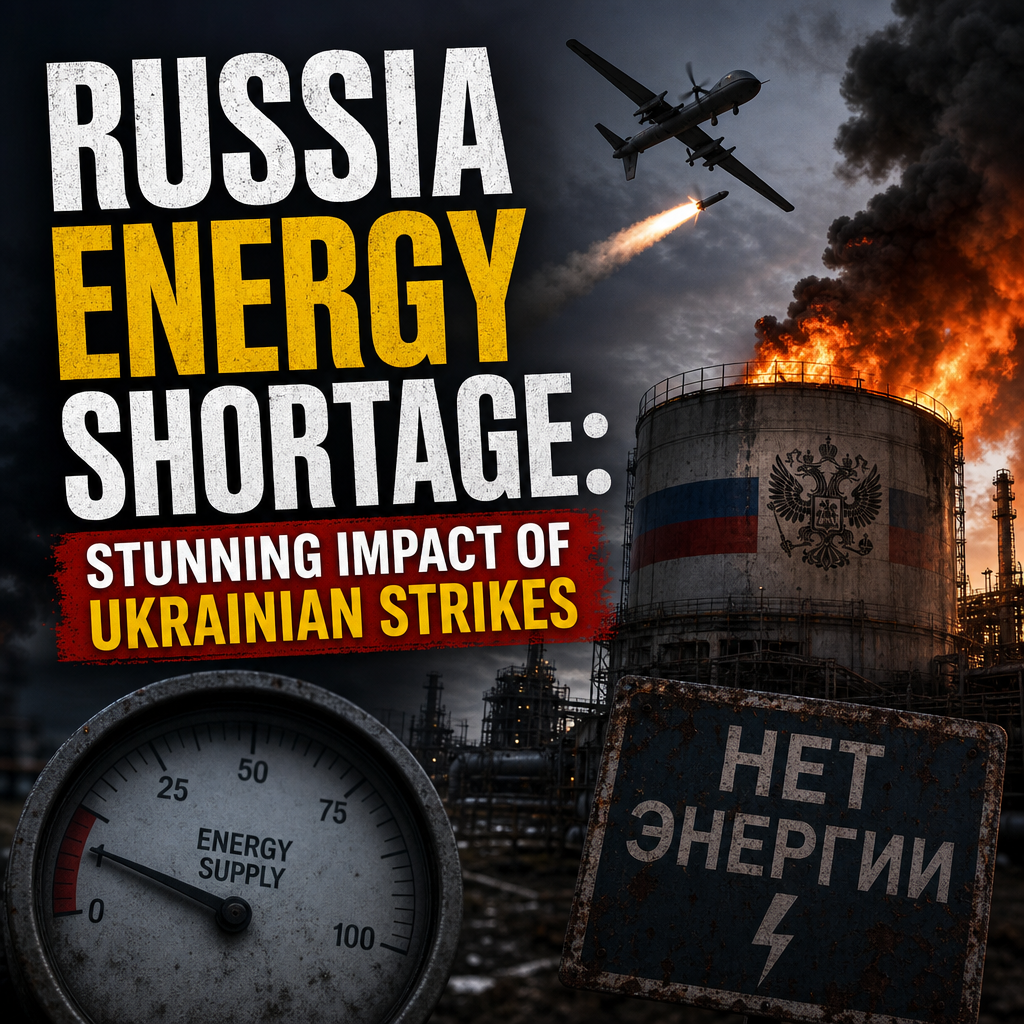
Russia Energy Shortage: Stunning Impact of Ukrainian Strikes


Russia energy shortage is emerging as one of the clearest signs that the war is increasingly affecting infrastructure deep inside Russia, but the scale and long-term meaning of the disruption are still being debated. Ukrainian drone and missile strikes on refineries, fuel depots, and other energy assets have raised questions not just about military vulnerability, but about how much pressure Russia can absorb before the damage starts showing up in prices, logistics, and public confidence.
What makes the story complicated is that the sources covering it frame the issue from very different angles. Al Jazeera’s reporting focuses on the practical consequences of repeated attacks and the possibility that shortages could spread beyond isolated facilities. RT, by contrast, tends to emphasize resilience, state response, and the argument that Russia can repair damage faster than Ukraine can sustain attacks. Sky News, meanwhile, generally places the strikes in the broader war context, highlighting their strategic value while also stressing that battlefield effects are difficult to measure in real time. Taken together, these viewpoints suggest one thing clearly: the damage is real, but the full economic and political impact is still unfolding.



Why the Russia energy shortage matters
Energy infrastructure is not just another war target. In a country as large as Russia, refineries, pipeline links, storage sites, and distribution networks are part of a system that keeps transport, industry, and regional supply functioning. When Ukrainian strikes hit these assets, the effect is rarely immediate nationwide collapse. Instead, the pressure builds through bottlenecks.
That may mean:




– higher fuel prices in some regions
– temporary rationing or supply delays
– more expensive transport and shipping
– strain on repair crews and air defenses
– possible knock-on effects for military logistics
The most important question is whether the strikes are forcing Russia to divert resources away from offense and toward defense. Even when a facility is repaired, repeated attacks can push operators into a cycle of patch-up, restore, and protect, which is costly and disruptive. That is why analysts quoted in coverage of the issue often describe the campaign as more about cumulative attrition than one dramatic knockout blow.
At the same time, claims about a nationwide energy crisis should be treated cautiously. Russia still has large energy reserves, significant repair capacity, and the ability to reroute supplies in some cases. A shortage in one area does not automatically mean a systemic breakdown. In that sense, the phrase “energy shortage” can sometimes sound broader than the evidence supports.
What the different news outlets emphasize
The news sources available here point to three broad interpretations.
Al Jazeera: pressure is building, but not uniformly
Al Jazeera’s coverage centers on how severe the shortage actually is, suggesting the answer depends on what part of the energy chain is being measured. A refinery hit in one region may not leave drivers without fuel everywhere, but repeated strikes can still create a wider sense of vulnerability. That distinction matters.
The channel’s framing also reflects a broader wartime reality: the impact of Ukrainian strikes is not only physical but psychological. If Russian authorities must repeatedly reassure the public that supplies are stable, that alone is evidence that the attacks are forcing a response.
RT: resilience and restoration
RT’s perspective is likely to stress that Russia has experience managing infrastructure damage and that state control over key sectors can limit panic. This framing usually presents any shortage as temporary, localized, or exaggerated by hostile reporting. It also tends to emphasize the work of emergency crews, alternative supply routes, and official statements saying the situation is under control.
That view is important because it reflects the Russian state’s own messaging priorities. Even if shortages are real, the government has strong incentives to avoid signaling weakness. The gap between official reassurance and on-the-ground inconvenience can therefore be significant.
Sky News: strategic effect without overstating certainty
Sky News typically approaches such developments through the lens of their military and political consequences. The reporting often treats strikes on energy assets as strategically meaningful, especially when they force Russia to stretch its defenses and deal with domestic disruption. But it also avoids assuming that every strike translates into immediate battlefield advantage.
That caution is warranted. The war has repeatedly shown that tactical gains and strategic effects do not always line up neatly. A damaged refinery can matter a great deal without changing the front line overnight.
The bigger picture: can strikes change the war?
The most balanced conclusion is that Ukrainian strikes are probably not “breaking” Russia’s energy system, but they are making it more expensive and more fragile. That alone is significant.
Three likely effects stand out:
1. Repair costs are rising.
Repeated hits mean more spending on repairs, air defenses, and redundancy.
2. Regional unevenness is growing.
Some areas may feel supply pressure more than others, which can create political noise even if the national system remains intact.
3. Military planning becomes harder.
Energy logistics are closely tied to transport and war production. Any disruption forces adjustments.
Still, the limits matter. Russia’s system is large, and wartime states can absorb damage longer than outside observers expect. Also, some claims made in wartime media are designed to support morale or undermine the enemy, so it is wise to separate verified disruption from broader narrative warfare.
The most responsible reading is this: Ukraine’s strikes have likely created a meaningful and costly energy headache for Russia, but not yet a decisive collapse. The real measure of success may not be whether Russia runs out of fuel nationwide, but whether the Kremlin is forced into a continuous defensive posture that drains money, attention, and confidence over time.
In that sense, the Russia energy shortage is less about a single dramatic blackout and more about attrition. And in a war defined by endurance, attrition can matter just as much as spectacle.