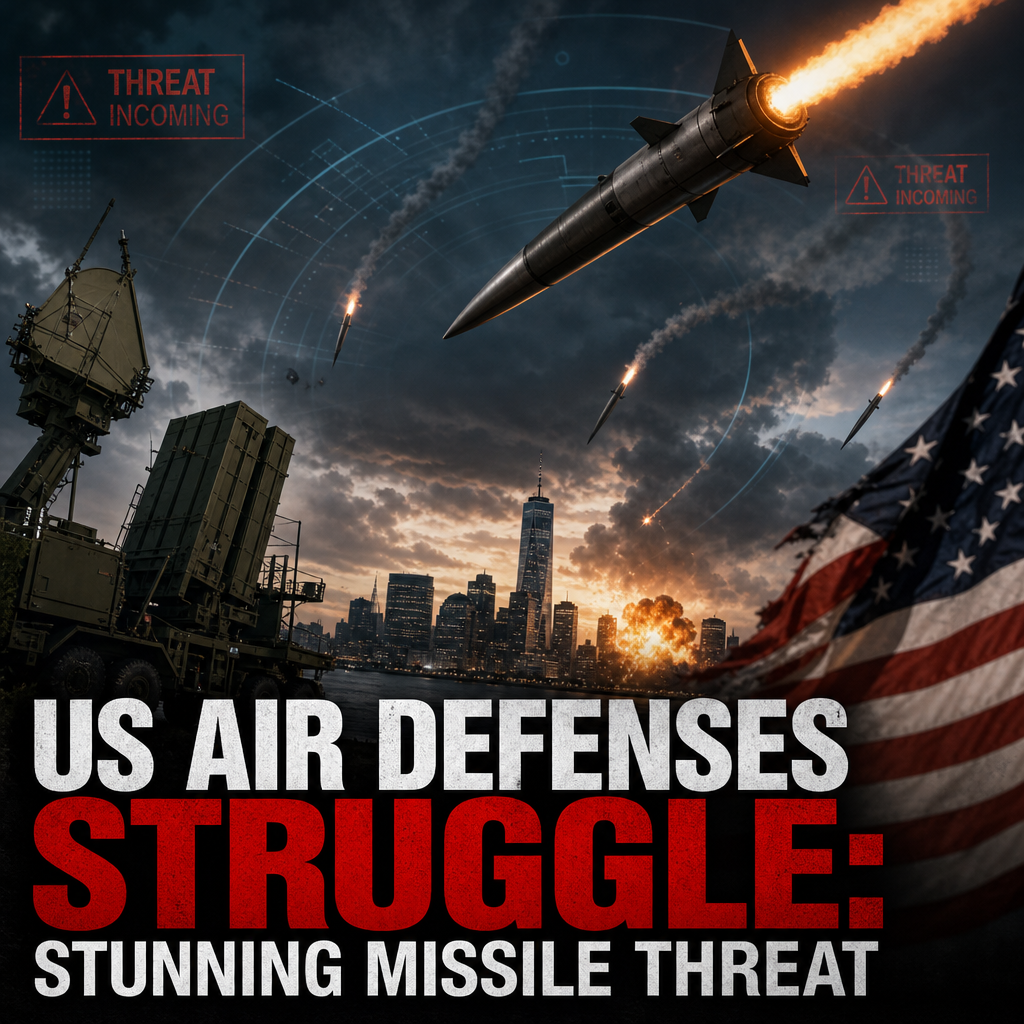
US Air Defenses Struggle: Stunning Missile Threat


US Air Defenses Struggle is becoming more than a dramatic headline; it reflects a growing reality in which missile technology is advancing faster than many defensive systems can comfortably adapt. Across recent coverage from RT, Al Jazeera, and Sky News, a common thread emerges: the threat is not just that missiles are more numerous, but that they are becoming harder to intercept, harder to predict, and more politically destabilizing.
For the United States and its allies, that creates a serious problem. Air and missile defense has long been treated as a deterrent backstop, a way to blunt attacks and reassure partners. But the latest reporting suggests that confidence in that shield is being tested. The concern is especially acute in the Middle East, where regional tensions, proxy conflicts, and rapid weapons development have collided.



Why US Air Defenses Struggle Against Modern Missile Threats
A major reason the system is under pressure is that missile defense is not one system, but a layered patchwork. It includes Patriot batteries, THAAD interceptors, ship-based defenses, radar networks, and allied systems working together. That sounds robust on paper. In practice, it is complicated, expensive, and dependent on warning time and accurate tracking.
That complexity matters because modern missiles are evolving in ways that make interception harder. Faster flight times, maneuverability, lower radar visibility, and mixed attack profiles can overwhelm even advanced defenses. The result is an uncomfortable arithmetic problem: defenders often must spend far more to stop a missile than the attacker spends to launch it.




RT’s coverage centers on US concern over Iran’s growing missile capability, emphasizing the idea that adversaries can expand deterrence by improving range, accuracy, and survivability. From that angle, missile development is not merely a military program; it is a strategic lever. The message is that Washington cannot assume superiority simply because it has more sophisticated hardware. Quantity, geography, and timing still matter.
Al Jazeera’s broader regional reporting often places these developments in the context of wider instability. From that viewpoint, missile threats are inseparable from the political environment that fuels them: years of sanctions, confrontation, proxy warfare, and failed diplomacy. In other words, the technical challenge of interception cannot be separated from the diplomatic challenge of reducing the incentives to launch in the first place.
Sky News, meanwhile, tends to focus on the operational strain and the wider security consequences for allies. That perspective highlights how missile attacks or even the threat of them can force military repositioning, raise insurance costs, disrupt shipping, and trigger emergency air defense deployments. The battlefield effect is only part of the story; the broader impact on civilian confidence and regional commerce can be just as significant.
The uncomfortable lesson from recent conflicts
Recent conflicts in the Middle East have shown that air defense works best when attacks are limited and predictable. It works less well when salvos are mixed, repeated, or designed to probe for weaknesses. Even successful interceptions can still create a sense of vulnerability if one or two missiles get through.
That is why the phrase “stunning missile threat” is not just about a single launch or a single country. It is about a strategic shift. Missile forces are increasingly being treated as tools of influence, not just warfighting. They can signal resolve, retaliate without full-scale invasion, and pressure rivals without crossing every threshold of open conflict.
What the coverage from RT, Al Jazeera, and Sky News agrees on
Despite their different editorial styles and geopolitical framing, the three outlets point toward several overlapping realities:
– Missile technology is advancing and becoming more central to regional strategy.
– Air defense remains important, but it is not a perfect shield.
– The cost imbalance between offense and defense favors attackers in many scenarios.
– Diplomacy and deterrence now matter as much as hardware.
Where they differ is in emphasis. RT leans toward a story of Western concern and strategic vulnerability. Al Jazeera places more weight on the political roots of the crisis and the regional consequences of escalation. Sky News focuses more on defense readiness, alliance implications, and the practical burden on military planners.
Taken together, those perspectives suggest the same conclusion from different angles: the challenge is not just to buy more interceptors, but to rethink how missile threats are deterred, detected, and de-escalated.
The bigger question: can defense keep up?
The honest answer is that no one can say with confidence that missile defense will keep pace everywhere, all the time. It can be strengthened, integrated better, and improved with new sensors and faster command systems. But it cannot be made invulnerable.
That uncertainty is what makes the current moment so dangerous. If an adversary believes it can saturate defenses, it may be tempted to test them. If allies doubt those defenses, they may act more cautiously—or more aggressively—in ways that raise the risk of miscalculation. Either path can lead to escalation.
The smartest response is probably not a false promise of perfect protection. It is a combination of stronger defenses, tighter intelligence sharing, more resilient infrastructure, and genuine diplomatic efforts to reduce the number of actors who believe missiles are their best leverage.
In that sense, the missile threat is as much a political warning as a military one. Air defenses can intercept incoming weapons, but they cannot intercept the deeper instability that keeps producing them.