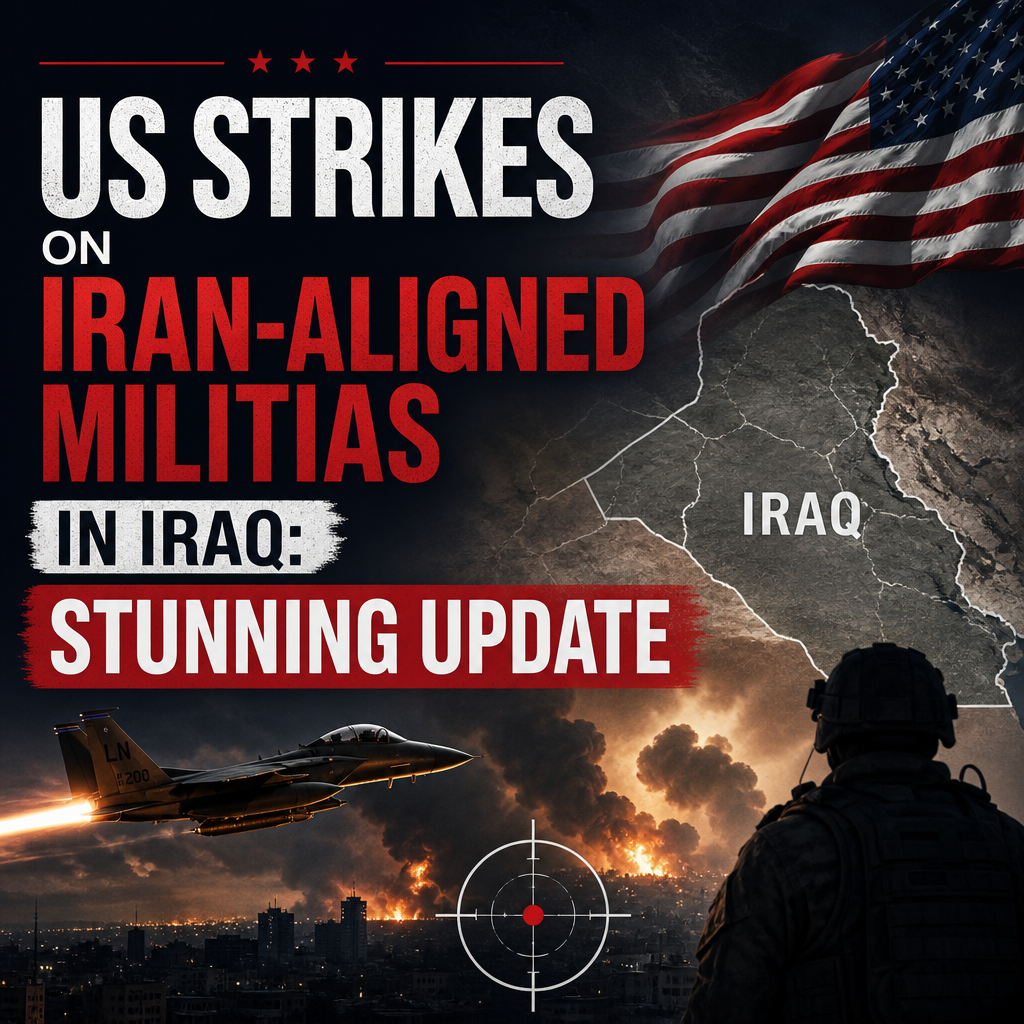
US Strikes on Iran-Aligned Militias in Iraq: Stunning Update


US strikes on Iran-aligned militias in Iraq have once again pushed the Middle East’s most volatile fault lines into the spotlight, raising urgent questions about deterrence, sovereignty, and whether any side is actually closer to de-escalation.
The latest round of violence matters because it is not happening in a vacuum. It sits inside a broader cycle of retaliation that has expanded since the war in Gaza intensified, with U.S. forces in Iraq and Syria repeatedly targeted by drone and rocket attacks, and Washington responding with airstrikes of its own. What makes this moment particularly striking is how the same event is being interpreted in sharply different ways: as self-defense by one side, as dangerous escalation by another, and as yet another sign that Iraq remains trapped between competing regional powers.



US strikes on Iran-aligned militias in Iraq: what the latest move signals
From the U.S. perspective, strikes on Iran-aligned militias are meant to send a blunt message: attacks on American personnel will carry consequences. That logic has been consistent across recent administrations. Washington says it does not want a wider war, but it also does not want to appear hesitant when its troops, diplomats, or facilities are threatened.
Supporters of that approach argue that restraint alone has not worked. Militias backed by Tehran, they say, have tested U.S. red lines for months, and limited strikes are intended to weaken launch sites, storage facilities, or command nodes without triggering a broader conflict. In that reading, the goal is deterrence rather than punishment.




But the counterargument is just as strong. Critics say these strikes can reinforce the very cycle they are meant to break. Each time the U.S. hits militia targets, groups aligned with Iran can frame the response as foreign aggression and justify further attacks. That dynamic risks turning Iraq into a permanent battleground for an indirect U.S.-Iran confrontation.
Sky News’ coverage of the region often reflects this broader security lens, emphasizing the danger of spillover and the potential for the conflict to expand beyond one country’s borders. That concern is especially relevant here, because the Iraq theater is not isolated: it is connected to tensions in Syria, the Red Sea, Lebanon, and the Persian Gulf.
Iraq’s sovereignty is at the center of the dispute
For Iraqi officials and many ordinary Iraqis, the main issue is not just who hit whom, but why their country keeps becoming the venue for someone else’s fight. Baghdad has long faced a difficult balancing act. It relies on a security partnership with the United States while also dealing with powerful armed factions that are politically embedded and, in some cases, openly sympathetic to Iran.
That is why Iraq’s reaction to U.S. strikes is often more complicated than a simple pro- or anti-American stance. Even leaders who dislike militia activity may still object to foreign airstrikes conducted without what they see as meaningful coordination. In Iraq, sovereignty is not an abstract principle; it is tied to public anger about repeated violations of airspace and the perception that the state cannot fully control armed groups operating within its borders.
Al Jazeera’s regional reporting has consistently highlighted that tension, often giving more weight to the political and humanitarian costs of escalation than to the military logic behind it. From that perspective, the central problem is not whether the U.S. can strike effectively, but whether such strikes are addressing symptoms while leaving the underlying crisis intact.
Why the militias matter so much
Iran-aligned militias in Iraq are important for three reasons:
– They have the capacity to harass U.S. forces and regional targets.
– They operate inside a deeply fragmented political environment.
– They can help widen any conflict involving Iran, Israel, or the United States.
That combination makes them both tactically significant and politically combustible. Even when their attacks are limited, their symbolism is powerful. They can signal resistance to Washington, pressure Iraqi leaders, and complicate any attempt at regional calm.
Different outlets, different emphasis — but the same risk
RT’s coverage of U.S. strikes in Iraq typically places heavier emphasis on the blowback from Washington’s military actions and on the geopolitical rivalry between the U.S. and Iran. That framing is important because it reminds readers that U.S. strikes do not occur in a moral or strategic vacuum. Whether one sees them as justified or provocative, they are part of a larger contest in which each side accuses the other of destabilization.
Al Jazeera tends to foreground the regional human and political consequences, including the strain on Iraqi institutions and the risk of civilian harm or public backlash. Sky News usually zeroes in on the security implications for Western forces and the possibility of broader escalation. Taken together, these angles offer a fuller picture: the strikes may be tactically aimed at reducing immediate threats, but strategically they sit inside a volatile, unresolved confrontation.
That is why any honest assessment has to resist easy conclusions. It is too simple to say the U.S. is merely defending itself, just as it is too simple to say the strikes are purely reckless. The reality is messier. Washington faces genuine security threats from militia attacks. At the same time, repeated strikes inside Iraq can deepen instability, undermine Baghdad’s authority, and strengthen the narrative that foreign powers are using Iraqi territory as a chessboard.
The bigger question: deterrence or escalation?
The real test is whether these strikes change behavior. If militia attacks fall off, U.S. officials will argue their approach worked. If attacks continue, or if they intensify, the strikes may look less like deterrence and more like another turn in an endless cycle.
What seems clear now is that the situation remains highly unstable and open-ended. The U.S. wants to protect its forces without getting dragged into a larger war. Iran-aligned militias want to pressure Washington while preserving their local influence. Iraq wants to avoid becoming the arena where all of this plays out. Those goals do not fit together neatly.
For now, the latest update is not a clean break from the past, but a reminder that the region is still one miscalculation away from something far worse.